PuniCodex

Extended Lore

Χείρων Cheírōn

Etymology · Orthography · Cult · Iconography · Reception · Sources

Tier 1 Cheírōn.com
Cheírōn — Wise Centaur, Teacher
01

Quick Facts

Essential information about Cheírōn, Wise Centaur, Teacher

Original ScriptΧείρων
Unicode RestorationCheírōn
Reconstructed Pronunciation/kʰéː.rɔːn/
PantheonGreek
DomainWise Centaur, Teacher
MeaningHand
ClassificationTier 1
Primary DomainCheírōn.com
Sacred SymbolsThe Pelian Ash Spear, The Cave on Mount Pelion, The Lyre, Herbs and Remedies (φάρμακα), The Hydra-Poisoned Arrow
02

Etymology & Word Family

From original script to Unicode restoration

Original Script Χείρων Cheírōn — "Hand"
Unicode Restoration Cheírōn Restored stress, length, and script
Modern ASCII chiron Plain-ASCII fallback

The name Cheírōn carries the orthographic signature of the greek tradition: Χείρων. Unicode restoration recovers what ASCII flattens.

03

Unicode Character Breakdown

Character-by-character philological analysis

CharacterUnicodeNameBlockPhonetic Role
CU+0043Latin Capital Letter CBasic LatinSame
hU+0068Latin Small Letter HBasic LatinChi (ch)
eU+0065Latin Small Letter EBasic LatinEpsilon of εί
íU+00EDLatin Small Letter I with AcuteLatin-1 SupplementAcute iota — tonos on εί (Χείρων)
rU+0072Latin Small Letter RBasic LatinRho
ōnU+014DCharacter U+014DLatin Extended-ALong omega + nu

The Tier 1 classification reflects how much of the original phonology this restoration preserves — stress and vowel length for Greek names, distinctive letters and diacritics for every other tradition.

04

Cult & Worship

How the sacred was kept — rites, sanctuaries, remains

The Cult

Cheírōn had no Panhellenic sanctuary comparable to those of the Olympians, but a cave above Portaria on Mount Pelion is traditionally identified as the Cheironeion, his school and presumed place of worship. As a civilized centaur and teacher of heroes, he hovered between the daimonic and the heroic, and Thessalian communities may have honoured him as a local hero or healing spirit. His death by Herakles' poisoned arrow and translation to the stars as Centaurus gave him a place in astral cult. Modern Mount Pelion attracts hikers and mythological tourists to the cave of Chiron, a revived pilgrimage that is archaeological and literary rather than devotional.

In the Earth

No great temple of Cheírōn is known; he is a daimonic tutor, not an Olympian with a state cult, though a cave above Portaria on Mount Pelion is traditionally identified as the Cheironeion, his school. His real monument is the art: Attic black- and red-figure vases repeatedly show Peleus handing the infant Achilles into the centaur's arms, and Roman sarcophagi of the 2nd–3rd c. CE show him teaching the lyre — the 'education of Achilles' among the most copied sarcophagus compositions of the empire. The sculpted centauromachies — the Olympia west pediment and the Parthenon south metopes — preserve the wild centaur type against which his justice was defined.

05

Iconography

How Cheírōn was imaged across the ages

The Image

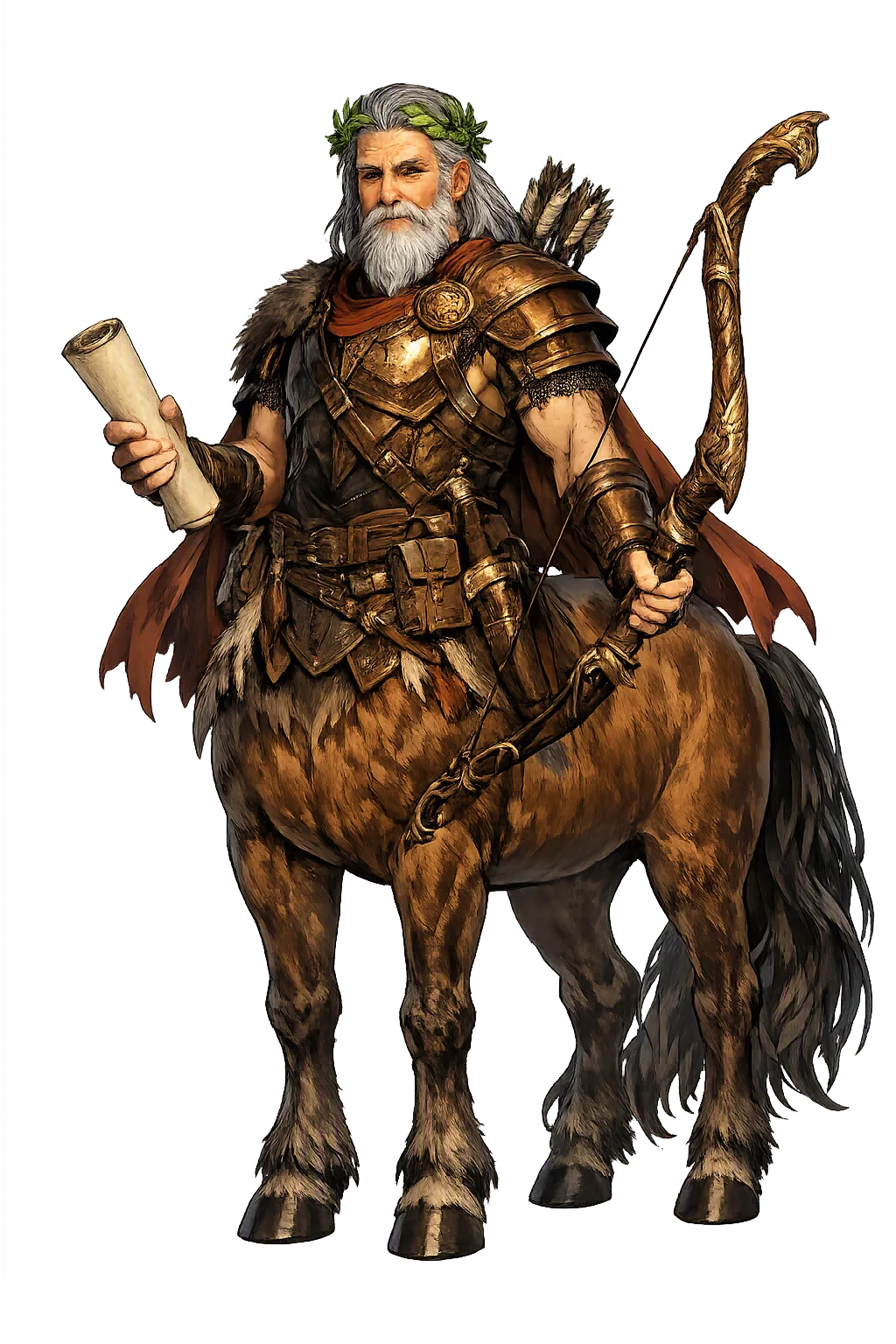
Cheírōn is one of the most frequently imaged centaurs in Greek art. Attic black- and red-figure vases show Peleus entrusting the infant Achilles to the old centaur, while Roman sarcophagi of the second and third centuries CE depict Cheírōn teaching the young hero to play the lyre. His attributes are the animal pelt, the branch or staff, and the lyre, marking him as both beast and educator. Hellenistic and Roman gem cutters also showed him with Achilles. After antiquity he was revived by Renaissance humanists as the model of the wise preceptor, and the constellation Centaurus — located in the southern sky — preserves his starry transformation.

06

Reception & Transformation

The name after its own age — transmission, translation, survival

Afterlives

Cheírōn's afterlife is that of the wounded healer and the ideal mentor. In antiquity he was already the teacher of a remarkable roster — Achilles, Asclepius, Jason, Herakles — and later educators from the Renaissance onward cited him as the model of patient, all-knowing instruction. His most striking modern reception is astrological: the minor planet 2060 Chiron, discovered by Charles Kowal in 1977, was named for him and has become a key symbol in contemporary astrology for the wounded healer archetype, a reading that draws on his accidental poisoning by a Hydra-tipped arrow. Fantasy literature and film continue to deploy centaurs as wise warriors or savage hybrids, with Chiron as the type of the benevolent one, and the name survives in medicine and psychotherapy as shorthand for the teacher who carries his own wound. His name thus bridges classical pedagogy, modern wellness culture, and popular fantasy.

Identifications Across Traditions

Rome changed Cheírōn least of all the Greek figures: he keeps his name as Chiron in Latin, too singular to be merged with any Italian power. What Rome absorbed was his catasterism — Latin poets and star-cataloguers fixed him in the sky, debating whether the Centaurus or the Sagittarius was his (Ovid, Fasti 5; Hyginus, Astronomica 2.38). In later tradition he remains the named exception among his kind: Dante makes him chief of the centaurs who guard the violent in Inferno 12 — still 'Chiron, who nursed Achilles,' still teaching, still assigning duties to his infernal pupils. The word 'centaur' traveled into every European language, but Cheírōn travels as himself, the one monster whom civilization quotes.

Modern Legacy

His name lives in the sky: the minor planet 2060 Chiron, discovered in 1977 between Saturn and Uranus, was named for him and gave its class of objects — the centaurs, bodies orbiting among the giant planets — their collective name. Modern astrology adopted him as the emblem of the wounded healer, the one whose incurable hurt becomes the source of healing for others. Ancient herbalists named the plant centaury (κενταύριον) after the centaurs' healing lore. And the old association of his name with χείρ, the hand, echoes — by the word's own root, not by his name's — in 'surgery', from χειρουργία, 'hand-work.'

07

The Meditation

What Cheírōn means — beyond the dictionary

Cheírōn is the Greek answer to a question the centauromachy asks in stone at Olympia and on the Parthenon: can nature be educated? He is a kentauros — the very type of ungoverned appetite — who is instead called most just. That he is Kronos's son and Zeus's half-brother matters: he belongs to the older, Titan order, yet serves the new one by raising its heroes, as if the wild past could be redeemed only by becoming a teacher. His unhealable wound completes the thought — the master of remedies cannot master his own pain, and immortality becomes not a privilege but a sentence. That he must surrender deathlessness to find release is among the most quietly radical moments in Greek myth: even an immortal may long for the human portion.

08

Frequently Asked Questions

Common questions about Cheírōn, Wise Centaur, Teacher, and Unicode restoration

01How do you pronounce Cheírōn?

In reconstructed pronunciation, Cheírōn is /kʰéː.rɔːn/ — approximately 'KHEH-rōn' — long ē, long ō, the pitch rising on the first syllable.

02What does Cheírōn mean?

Cheírōn means Hand in the greek tradition.

03What are the symbols of Cheírōn?

Cheírōn is associated with The Pelian Ash Spear (The great spear of ash wood that Cheírōn cut on Pelion's peak and gave to Peleus at his wedding — the same spear Achilles alone could wield (Iliad 16.143–144). The teacher's gift that arms the hero.), The Cave on Mount Pelion (His dwelling and school, the legendary academy of heroes; the gods themselves feasted there at the wedding of Peleus and Thetis (Pindar, Pythian 3.86–95).), The Lyre (The instrument of the education he gave Achilles, who in Iliad 9 (186–189) is found in his hut singing the glories of heroes to the lyre.), Herbs and Remedies (φάρμακα) (The healing lore he taught Asklepios and gave to Peleus's line; Achilles treats wounds with remedies 'that Cheiron gave his father' (Iliad 4.219, 11.831–832).), The Hydra-Poisoned Arrow (Herakles's stray arrow, dipped in the Lernaean hydra's venom, that struck his knee and gave the immortal an unhealable wound (Apollodorus, Library 2.5.4).).

04Why restore Cheírōn in Unicode?

Plain ASCII chiron strips the stress, length, and script that make the name specific. Unicode restoration returns the name to its original written dignity.

05What is the most important myth about Cheírōn?

“Son of Kronos and Philyra” — the Birth story that anchors the mythology of Cheírōn, told in full on the lore page.

09

Scholarly Sources

The philological foundations of this restoration

Every claim on this page is grounded in established scholarship. The orthographic restorations follow disciplinary convention. The etymological chain follows the best available reference works. This is not invention — it is resurrection through scholarship.

◈

Lexicography & Philology

  • Liddell, H. G., Scott, R., & Jones, H. S. A Greek-English Lexicon. Oxford: Clarendon Press, 9th ed. 1996.
◎

Primary Texts

  • Pindar
  • Homer, Iliad 4.218–219, 11.831–832, 16.140–144
  • Pindar, Nemean 3.43–58; Pythian 3.1–7, 3.86–95, 4.102–115
  • Apollodorus, Library 1.2.4, 2.5.4
  • Sophocles, Trachiniae 714–716; Ovid, Fasti 5.379–414; Hyginus, Astronomica 2.38
◉

Archaeology & Art History

  • Material evidence — iconography, inscriptions, and temple archaeology — for Cheírōn and related cults.
✦

Religious Studies

  • Apollonius Rhodius, Argonautica 1.553–558
  • Beekes, Etymological Dictionary of Greek, s.v. χείρ
Return

The Surface Awaits

You have traced the name from its earliest attestation to its Unicode restoration. Now return to the myth. The story is where the name lives.

Back to Lore
Cheírōn mascot