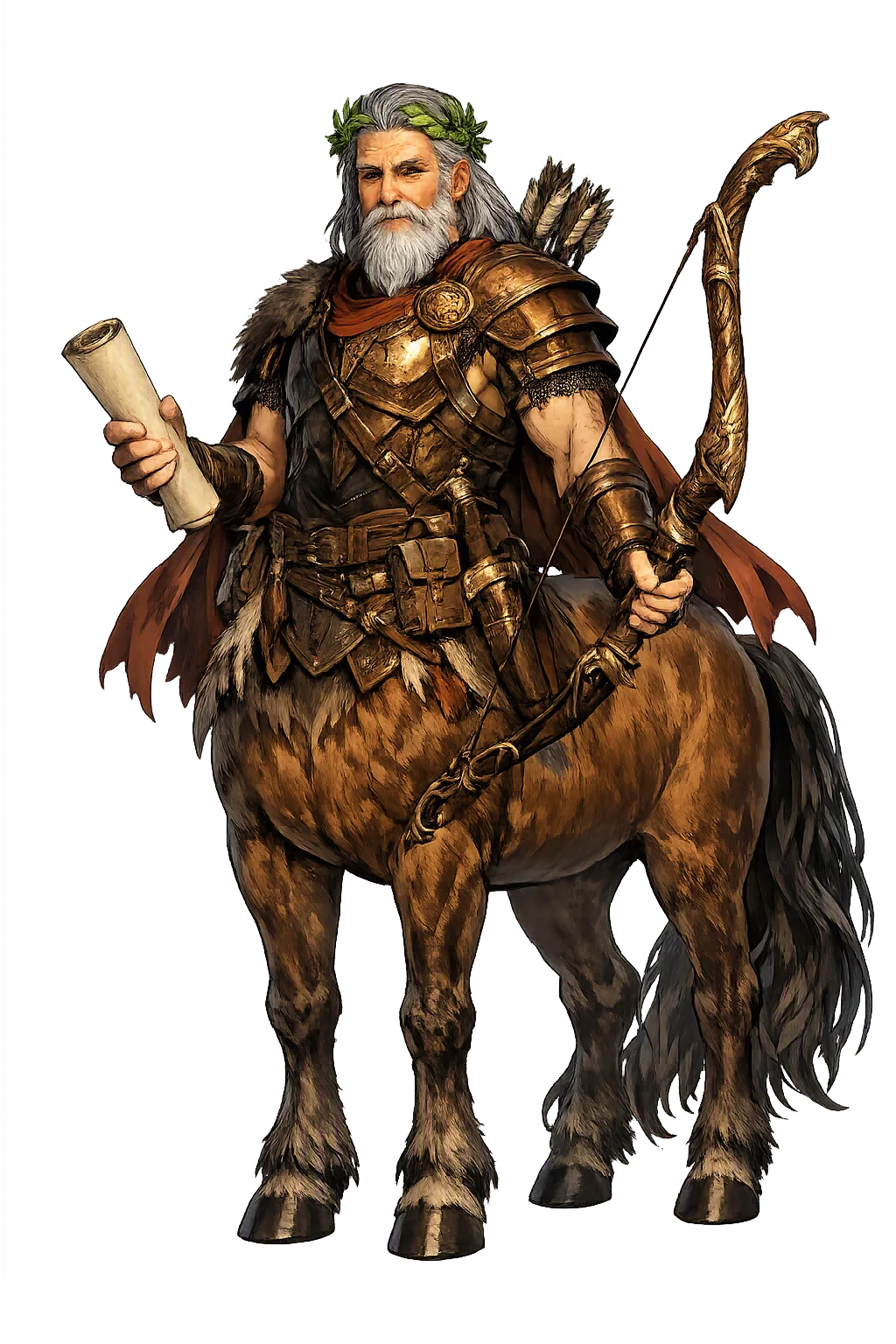
Stories of Cheírōn
Cheírōn stands at the hinge of two orders: Titan-born yet honored by the Olympians, beast-bodied yet the very image of wisdom. His myths are the myths of transmission — what one generation hands to the next.
Kronos lay with the Oceanid Philyra in the shape of a horse, and from that union was born a child of double nature — half god, half horse (Apollodorus, Library 1.2.4). Pindar names him 'the son of Philyra and Kronos', making Cheírōn the half-brother of Zeus and Poseidon (Pythian 4.102–115) — an older generation's blood serving the new order. Philyra, ashamed of her foal, begged to be changed into anything else and became a linden tree, under which the infant was found and reared by Apollo and Artemis; from them he drew the arts he would spend eternity handing on. The myth's double nature runs deeper than the body: the wisest of teachers begins as the child of deception and rejection, and his school in the cave on Pelion is founded by the one centaur whom the gods did not exile from their company.
Pindar gives the roll of his pupils: in his cave Cheírōn reared Iason, gentle-handed Asklepios whom he taught the craft of remedies, and Achilles, whom he fed on the marrow of lions and wild boars to make him fierce (Nemean 3.43–58). Homer twice seals the bond: Achilles treats wounds with remedies 'that Cheiron gave to his father in friendship' (Iliad 4.218–219), and is the man 'whom Cheiron taught, the most just of the centaurs' — dikaiotatos Kentaurōn (Iliad 11.831–832). Actaeon and Herakles also passed through his tutelage. When the Argo sailed, the centaur came down from Pelion to see her off and give the Argonauts his blessing for the voyage (Apollonius Rhodius, Argonautica 1.553–558). And in Pindar's grief for the sick Hieron, the poet's deepest wish is that Cheírōn still lived in his cave, that another healer might rise from Pelion and sail to Sicily (Pythian 3.1–7). The school had an address, and the whole Greek world knew it.
When Peleus married the sea-goddess Thetis, the gods came down from Olympus and the wedding feast was held on Pelion in Cheírōn's cave; the centaur gave the bridegroom a spear of mountain ash cut from Pelion's peak (Pindar, Pythian 3.86–95; Iliad 16.143–144). That spear passed to Achilles, and at Troy no other Achaean could wield it — Patroklos himself left it behind when he donned Achilles's armor, 'heavy, huge, and strong, which no other of the Achaeans could brandish' (Iliad 16.140–144). The teacher's gift thus runs through the whole Iliad: it is the one weapon that marks the hero his pupil became. The marriage it honored also produced the child Cheírōn would raise — the spear, like the school, was an investment in Achilles before Achilles existed. And when the child was old enough, the centaur received him on Pelion and took up the education the gift had already begun.
When Herakles fought the wild centaurs at the cave of Pholos, one of his arrows — tipped with the hydra's incurable venom — struck Cheírōn's knee (Apollodorus, Library 2.5.4). The poison that no healer could answer burned in the flesh of the greatest healer of all; immortal, he could neither heal nor die, and the Iliad preserves the grim acknowledgment — 'Cheiron, the most just of centaurs, whom the gods taught, and whom Herakles's shaft slew' (11.831–832, where even epic grammar staggers at the thought). Sophocles remembers the shaft as the one 'wherewith Cheiron was struck' (Trachiniae 714–716). At last he surrendered his immortality — offered in some tellings in exchange for Prometheus's release — and was allowed to die; Zeus set him among the stars, and Ovid watches the father of heroes' education take his place in the sky (Fasti 5.379–414; Hyginus, Astronomica 2.38). The teacher's last lesson is mortality itself.
Wisdom · Teaching · Heroes
Cheírōn is the exception among the wild κένταυροι: the immortal son of Kronos who dwells in a cave on Mount Pelion and turns raw princes into heroes. Where his kin are drunkards and rapine, Homer calls him δικαιότατος Κενταύρων — the most just of centaurs. He is the teacher: medicine for Asklepios, the lyre and the remedies for Achilles, the whole heroic craft for Iason and Herakles.
He reared Achilles, Iásōn, and Asklepios on Mount Pēlion — 'the most just of the Centaurs' (Iliad 11.832).
He taught Asklepios the art of drugs, and was himself struck by Herakles' hydra-venomed arrow that no healing art could cure.
From him the heroes learned the chase itself — tracking, coursing, and spear-work in the mountain wilds.
Herakles' stray arrow, dipped in the Lernaean hydra's venom, struck his knee — the healer whom no remedy could heal (Apollodorus, Library 2.5.4).
From the original script to the living URL
Χείρων
The name in its original Greek form. Cheírōn (Χείρων) is attested in the source tradition — “Hand”. Its diphthongs, long vowels, and acute accents carry the full phonetic and orthographic weight of the source tradition.
chiron
Reduced to plain chiron, the name loses everything that made it specific: diphthongs, long vowels, and acute accents. What remains is an ASCII string that machines can parse but that no longer speaks with its original voice.
Cheírōn
The Unicode restoration recovers what ASCII flattened. Cheírōn restores diphthongs, long vowels, and acute accents, returning the name to its original written dignity. The domain encodes to Punycode, but the browser displays the truth.
Cheírōn.com → xn--chern-1sa78d.com
The non-ASCII characters in Cheírōn are encoded while the ASCII remains visible. To the DNS, it is Punycode. To humanity, it is Cheírōn.
Owned, ideal, and ASCII forms of Cheírōn
Cheírōn
Restores Χείρων. The live temple domain — cheírōn.com.
chiron
Flattens Χείρων. The plain ASCII fallback — what DNS and legacy systems see.
How Cheírōn was spoken
How Cheírōn is preserved in writing
A bespoke provenance study for Cheírōn is being prepared by the PUNICODEX scholarly team.
Contribute scholarly provenance →The lore you have read is the living myth. Extended Lore opens the scholarly vault beneath it: the cult and its material remains, a history of the image, the name after antiquity, a meditation on what the name still means, and the full scholarly apparatus — etymology, orthography, sources.
Enter Extended Lore