
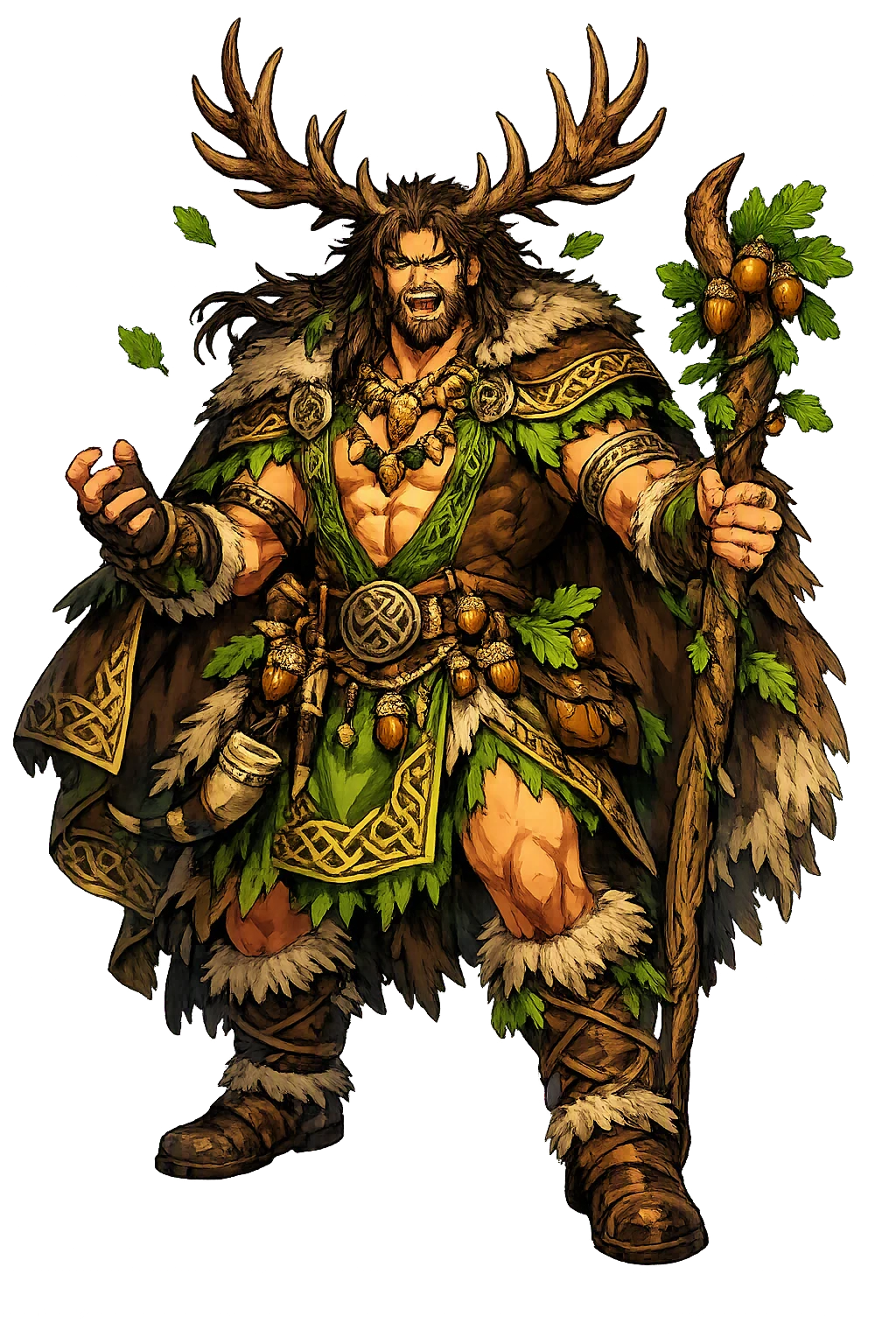
From Celtic transcription to Unicode: the journey of Cernunnos
Long before it was a domain, this name traveled through scripts. Cernunnos begins in Celtic transcription, passes through scholarly transliteration, and ends — for now — inside the punycode machinery of the global DNS. Each stage of that journey preserves some information and loses some, and the craft of restoration is knowing exactly which marks matter. This post follows the name stage by stage: the original script, the reconstructed pronunciation, the mythological record, the material evidence, and finally the Unicode form that carries all of it into the address bar. Think of it as a biography of a name, told through its spelling.
At a Glance
- Restored name: Cernunnos
- ASCII form: cernunnos
- Meaning: "The Horned One (from Gaulish)"
- Domain of influence: Wilderness, Animals, Fertility
- Pantheon: Celtic
- Classification: Tier 2
Overview
Cernunnos (cernunnos) — Wilderness, Animals, Fertility · The Horned One — is the antlered god of Gaul: named exactly once in the surviving record, on the Pillar of the Boatmen raised by the boatmen's guild of the Parisii in the reign of Tiberius, and pictured across the Celtic world as the cross-legged lord who holds the torc of rank in one hand and the ram-horned serpent of the underworld in the other, with the beasts of the wild gathered at his back.
The Gaulish name is built on the pan-Celtic word for horn — Proto-Celtic karnon, Old Irish corn, Welsh corn — and the standard gloss is 'the horned one'; the Paris inscription illustrates its own etymology, showing a balding, bearded head wearing antlers with a torc hanging from each. The most famous image of the god, the cross-legged antlered figure of the Gundestrup cauldron, carries no inscription at all: the identification is argued from the horns, the torc, and the serpent, and honest scholarship keeps the word 'Cernunnos' in quotation marks wherever the stone does not speak.
PuniCodex restores the name as Cernunnos. The attested Gaulish form is already plain Latin letters — ERNVNNOS in the capitals of the Paris stone — with no diacritic and no distinctive letter for the ASCII alphabet to lose, which places the name in Tier 2 by the mechanical rule. The temple is domain-less: cernunnos.com is registered to a third party outside the PuniCodex collection and is watched for release, and no form of the name is claimed as owned.
The Name
The name is attested once, in Roman capitals, as [C]ERNVNNOS on the Pillar of the Boatmen. The initial letter is lost at the broken edge of the stone and restored as C by convention — a restoration three centuries of scholarship have upheld, since the Gaulish horn-root karno- predicts exactly this word. The double NN and the final -OS are certain; the name is a Gaulish nominative in full.
The etymology is the standard one: Proto-Celtic karnon 'horn' (Matasović, EDPC) with the suffix that forms theonyms and titles, hence 'the horned one'. Delamarre's Dictionnaire de la langue gauloise registers both the root and the name. The details remain honestly debated: whether the word functioned as a personal theonym or as an epithet of a god otherwise named, and how the suffix formation is to be analysed. The long-proposed connection with the Old Irish heroic epithet cernach (Conall Cernach) is philologically possible but unproven; Vendryes registers the Irish material and Mac Cana counsels caution.
Because the Gaulish form is plain ASCII, the Unicode restoration Cernunnos differs from the lowercase entry only by capitalization — Tier 2 by the mechanical rule, a statement about orthography and never about the god.
The letter-by-letter transformation runs:
- c → C — Same
- e → e — Same
- r → r — Same
- n → n — Same
- u → u — Same
- n → n — Same
- n → n — Same
- o → o — Same
- s → s — Same
The project holds no domain for this name: cernunnos.com is registered to a third party outside the PuniCodex collection and is watched for release. The temple lives at its canonical lexicon address.
The Original Script
The name is preserved in the Latin alphabet as [C]ERNVNNOS — Gaulish, attested in the early 1st c. CE on the Pillar of the Boatmen at Paris, the name's only inscription. Gaulish elsewhere in Gaul was also written in the Greek alphabet, but this name survives in the Latin-letter tradition alone; no native Celtic script attests it, and the manuscript cultures of Ireland and Wales, which preserve so much else, never wrote it down.
The scholarly rendering proceeds step by step:
- The inscription is Roman capitals; the initial letter is lost at the stone's broken edge and restored as C, a reading upheld by the horn-root karno- that predicts the word.
- The doubled NN of ERNVNNOS is certain and is kept in the normalized form Cernunnos.
- The final -OS is the Gaulish nominative singular ending; modern English habitually flattens it to '-us', which the restoration resists.
- The attested form is plain ASCII — no diacritic, no distinctive letter — so the Unicode restoration differs from the lowercase entry only by the capital, fixing the name in Tier 2.
Because the name is pure ASCII, its domain was registered in the ordinary way long ago: cernunnos.com is held by a third party outside the PuniCodex collection and is watched for release. This temple claims no domain it does not hold.
Pronunciation
The reconstructed pronunciation of the name is /kerˈnun.nos/ — Gaulish Reconstruction.
Phoneme by phoneme:
- Cer- — Voiceless velar stop [k] (Gaulish c is always hard), short open [e], trilled [r]; the stressed syllable, and the worn descendant of the horn-root karno-
- -nun- — Voiced alveolar nasal [n], short back [u], and the doubled nasal across the syllable boundary, written out in full in the inscription's ERNVNNOS
- -nos — Short [o] and final voiceless [s]: the Gaulish nominative ending, never to be anglicized into '-us'
For the modern speaker, the closest approximation is: 'ker-NOON-nos' — every c hard, the double n fully sounded, the final syllable crisp.
Kindred and historical forms of the name:
- Gaulish — [C]ERNVNNOS, the single epigraphic attestation, Pillar of the Boatmen (1st c. CE)
- Proto-Celtic — karnon, 'horn', the root beneath the name (Matasović)
- Insular cognates — Old Irish corn, Welsh corn, 'horn, drinking-horn'
- Proposed echo — Conall Cernach of the Ulster Cycle, whose epithet has been linked to the theonym — proposed, never proven
Cernunnos is Tier 2 because the attested form preserves nothing the ASCII alphabet loses: the Paris stone writes plain Latin letters, and the restoration changes only the capital.
Mythology
Cernunnos has no mythology in the literary sense — no tale, no genealogy, no surviving word of his deeds. The Gauls entrusted their tradition to memory, and what memory would not carry is gone. What survives is a dossier of stone, silver, and bronze, and the whole tradition must be read from those.
The Name on Stone (Pillar of the Boatmen)
Under the choir of Notre-Dame in 1711, workmen uncovered the monument the nautae Parisiaci — the boatmen's guild of the Parisii — had raised to Jupiter in the reign of Tiberius, early in the first century CE. Among its carved gods, one block shows a balding, bearded head wearing antlers, a torc hanging from each antler, and above the figure runs [C]ERNVNNOS. The first letter is lost and restored by convention, but the reading has held: the only text in the world that names the horned god.
The Cross-Legged Lord (Gundestrup)
In 1891 a peat-cutter's spade struck silver in the Rævemosen bog at Gundestrup in Jutland: a gilded vessel of thirteen plates, the masterpiece of Celtic metalwork. On one interior plate sits the figure the world now pictures when it hears the name — cross-legged, antlered, the torc in the right hand and the ram-horned serpent in the left, a stag with matching antlers beside him and the animals of the wild closing round. No inscription names him; the identification is inference from the Paris pillar's evidence, and the scholarship says so plainly.
The Antlered Lords of Gaul
The figure recurs across Roman Gaul unnamed. At Reims an altar seats him cross-legged between Apollo and Mercury, emptying a sack of grain or coin over a bull and a stag. At Saintes the cross-legged figure keeps his serpents. In the rock carvings of Val Camonica in northern Italy, a standing antlered figure with torcs on his arms was cut perhaps four centuries before the Paris pillar — the oldest of the horned images, and proof that the type long predates the name's one attestation.
The Insular Question
Irish literature preserves no Cernunnos. The proposed echo is Conall Cernach, the Ulster Cycle hero who stands beside Cú Chulainn as the second champion of Ulster: his epithet cernach has been linked to the Gaulish horn-name from Vendryes to Mac Cana, and the honest verdict is suspension — the philology permits it, the sources never confirm it.
Symbols & Iconography
The iconography of Cernunnos is the whole of his dossier — Gaul wrote no myths down, so the attributes carry the meaning directly:
- The antlers — The stag's crown that illustrates the name itself: sovereignty over the wild made visible, on the Paris pillar and every image that follows it
- The torc — The gold neck-ring of rank in the Celtic world; on Gundestrup he grips it, on the Paris pillar it hangs from his antlers, at Reims it sits with the sack of plenty: wealth held, worn, and dispensed
- The ram-horned serpent — The hybrid creature of Gaulish art, serpent's body and ram's horns, a chthonic being found in the company of high gods; Cernunnos holds it bare-handed
- The cross-legged seat — The seated posture of Gundestrup, Reims, and Saintes: a stillness the scholarship has long remarked, the repose of a lord who does not chase what already answers to him
- The gathered beasts — Stag, boar, bull, and the padding wolf: the retinue of the wild that closes round him on the cauldron plate
Archaeology & Evidence
Cernunnos is the most materially grounded name in the Celtic lexicon and the most textually impoverished: his entire attestation is archaeological.
The Pillar of the Boatmen, raised by the boatmen's guild of the Parisii under Tiberius (14–37 CE) and rediscovered beneath Notre-Dame in 1711, carries the name's only inscription — [C]ERNVNNOS, above the antlered head with torcs — and stands today in the Musée national du Moyen Âge, Paris. The Gundestrup cauldron, cut from the peat at Rævemosen, Jutland, in 1891 and dated to around the first century BCE or CE, shows the cross-legged antlered figure with torc and ram-horned serpent on its most famous interior plate; it is the treasure of the National Museum of Denmark, Copenhagen.
The supporting gallery is wide: the Reims altar with its antlered figure between Apollo and Mercury above the bull and stag; the cross-legged relief from Saintes; the horned figure with serpents from Cirencester in Roman Britain; and the fourth-century BCE antlered carving of Val Camonica — the oldest horned image in the Celtic world. No temple, votive deposit, or cult site can be securely assigned to the god; the images are the cult's surviving footprint.
Realm & Domain
Cernunnos is the horned lord of the wild: the god the Gauls pictured enthroned among the animals, holding the wealth of the torc and the chthonic power of the serpent, at the meeting-point of wilderness, fertility, and the world below.
Wilderness
On the Gundestrup plate the antlered figure sits in the midst of the beasts — stag, boar, and the wolfish creature that pads toward him — the still centre of the untamed wood.
Animals
His antlers match the stag's beside him; the images make him not a hunter of beasts but their sovereign, the one the animals approach without fear.
Fertility
At Reims the antlered god empties a sack of grain or coin over a bull and a stag: the horned one as the source of abundance, dispensing plenty between Apollo and Mercury.
The Underworld
The ram-horned serpent in his hand is the chthonic animal of Gaulish art, and Caesar's report that the Gauls traced their descent from Dis Pater has kept the underworld reading of the horned lord alive — as hypothesis, never as proof.
Across Cultures
Rome met the horned god the way Rome met every god: by pairing him with her own. The Pillar of the Boatmen is a monument to Jupiter, with the Gaulish gods — the antlered one among them — carved in attendance; the Reims altar seats the horned figure between Apollo and Mercury, a Roman frame built round a native centre.
The deepest Roman comparison is inferential. Caesar reports that all the Gauls claim descent from Dis Pater, father of the underworld, and since the nineteenth century scholars have wondered whether the antlered lord with his serpent and his stillness is the god Caesar's informants meant. The identification is suggestive and unprovable; the standard handbooks — Mac Cana, Green, Koch — file it under hypothesis.
His closest kin inside the lexicon are the other lords of the Celtic otherworld: Arawn of Annwn, the Welsh otherworld king who hunts with white, red-eared hounds, and the Dagda, the good god of the Irish Tuatha Dé Danann whose cauldron never empties — figures of plenty and of the far country, whom the texts at least allow to speak.
Cultural Legacy
Cernunnos has the strangest afterlife in the lexicon: a god named once in antiquity who became, two millennia later, the most famous horned figure in modern religion. Margaret Murray's The God of the Witches (1931) made him the prime exhibit of her pan-European witch-cult — a thesis academic history has since dismantled, Ronald Hutton's The Triumph of the Moon (1999) being the standard autopsy — but the image outlived the theory.
Gerald Gardner placed the Horned God at the centre of modern Wicca, and 'Cernunnos' became the figure's conventional name across contemporary pagan practice worldwide. The Gundestrup plate did the visual work: the cross-legged, antlered silhouette is now among the most reproduced images of the ancient world, carried into fiction, film, games, and the devotional art of traditions that did not exist a century ago. A god with no surviving myth became the emblem of every wild thing that refuses to be tamed.
The Scholarly Record
The account of Cernunnos given in this edition rests on the witnesses and reference works listed below. The monuments supply the attestation; the etymological dictionaries secure the name; the handbooks discipline the identifications.
- Pillar of the Boatmen (CIL XIII 3026), dedicated by the nautae Parisiaci under Tiberius; rediscovered 1711; Musée national du Moyen Âge, Paris.
- The Gundestrup Cauldron, found 1891 in the Rævemosen bog, Jutland; National Museum of Denmark, Copenhagen.
- Caesar, De Bello Gallico 6.13–18 (Gaulish religion; the descent from Dis Pater).
- Delamarre, Xavier, Dictionnaire de la langue gauloise, 2nd ed. (Paris: Errance, 2003), s.v. carno-, Cernunnos.
- Matasović, Ranko, Etymological Dictionary of Proto-Celtic (Leiden: Brill, 2009), s.v. *karnon 'horn'.
- Vendryes, Joseph, Lexique étymologique de l'irlandais ancien (Dublin: Dublin Institute for Advanced Studies, 1959–) — the lexicon's cited authority for this entry.
- Mac Cana, Proinsias, Celtic Mythology (London: Hamlyn, 1970).
- Koch, John T., ed., Celtic Culture: A Historical Encyclopedia, 5 vols. (Santa Barbara: ABC-CLIO, 2006), s.v. Cernunnos, Gundestrup cauldron.
- Green, Miranda, The Gods of the Celts (Gloucester: Alan Sutton, 1986); Symbol and Image in Celtic Religious Art (London: Routledge, 1989); Animals in Celtic Life and Myth (London: Routledge, 1992).
- Murray, Margaret A., The God of the Witches (London: Sampson Low, 1931); Hutton, Ronald, The Triumph of the Moon (Oxford: Oxford University Press, 1999) — for the modern reception.
A Meditation
Cernunnos is the god built from evidence alone. No hymn, no saga, no genealogy — one word on a Paris stone, one silver plate from a Danish bog, and a scattered congregation of images that agree with each other across six hundred miles and four hundred years.
He asks a different kind of attention than the storied gods: not 'what did he do?' but 'what did they see, that they carved him so carefully and wrote his name so rarely?' The answer the monuments give is always the same — the still one in the middle of the animals, holding rank in one hand and the underworld in the other, entirely at peace. Some gods are known by their stories. This one is known by his posture, and the posture has proved enough: two thousand years later, the world still recognizes the silhouette.
The Unicode Restoration
Cernunnos is classified as Tier 2: the restoration needs no distinctive letters or diacritics its ASCII form would lose. The ASCII fallback cernunnos still resolves everywhere, but it is the restored form that carries the name's full information. That is the whole thesis of this temple: the marks are the message.
Why This Restoration Matters
Every stage of the journey from Celtic transcription to Unicode was an act of care: the scribe who first wrote the name, the lexicographer who glossed it, the engineer who taught the DNS to carry it. The PuniCodex restoration is the latest stage, not the last word — the Scholarly Edition is revised as the evidence improves. What does not change is the principle: a name deserves to be written the way its own tradition wrote it. Cernunnos in the address bar is that principle, made routable.
Explore Further
This post is one doorway into the temple. The home page carries the full character breakdown and the ambient canvas; the lore page tells the myths in long form; the Scholarly Edition preserves the sources, pronunciation data, and revision history; and the patron wall supports the restoration directly. For the wider map, browse the Lexicon, explore the Pantheon, or return to the PuniCodex blog.
Related Names
Sources
The full scholarly apparatus — every citation, revision, and review — lives in the Scholarly Edition. Key references for this post:
- Pillar of the Boatmen (CIL XIII 3026), Paris, early 1st c. CE; Musée national du Moyen Âge, Paris.
- Delamarre, Xavier, Dictionnaire de la langue gauloise, 2nd ed. (Paris: Errance, 2003), s.v. carno- 'horn', Cernunnos.
- Green, Miranda, The Gods of the Celts (Gloucester: Alan Sutton, 1986), on the iconography of the antlered god.
- Koch, John T., ed., Celtic Culture: A Historical Encyclopedia, 5 vols. (Santa Barbara: ABC-CLIO, 2006), s.v. Cernunnos.
- Lexicon authorities for this entry: Vendryes.