PuniCodex

Extended Lore

CERES Cerēs

Etymology · Orthography · Cult · Iconography · Reception · Sources

Tier 1 Cerēs.com
Cerēs — Agriculture, Grain, Harvest
01

Quick Facts

Essential information about Cerēs, Agriculture, Grain, Harvest

Original ScriptCERES
Unicode RestorationCerēs
Reconstructed Pronunciation/ˈke.reːs/
PantheonRoman
DomainAgriculture, Grain, Harvest
MeaningGoddess of grain and growth — the source of the word "cereal"
ClassificationTier 1
Primary DomainCerēs.com
Sacred SymbolsThe wheat-sheaf, The torch, The poppy, The sow
02

Etymology & Word Family

From original script to Unicode restoration

Original Script CERES Cerēs — "Goddess of grain and growth — the source of the word "cereal""
Unicode Restoration Cerēs Restored stress, length, and script
Modern ASCII ceres Plain-ASCII fallback

The name Cerēs carries the orthographic signature of the roman tradition: CERES. Unicode restoration recovers what ASCII flattens.

03

Unicode Character Breakdown

Character-by-character philological analysis

CharacterUnicodeNameBlockPhonetic Role
CU+0043Latin Capital Letter CBasic LatinSame
eU+0065Latin Small Letter EBasic LatinSame
rU+0072Latin Small Letter RBasic LatinSame
ēU+0113Latin Small Letter E with MacronLatin Extended-ALong ē
sU+0073Latin Small Letter SBasic LatinSame

The Tier 1 classification reflects how much of the original phonology this restoration preserves — stress and vowel length for Greek names, distinctive letters and diacritics for every other tradition.

04

Cult & Worship

How the sacred was kept — rites, sanctuaries, remains

The Cult

Cerēs was worshipped at her Aventine temple, vowed by the plebeian dictator Aulus Postumius Albus in 496 BCE and dedicated the following year; its surviving podium beside the Circus Maximus still marks the plebeian triad's house. The Cerealia of April, with their ludi and the strange ritual of foxes tied with burning brands, formed her principal festival. The search for Proserpina was enacted in torch-lit processions, and the porca praecidanea, a pig sacrificed before harvest, opened the grain cycle. The mundus rites connected her, if obliquely, to the underworld, while her priesthoods at Rome and Enna in Sicily were among the most prestigious in the Mediterranean.

In the Earth

The Aventine temple’s podium still stands beside the Circus Maximus, its massive concrete-and-travertine platform the surviving footprint of the plebeian triad’s house. In Sicily, her true archaeological homeland, the sanctuary treasures were so famous that Cicero built a prosecution around them: the Verrines catalogue the gold, ivory, and bronze of the temple at Enna, whose priesthood Verres’ theft violated. At Morgantina in central Sicily, excavation of the sanctuary of Demeter and Kore yielded a cache of silver vessels looted in the twentieth century and repatriated from the Metropolitan Museum and the Getty in 2010–2011 — the most celebrated restitution in classical archaeology, and a direct material thread from the grain goddess’s cult to the modern museum. The Cerealia’s games are fixed in the fasti, and votive terracottas from the grain districts of Latium and Sicily fill the cases of the Roman and Agrigento museums with her ears of wheat.

05

Iconography

How Cerēs was imaged across the ages

The Image

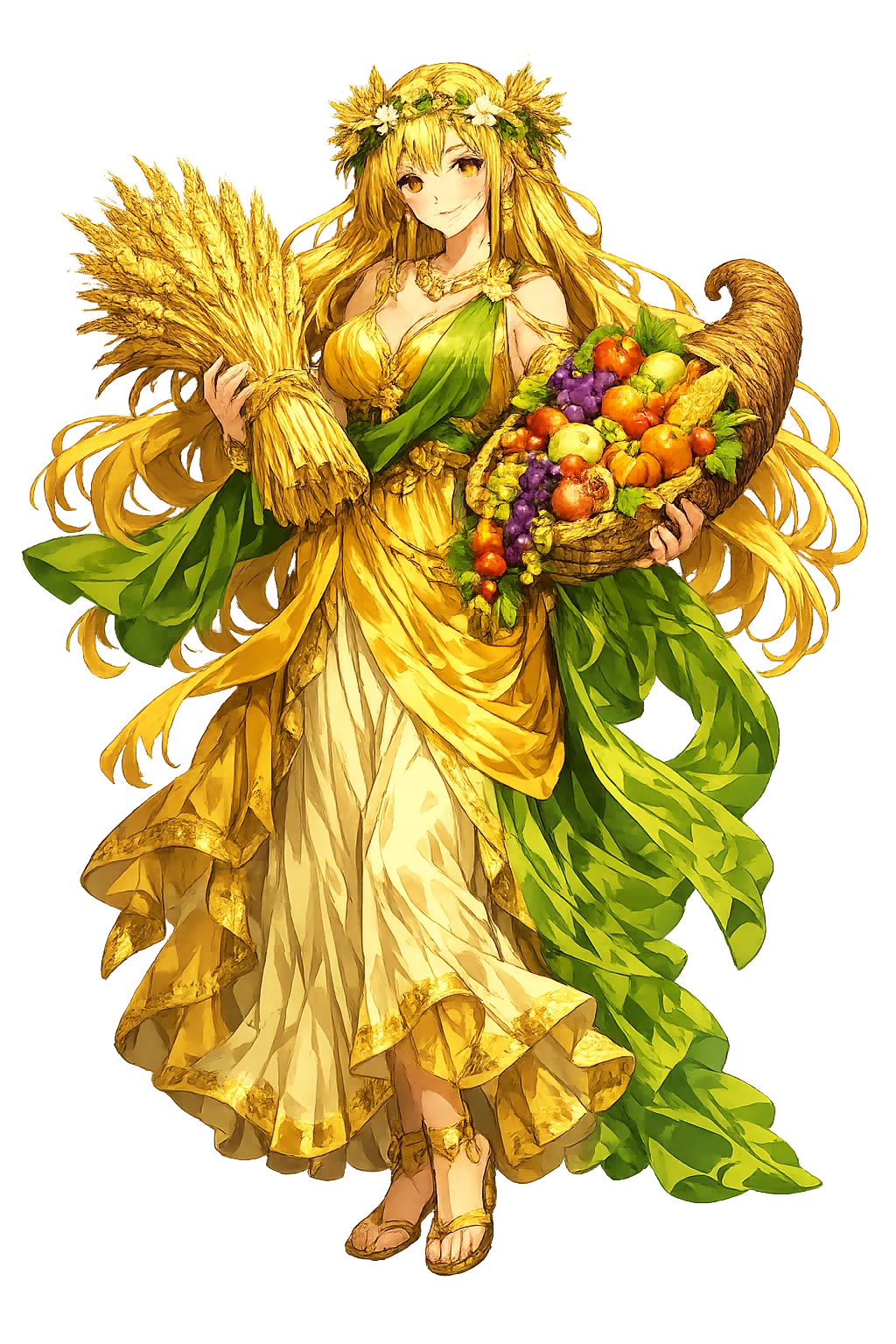
Cerēs is the seated matron of abundance: wheat sheaves in her hand or crown, a torch for the nocturnal search, a serpent-drawn chariot, and a sceptre or basket of bread. Roman coins minted during grain shortages show her with ears of wheat and a modius measure, turning theology into political reassurance. Votive terracottas from central Italy repeat the same modest figure, while the great Sicilian temples—at Enna and elsewhere—once housed chryselephantine statues whose loss we know only from Cicero's indignant catalogue in the Verrines. Her attributes never stray far from the fields: grain, torch, and the fruits of cultivated earth.

06

Reception & Transformation

The name after its own age — transmission, translation, survival

Afterlives

Cerēs was identified with Greek Demeter from an early date, and her Sicilian cult—especially at Enna—shaped the Roman reception of the Eleusinian mysteries. Renaissance mythographers such as Boccaccio and Cartari placed her among the planetary gods, restoring her classical attributes for European courts. The grain dole (cura annonae) made her a political deity: emperors who guaranteed bread claimed her favor, and Augustine later mocked the theatrics of her festivals in the City of God. The word "cereal" descends directly from her name, and the discovery of the first asteroid in 1801 was named Ceres in honor of the goddess who governs growth. In modern reception she has become an emblem of agriculture, food security, and sustainable cultivation, her torch-bearing search for Proserpina read as an allegory of seasonal return and human dependence on the harvest.

Identifications Across Traditions

Her equation with Dēmētēr was near-total and early: Greek foundations in southern Italy had long paired the grain goddesses, and when famine struck in 496 BCE the Sibylline Books prescribed the importation of rites ‘in the Greek manner’ — the process that Dionysius of Halicarnassus (6.17) records as the making of the Aventine cult. Rome nonetheless bent the figure to its own stresses: the plebeian politics of the triad, the annōna that made her the patron of the grain fleet, and the Cerealia’s games. Sicily — her mythic homeland, with the meadow at Enna — became Rome’s first granary and her most pious province; Cicero’s Verrines preserve the inventory of her temple’s treasures. Late antiquity folded her further: her iconography passed into Isis’, and Augustine (City of God 18.13) sneered at the Roman mysteries as Greek rites wearing Latin names. The syncretism was so complete that the goddess’s Roman core — bread, law, the plebs — is visible only against the Greek outline she borrowed.

Modern Legacy

‘Cereal’ is her everyday immortality: every breakfast bowl in the West carries her name, from the Latin Cerialia, her festival’s gifts. The dwarf planet Ceres — first asteroid discovered, by Piazzi in 1801, and explored by NASA’s Dawn probe in 2015 — keeps her aloft in the heavens, and her surface features are named for agricultural spirits of every nation. In America she is a civic deity: her statue crowns the Chicago Board of Trade, the world’s great grain market, and her face appears on the state seals of New Jersey and North Carolina, holding the cornucopia of plenty. Currency, too, once carried her — revolutionary France printed her on its assignats as the guarantor of subsistence. Of all the Roman gods, she is the one whose name a modern speaker is most likely to speak daily, three times a day, without knowing it: the goddess of breakfast.

07

The Meditation

What Cerēs means — beyond the dictionary

Cerēs is the goddess of the daily miracle nobody notices: that seeds kept become bread, that fields kept become cities, that mothers searching become seasons. She asks the farmer's and the state's same question: the grain you eat was someone else's keeping — so whose keeping are you, and what will your furrow feed when you are done?

The annona was her quiet empire: fleets of grain-ships from Sicily and Egypt, timed to her calendar, feeding a city that never thanked the ships enough. Rome learned the lesson every state relearns — whoever keeps the grain keeps the peace — and named the fleet's goddess once, correctly, for growth.

Her games told the same truth in lighter dress: the Cerealia, when the city ate well and played hard in her honor, because the goddess of bread was never a goddess of guilt. The granary was her temple; the festival, her thanks; and the law carved at her door was her reminder that food and fairness grow in the same field.

08

Frequently Asked Questions

Common questions about Cerēs, Agriculture, Grain, Harvest, and Unicode restoration

01How do you pronounce Cerēs?

In reconstructed pronunciation, Cerēs is /ˈke.reːs/ — approximately KEH-rehs — hard c, long second vowel.

02What does Cerēs mean?

Cerēs means Goddess of grain and growth — the source of the word "cereal" in the roman tradition.

03What are the symbols of Cerēs?

Cerēs is associated with The wheat-sheaf (The gift that made agriculture — and law — possible), The torch (The search that never ends — maternal persistence as cosmic order), The poppy (Sleep and renewal — the flower of the fallow field), The sow (Her sacrificial animal — the pig offered to Cerēs at funerals (the porca praesentanea), guardian of the boundary between grain and the dead).

04Why restore Cerēs in Unicode?

Plain ASCII ceres strips the stress, length, and script that make the name specific. Unicode restoration returns the name to its original written dignity.

05What is the most important myth about Cerēs?

“The Teaching of the Furrow” — the The Gift story that anchors the mythology of Cerēs, told in full on the lore page.

09

Scholarly Sources

The philological foundations of this restoration

Every claim on this page is grounded in established scholarship. The orthographic restorations follow disciplinary convention. The etymological chain follows the best available reference works. This is not invention — it is resurrection through scholarship.

◈

Lexicography & Philology

  • Lewis & Short
  • Varro
  • Horace
  • Cambridge
◎

Primary Texts

  • Ovid
  • Cicero
  • Ovid, Fasti 4 and Metamorphoses 5.341–661, 8.738–878
  • Cicero, In Verrem 2.4.106–108
◉

Archaeology & Art History

  • Material evidence — iconography, inscriptions, and temple archaeology — for Cerēs and related cults.
✦

Religious Studies

  • Lewis & Short, A Latin Dictionary, s.v. Cerēs, Cerialis
  • Varro, De lingua Latina 5.64
  • Livy 2.32; Dionysius of Halicarnassus 6.17
  • de Vaan, Etymological Dictionary of Latin (2008), s.v. Cerēs
Return

The Surface Awaits

You have traced the name from its earliest attestation to its Unicode restoration. Now return to the myth. The story is where the name lives.

Back to Lore
Cerēs mascot