The Living Myth
Agriculture, Grain, Harvest · Goddess of grain and growth — the source of the word "cereal"
Stories of Cerēs
Cerēs' myths are Rome's double helix: the Greek mother-goddess woven into the Italian grain-god, until the field and the mystery were one.
Before Cerēs, Ovid says, the acorn was the meal and the woodland the pantry. The goddess changed the menu and the world with it: she first broke the soil with the curved plough, yoked the ox, gave mortals the grains, and taught them to bind harvest to seed (Fasti 4.401–416; Hyginus, Fabulae 277). Rome drew the conclusion itself: where grain is stored, surplus exists, and where surplus exists, property, boundaries, and law must follow — the flamen Cerealis and the Vestals’ salted meal kept her ritual at the very center of the civic year, and Cicero could treat her mysteries as a moral foundation of the state. Varro explains her name as taken a creando, ‘from creating’ (De lingua Latina 5.64). The myth is an etymology acted out: the goddess named for growth grows law itself, and the furrow becomes the first line of Rome’s constitution.
While the nymph Cyane reached out to stop him, Pluto split the earth and carried off Proserpina from her Sicilian meadow by the lake of Pergusa — and Cerēs, lighting torches at Aetna’s fires, searched the world nine days without tasting food (Metamorphoses 5.341–508; Fasti 4.417–620). At Eleusis an old woman offered her barley-water; mocked by a boy as she drank, the goddess sprinkled him with meal and turned him into a star-backed lizard. Joy returned only when Jupiter ruled that Proserpina, having eaten of the pomegranate, should spend that portion of the year below — and the myth explains the seasons in the grammar of a mother’s grief. But the Roman telling adds its own office: the search founded the rites at the grain’s return, and Ovid closes the sequence with Cerēs sending Triptolemus across the world in a dragon chariot to teach the plough. Grief here is not the opposite of agriculture; it is agriculture — the year measured by a loss that repeats and a return that rescues.
In 494 BCE the plebeians, crushed by debt, seceded to the Sacred Mount — and the settlement that brought them home vowed a temple on the Aventine to Cerēs, Liber, and Libera, dedicated in 493 (Livy 2.32; Dionysius of Halicarnassus 6.17). The choice was political theology: grain, wine, and growth were the people’s substance, and the goddess of that substance became the patron of the plebs. Her temple kept their archive — the plebeian aediles deposited their records and the state’s grain stores in her house — and in famine the Senate sent the Vestals’ own supply. When a later famine emptied the treasury, it was to her Sibylline oracle that Rome turned, importing her Greek sister’s rites in the Greek manner. The Aventine triad made the point that Rome never tired of testing: whoever keeps the grain keeps the peace, and the goddess of bread is also — inevitably — the goddess of the people’s rights.
Some lessons Cerēs taught with famine. When Erysichthon felled the trees of her sacred grove — ignoring the warning nymph, striking even the oak that bled — the goddess did not strike him down. She sent her servant Fames instead, Hunger herself, to breathe herself into him (Metamorphoses 8.738–878). From that hour the more he ate the more he starved: feast after feast vanished into a void, and when his wealth was gone he sold his daughter Mestra, whom Neptune had blessed with the power to change shape — horse, bird, stag, back again — until even that resource failed, and the tale ends where it must, with Erysichthon gnawing himself. It is the most disturbing of Ovid’s Cerēs stories and the most coherent: the man who destroys the goddess’s grove discovers that the grove was his own stomach. The Grain Mother’s justice is not lightning but arithmetic — he who wastes the source of food becomes, exactly, food’s absence.
Agriculture, Bread, Law, and the People's Goddess
Cerēs is Rome's oldest working goddess: the power of grain and growth, patron of the plebeians who eat it, and the deity whose Greek sister's myth (Dēmētēr and Persephonē) she borrowed so completely that Rome's religion of the field became one with the mystery of the seasons.
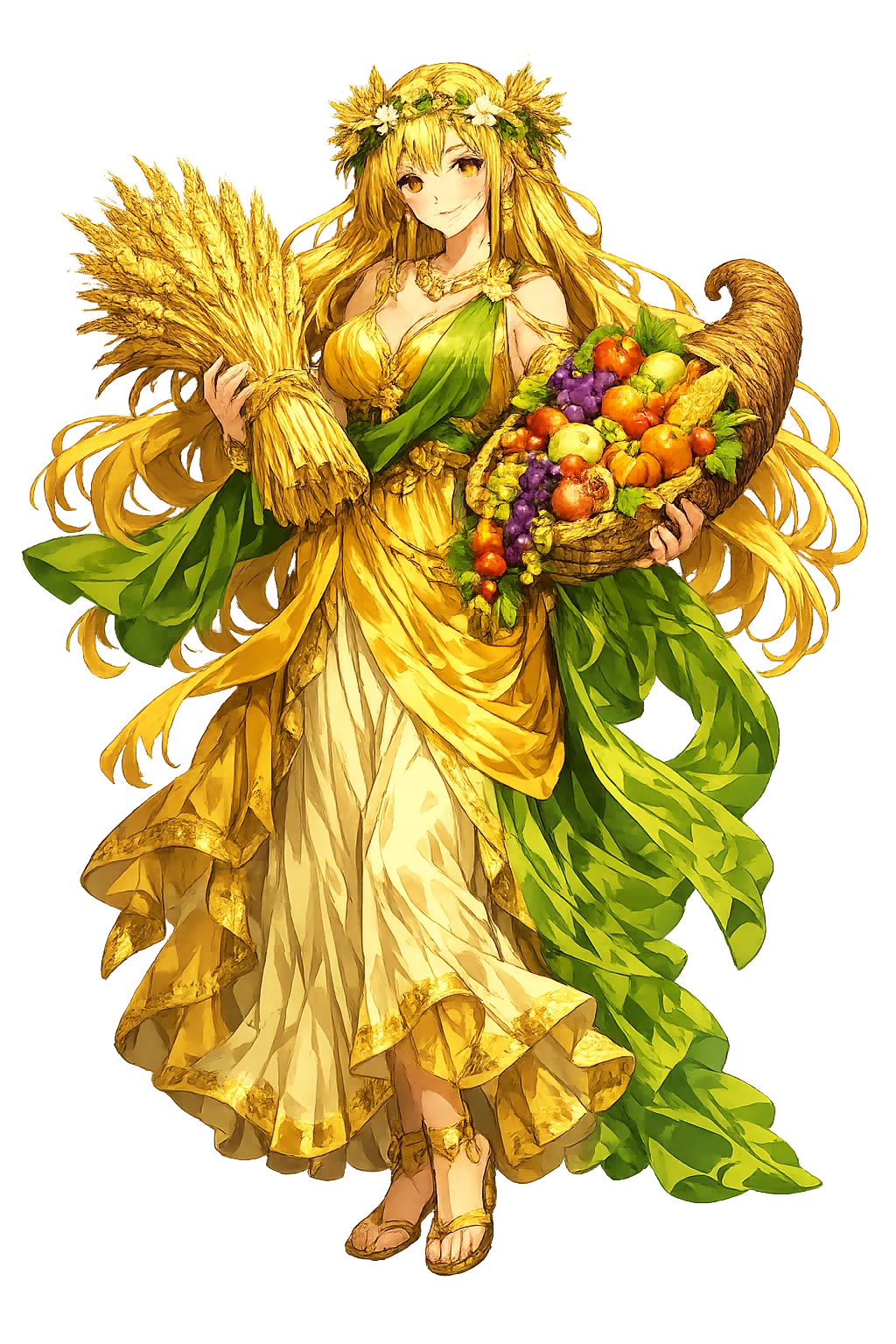
The wheat-sheaf she carries — the staff of civilization.
Her search for Proserpina by torchlight — the mother who would not stop.
Cerēs, Liber, Libera — the Aventine trinity of the common people.
Rome's annona: the wheat-ships of Sicily and Egypt under her protection.
From the original script to the living URL
CERES
The name in its original Roman form. Cerēs (CERES) is attested in the source tradition — “Goddess of grain and growth — the source of the word "cereal"”. Its macron-length vowels carry the full phonetic and orthographic weight of the source tradition.
ceres
Reduced to plain ceres, the name loses everything that made it specific: macron-length vowels. What remains is an ASCII string that machines can parse but that no longer speaks with its original voice.
Cerēs
The Unicode restoration recovers what ASCII flattened. Cerēs restores macron-length vowels, returning the name to its original written dignity. The domain encodes to Punycode, but the browser displays the truth.
Cerēs.com → xn--cers-dva.com
The non-ASCII characters in Cerēs are encoded while the ASCII remains visible. To the DNS, it is Punycode. To humanity, it is Cerēs.
Owned, ideal, and ASCII forms of Cerēs
Cerēs
Restores CERES. The live temple domain — cerēs.com.
ceres
Flattens CERES. The plain ASCII fallback — what DNS and legacy systems see.
How Cerēs was spoken
How Cerēs travels from ancient script to the modern URL
The lore you have read is the living myth. Extended Lore opens the scholarly vault beneath it: the cult and its material remains, a history of the image, the name after antiquity, a meditation on what the name still means, and the full scholarly apparatus — etymology, orthography, sources.
Enter Extended Lore