
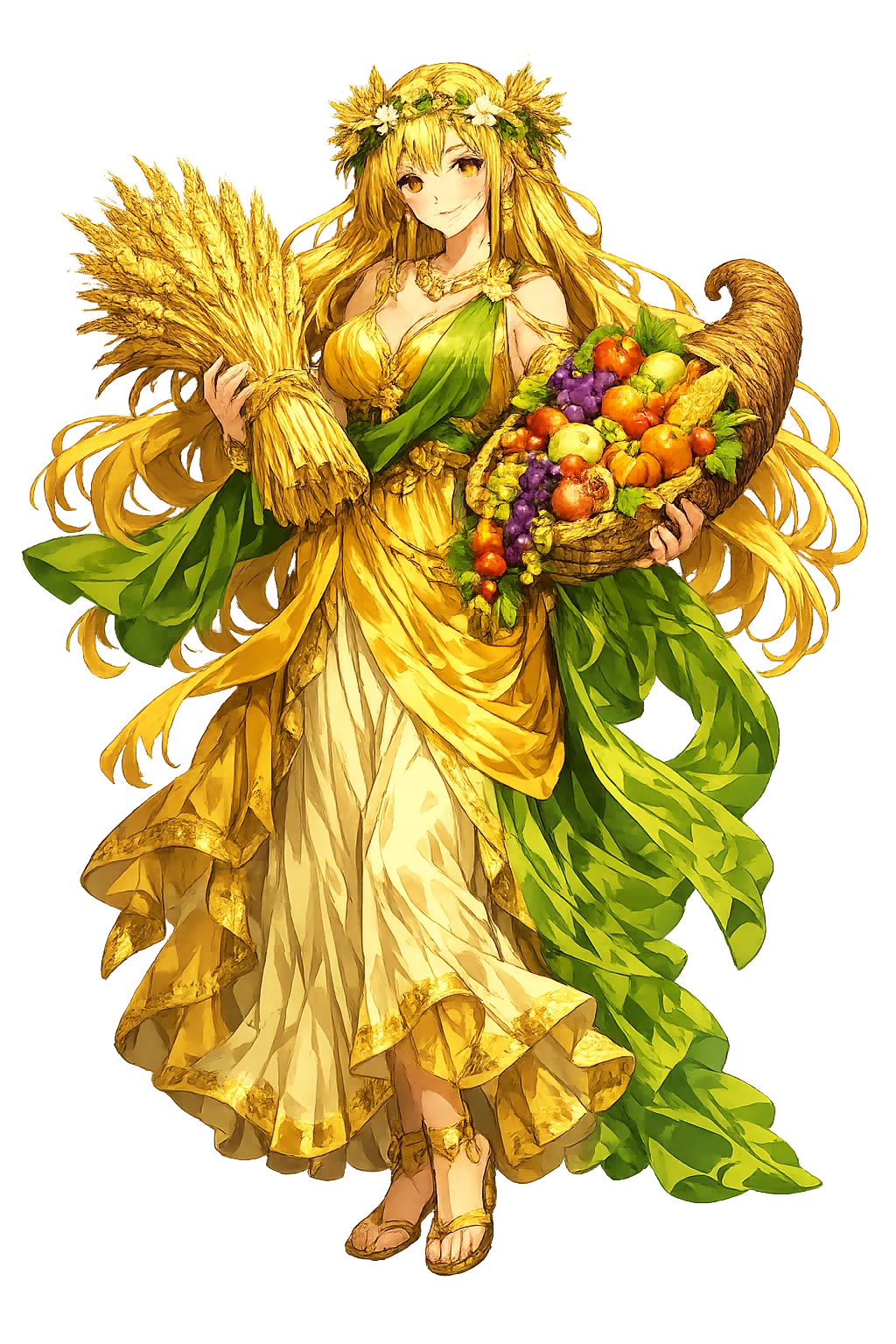
Cerēs walks into a agriculture, food & harvest firm
Walk into any agriculture, food & harvest outfit and watch for ten minutes. You will see a very old act performed with newer props. The act has a name. It is Cerēs.
Before the Office, the Story
The Teaching of the Furrow. Before Cerēs, Ovid says, the acorn was the meal and the woodland the pantry. The goddess changed the menu and the world with it: she first broke the soil with the curved plough, yoked the ox, gave mortals the grains, and taught them to bind harvest to seed (Fasti 4. 401–416; Hyginus, Fabulae 277).
The Torches of Cerēs. While the nymph Cyane reached out to stop him, Pluto split the earth and carried off Proserpina from her Sicilian meadow by the lake of Pergusa — and Cerēs, lighting torches at Aetna’s fires, searched the world nine days without tasting food (Metamorphoses 5. 341–508; Fasti 4. 417–620).
At a Glance
- Temple: Cerēs
- Pantheon: Roman
- Domain of influence: Agriculture, Grain, Harvest
- Pattern seats: 6
- Sectors touched: Energy & Natural World · Commerce & Governance · Home & Lifestyle · Technology & Innovation
- Strongest seat: Agriculture, Food & Harvest
- Series: The Resonance Files, No. 101 of 546
The Reveal, Seat by Seat
Agriculture, Food & Harvest
The goddess of grain and growth whose name roots the word “cereal” — Rome’s oldest working deity of the field. The match is not poetic license. Strip the trade to its function and the function is the myth.
Environmental & Climate Services
The field and its seasons; agriculture as stewardship. The match is not poetic license. Strip the trade to its function and the function is the myth.
Finance, Wealth & Commerce
Her statue crowns the Chicago Board of Trade; the grain market's own goddess. The match is not poetic license. Strip the trade to its function and the function is the myth.
Food & Hospitality
The Roman grain mother; the cereal on every menu. The match is not poetic license. Strip the trade to its function and the function is the myth.
Legal, Justice & Compliance
Now read the why-line with the office in mind: Her Aventine temple held the plebeian archives; the sheaf that made law possible. The people doing this work did not borrow the archetype. They re-derived it — the way Cerēs was always going to be re-derived wherever agriculture, grain, harvest matters.
Not the First Rebrand
Her equation with Dēmētēr was near-total and early: Greek foundations in southern Italy had long paired the grain goddesses, and when famine struck in 496 BCE the Sibylline Books prescribed the importation of rites ‘in the Greek manner’ — the process that Dionysius of Halicarnassus (6. 17) records as the making of the Aventine cult. The office is only the latest translation.
The Method, Stated Plainly
None of this is numerology. A seat exists only where the match can be argued from the deity’s documented domains and deeds — weighted, published, and falsifiable. The derivation, the weights, and the challenge process are public on the methodology page. If a seat in this file reads wrong, the atlas itself tells you how to prove it — and the correction becomes part of the record.
For the Ones Who Work There
For a sponsor in agriculture, food & harvest, the fit here is not adjacency — it is inheritance. Your trade already tells this story every working day; the temple simply holds the original. The patron tier and the advertising terms carry the mechanics; the myths above carry the reason.
The File Continues
This is one of 546 Resonance Files — the third dispatch from every flagship temple, where the myths meet the markets. The temple's founding dispatch tells the name's story; its Restoration File tells the spelling's; the blog index holds the whole archive.
Continue the series — previous: Kérberos (read it) · next: Ceridwen (read it).
The Resonance Files are argued from the same canonical record as the pattern atlas itself: the lexicon, the lore catalog, and the cited sources. Every seat can be challenged at the methodology page — and the challenge is the point.