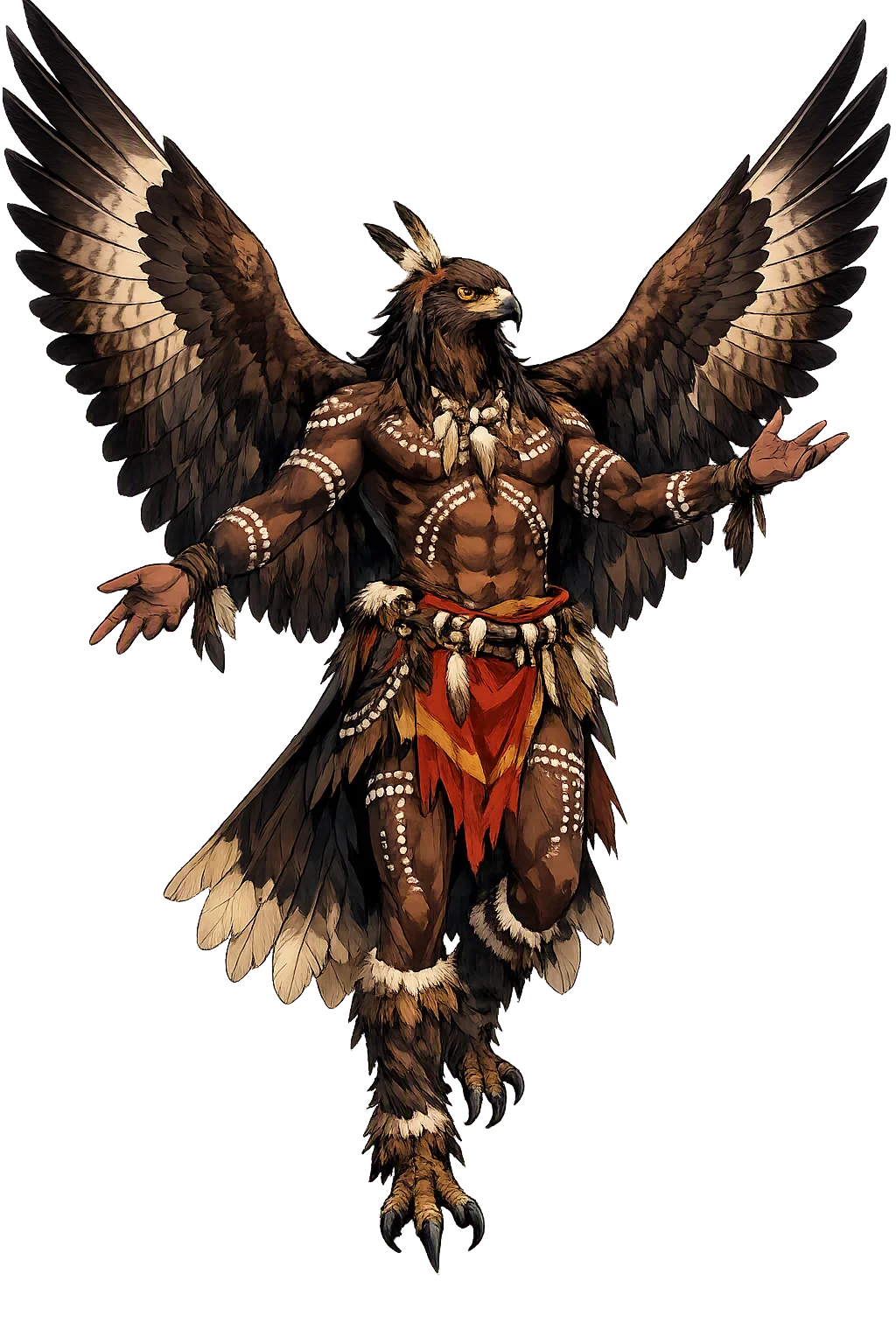
Stories of Bunjil
Bunjil's stories belong to the Dreaming of the Kulin nations — the Woiwurrung, Boonwurrung, Wathaurong, and their neighbors — recorded by A. W. Howitt, Aldo Massola, and the communities themselves. They explain how Country was made, how law was given, and how the creator withdrew into the sky so that he might continue to watch over the world.
In the Dreaming, Bunjil travelled across what is now central Victoria and shaped Country into its living form: he raised the mountains, traced the courses of the rivers, named the plants and animals, and taught each where it belonged. Then he did what a mere landscape-maker would not: he gave law. The Kulin peoples remember him establishing the rules of kinship and marriage, the obligations between clans, and the duties each people owes to its Country — seasonal burning, careful taking, respect for the places where spirit beings remain. His two wives, the black swans, and his son Binbeal the rainbow accompanied the work. Crucially, the stories insist that Country and law were made together: the mountains are not scenery but scripture, and the river's bends are not geography but instruction. (Howitt 1904; Massola 1968) The tradition encodes a complete environmental philosophy — creation, tenure, and responsibility in a single narrative.
In the telling recorded from Boonwurrung elder Carolyn Briggs, the Kulin nations fell into conflict and began to neglect family and Country, and the sea rose in anger and would not stop. The people gathered and asked Bunjil to intervene. He agreed — but on a condition: they must change their ways and return to the law. He walked to the water's edge, raised his spear, and commanded the sea to stop, and the sea stopped. (Briggs, 'Boon Wurrung Story', Yarra Healing 2000) The story is told as a moral charter, but it carries what may be a far older memory: at the end of the last Ice Age, rising seas flooded the Bassian Plain and cut Tasmania from the mainland — an inundation the ancestors of the Kulin peoples witnessed over generations, and which Australia's oral traditions are now famous for preserving with geological accuracy. The myth's force lies in its bargain: the sea keeps its bounds only while the people keep their obligations — a covenant, not a one-time miracle.
When his work was finished, Bunjil called his family together and asked Waang, the crow, to release the winds — which Waang kept tied in skin bags — so that they might all be carried to the sky. Waang opened the whirlwind, and the wind lifted Bunjil and his wives and son upward. Bunjil became the bright star Altair; his two wives, the black swans, became the stars on either side; and some tellings say he departed from the island of Deen Maar, off the coast of what is now south-western Victoria, which remains a sacred place of the Gunditjmara and Eastern Maar peoples. (Howitt 1904; Mudrooroo 1994; NIAA, Deen Maar Indigenous Protected Area) The departure is not an abandonment: the eaglehawk still circles above Country, and the star still marks the season. The creator withdrew so that the creation could belong to the people — and he stayed close enough to watch what they do with it.
In Gariwerd — the country now known as the Grampians — Bunjil took shelter in a cave in the Black Range, and there, in red ochre, his image was painted: the creator figure flanked by two dingoes, gazing out over the valley. The site known as Bunjil's Shelter is one of the most important Aboriginal rock-art places in Victoria, protected under the Aboriginal Heritage Act 2006 and visited only under the protocols its Traditional Owners set. It is not treated as a relic of a finished religion. For the Jardwadjali and Djab Wurrung peoples, and for the wider Kulin community, the shelter is a place where the ancestor's presence is understood to remain — a working site of memory, education, and obligation, cared for rather than merely conserved. (Parks Victoria 2009) The painting turns myth into address: whoever stands before it is standing where the creator once stood, being looked at by the one who is supposed to be watched for.
Sky Ancestor, Law-Giver, and Moiety Founder
Bunjil is the wedge-tailed eaglehawk made ancestor of the Kulin nations of central Victoria. In the Dreaming he shaped the mountains, rivers, plants, animals, and the laws by which people should live. He is one of two moiety ancestors, paired with Waang the crow, and after his work on earth he was lifted into the sky, where he remains as the star Altair.
He shaped the land, water, flora, and fauna of south-eastern Australia, and established the order of the living world.
After creation he ascended to the sky and became the star Altair; his two wives became the black swans beside him.
He gave the Kulin peoples their social and ecological laws, including the obligation to care for Country and each other.
As the eaglehawk ancestor he heads one of the Kulin moieties, balanced by Waang the crow on the other side.
From the original script to the living URL
Bunjil
The name survives in scholarly transliteration. Bunjil is the standard Aboriginal romanisation, documented in academic sources — “The eaglehawk”. Because the spelling uses only Latin letters, the form is the same in both ASCII and Unicode.
No indigenous writing system is securely attested for individual aboriginal names. The form shown is a modern scholarly transliteration.
bunjil
The plain bunjil form is identical to the Unicode restoration. Because this name is already written in Latin letters, no diacritics, stress, or script information were lost — only capitalization differs.
Bunjil
The Unicode restoration does not need to recover lost marks for Bunjil. Its value is canonical spelling and consistent cataloguing, not the reconstruction of erased orthography. The domain is readable as-is to both DNS and humanity.
Bunjil.com
This restoration is written entirely in ASCII letters — no Punycode encoding stands between Bunjil and the DNS. The domain reads identically to machines and to human eyes.
Owned, ideal, and ASCII forms of Bunjil
Bunjil
The full Unicode restoration. bunjil.com is not in the PuniCodex collection — it is watched for release; if it drops, this temple upgrades to an owned flagship.
How Bunjil was spoken
How Bunjil is preserved in writing
No indigenous writing system is securely attested for individual aboriginal names. The form shown is a modern scholarly transliteration.
Contribute scholarly provenance →The lore you have read is the living myth. Extended Lore opens the scholarly vault beneath it: the cult and its material remains, a history of the image, the name after antiquity, a meditation on what the name still means, and the full scholarly apparatus — etymology, orthography, sources.
Enter Extended Lore