PuniCodex

Extended Lore

Bunjil

Etymology · Phonology · Orthography · Cultural Legacy · Primary Sources

Tier 2 Bunjil
Bunjil — Creator Eaglehawk
01

Quick Facts

Essential information about Bunjil, Creator Eaglehawk

Scholarly TransliterationBunjil
Unicode RestorationBunjil
Reconstructed Pronunciation/ˈbʊn.dʒɪl/
PantheonAboriginal
DomainCreator Eaglehawk
MeaningThe eaglehawk
ClassificationTier 2
Primary DomainBunjil
Sacred SymbolsWedge-tailed eagle, Spear, Black swan, Rainbow
02

Etymology & Word Family

From original script to Unicode restoration

Scholarly Transliteration Bunjil Bunjil — "The eaglehawk"
Unicode Restoration Bunjil Restored stress, length, and script
Modern ASCII bunjil Plain-ASCII fallback

The name Bunjil is a conventional Latin transcription of an Aboriginal theonym. The PuniCodex restoration capitalises the first letter, giving the standard proper-name form. Because no diacritic or distinctive letter is added, the ASCII string 'bunjil' already encodes the conventional spelling; the name is therefore Tier 2.

03

Unicode Character Breakdown

Character-by-character philological analysis

CharacterUnicodeNameBlockPhonetic Role
BU+0042Latin Capital Letter BBasic LatinSame, capitalized
uU+0075Latin Small Letter UBasic LatinSame
nU+006ELatin Small Letter NBasic LatinSame
jU+006ALatin Small Letter JBasic LatinSame
iU+0069Latin Small Letter IBasic LatinSame
lU+006CLatin Small Letter LBasic LatinSame

The Tier 2 classification reflects how much of the original phonology this restoration preserves — stress and vowel length for Greek names, distinctive letters and diacritics for every other tradition.

04

Cultural Significance

From ancient cult to modern Unicode

Ancient Domain

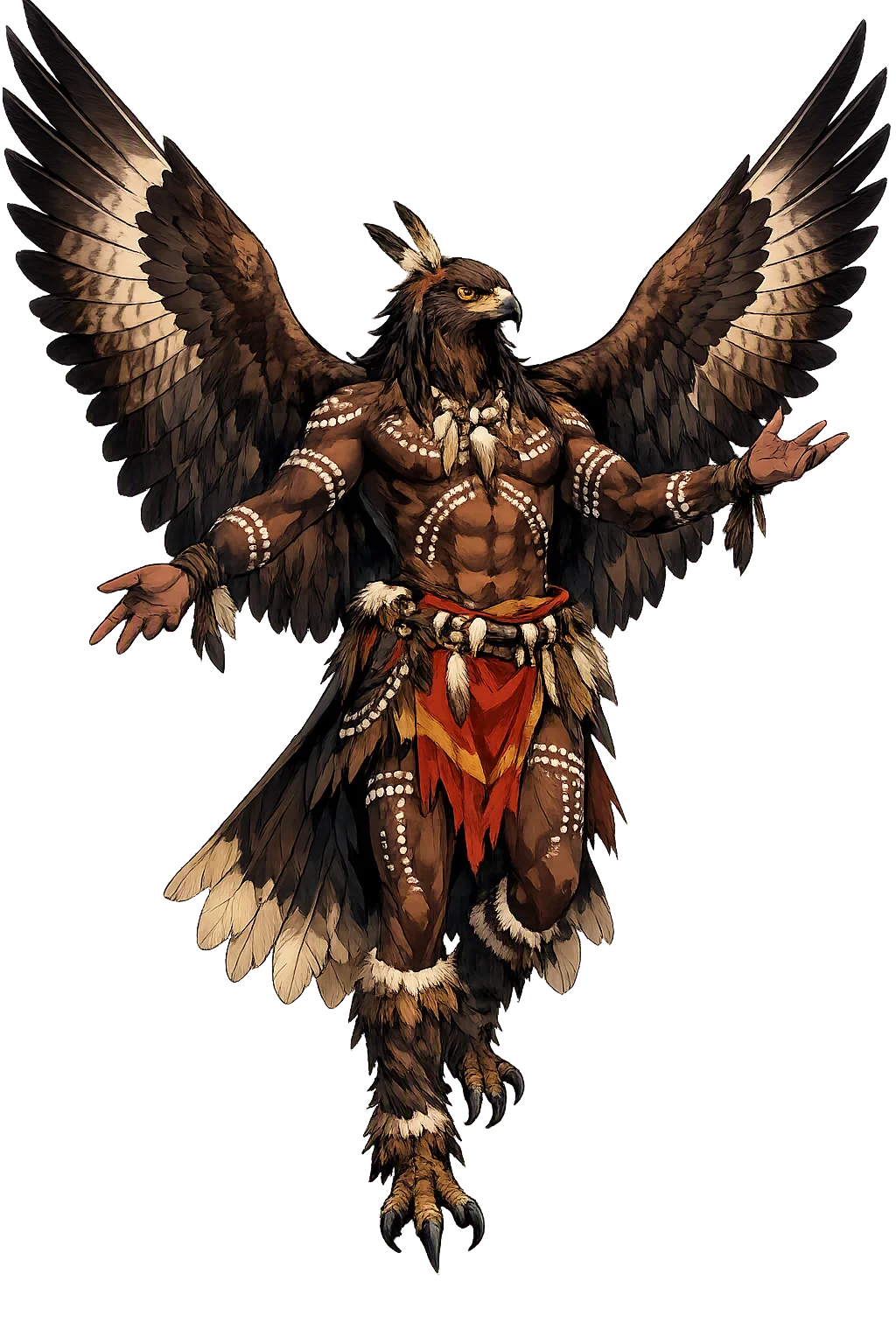
Bunjil is the wedge-tailed eaglehawk made ancestor of the Kulin nations of central Victoria. In the Dreaming he shaped the mountains, rivers, plants, animals, and the laws by which people should live. He is one of two moiety ancestors, paired with Waang the crow, and after his work on earth he was lifted into the sky, where he remains as the star Altair.

Bunjil in Later Traditions

Bunjil is not a solitary deity but one half of a Kulin social and cosmological pair. The eaglehawk moiety, headed by Bunjil, is balanced by the crow moiety, headed by Waang. This pairing structures kinship, marriage, and ritual obligations across the Kulin nations. Different clans emphasise different episodes — the Woiwurrung stress the sky ascent and Altair, the Boonwurrung remember the rising-sea story, and the Wathaurong preserve place-based accounts tied to the coast and to Bunjil's Shelter. In the colonial period the name was recorded under many spellings — Winjeel, Wingeel, Pundjel, Bunjel — reflecting dialect variation and the difficulty of rendering Aboriginal phonology in English orthography.

Modern Legacy

Bunjil remains a powerful symbol of Aboriginal Victoria. Bunjil's Shelter in the Black Range Scenic Reserve is a protected cultural site and a focus of education and tourism. Public art, including the giant sculpture Eagle in Melbourne, takes Bunjil as its inspiration. For the Wurundjeri, Boonwurrung, and other Kulin communities, Bunjil is not only an ancestral figure but a living authority in discussions of land care, cultural identity, and reconciliation.

Unicode Restoration as Cultural Act

Restoring Bunjil in a domain name is more than orthographic accuracy. It is a statement that the internet should recognize the full range of human writing — not only the ASCII keyboard.

05

Frequently Asked Questions

Common questions about Bunjil, Creator Eaglehawk, and Unicode restoration

01How do you pronounce Bunjil?

In reconstructed pronunciation, Bunjil is /ˈbʊn.dʒɪl/ — approximately 'BUN-jil' — stress the first syllable; the 'j' is the 'j' of 'jump', and the final vowel is short like the 'i' in 'kit'..

02What does Bunjil mean?

Bunjil means The eaglehawk in the aboriginal tradition.

03What are the symbols of Bunjil?

Bunjil is associated with Wedge-tailed eagle (The living form of Bunjil and the largest bird of prey in Australia; a sign of creative power and watchful authority), Spear (The instrument with which Bunjil commanded the rising sea to stop, and a mark of law-giving authority), Black swan (Bunjil's two wives, who became the stars flanking Altair after his ascent), Rainbow (His son Binbeal, the rainbow spirit, who continues the creative lineage).

04Why restore Bunjil in Unicode?

Plain ASCII bunjil strips the stress, length, and script that make the name specific. Unicode restoration returns the name to its original written dignity.

05What is the most important myth about Bunjil?

In the Dreaming, Bunjil travelled across what is now central Victoria. He formed the mountains, traced the rivers, named the plants and animals, and laid down the laws that govern how people relate to one another and to Country. These laws are not separate from the land; they are remembered in place names, songlines, and the seasonal responsibilities of each clan. (Massola 1968; Howitt 1904)

06

Scholarly Sources

The philological foundations of this restoration

Every claim on this page is grounded in established scholarship. The orthographic restorations follow disciplinary convention. The etymological chain follows the best available reference works. This is not invention — it is resurrection through scholarship.

Lexicography & Philology

  • AIATSIS
  • Massola

Primary Texts

  • Primary sources in the aboriginal tradition for Bunjil.

Archaeology & Art History

  • Material evidence — iconography, inscriptions, and temple archaeology — for Bunjil and related cults.
  • The principal material site associated with Bunjil is Bunjil's Shelter, a rock-art shelter in the Black Range Scenic Reserve within Gariwerd (Grampians National Park region), Victoria. The site is protected under the Aboriginal Heritage Act 2006 and is managed with Traditional Owner input. Textual witnesses include A. W. Howitt's ethnographic notes (AIATSIS MS 69), Aldo Massola's 1968 compilation, and contemporary community publications by Kulin educators and language custodians.

Religious Studies

  • Howitt, A. W. The Native Tribes of South-East Australia (Macmillan, 1904)
  • Massola, Aldo. Bunjil's Cave: Myths, Legends and Superstitions of the Aborigines of South-East Australia (Lansdowne Press, 1968)
  • Mudrooroo. Aboriginal Mythology: An A–Z (Thorsons, 1994)
  • Briggs, Carolyn. 'Boon Wurrung Story.' Yarra Healing (2000)
  • Parks Victoria. 'Bunjil Shelter – Black Range Scenic Reserve, Stawell – Visitor Guide' (2009)
  • AIATSIS. A. W. Howitt Collection (MS 69)
  • National Indigenous Australians Agency. Deen Maar Indigenous Protected Area (2015)
Return

The Surface Awaits

You have traced the name from its earliest attestation to its Unicode restoration. Now return to the myth. The story is where the name lives.

Back to Lore
Bunjil mascot