
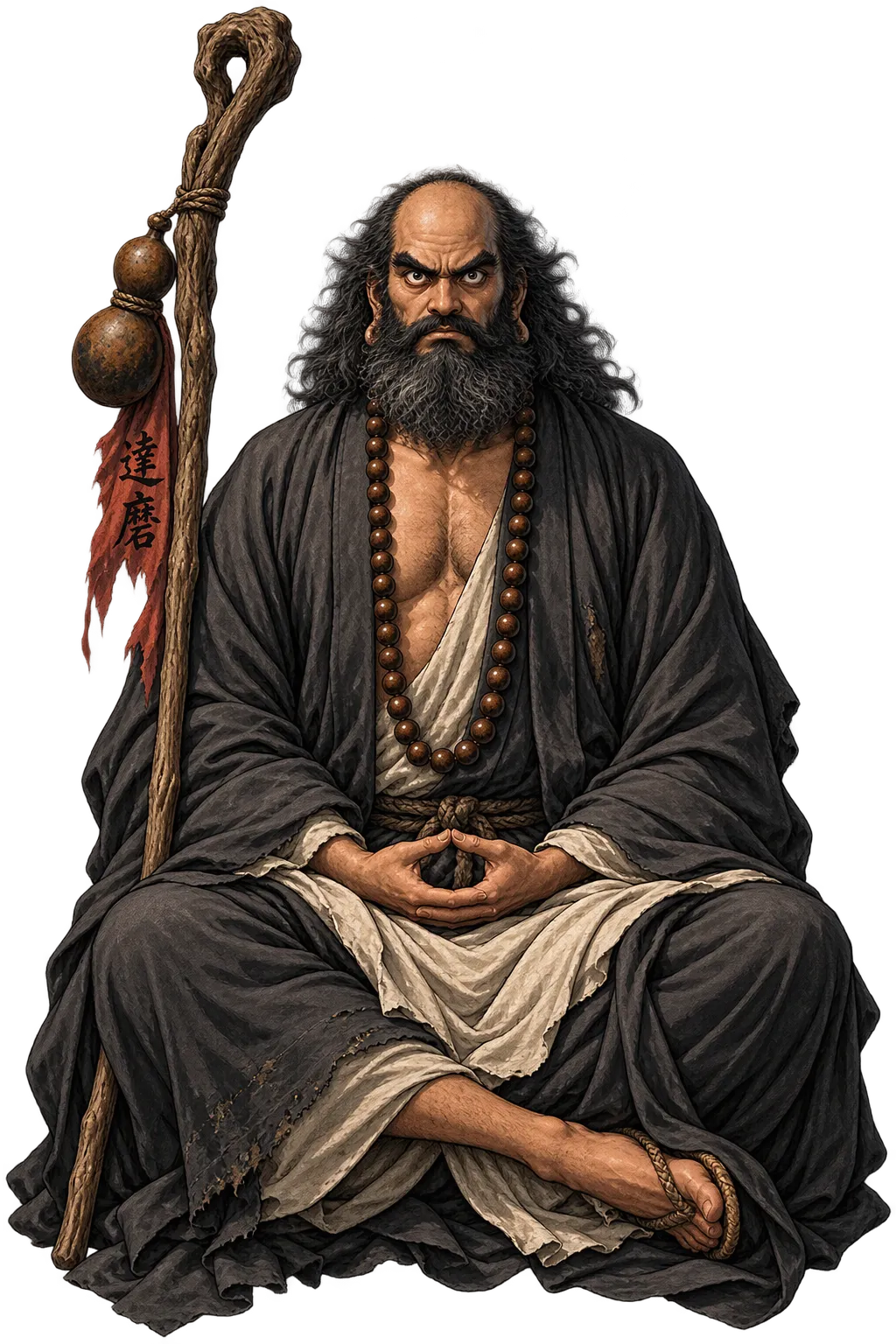
Why Bodhidharma is spelled that way — and what it costs to get it right
There is a version of this name the early internet had to settle for: bodhidharma. This is the file on how Bodhidharma replaced it.
Bodhidharma’s mythology is a layer-cake of history and legend: the historical missionary of the early sixth century; the wall-gazer of the Zen records; the Shaolin temple’s patron of the martial arts; and Japan’s round Daruma doll, whose blank eyes you fill in when your wish comes true. The legend grew because the teaching needed a body — and the body it chose was defiant, foreign, and perfectly still.
At a Glance
- Restored name: Bodhidharma
- ASCII form: bodhidharma
- Meaning: "Dharma of awakening"
- Domain of influence: Zen Patriarch, Wall-Gazer
- Pantheon: Chinese
- Restoration: ASCII-equivalent form
- Original script: 菩提達磨
- Series: The Restoration Files, No. 97 of 597
The Name Before the Marks
The name is attested as 菩提達磨, as Transmission of the Lamp (Jingde Record of the Transmission) and Blue Cliff Record (Hekiganroku), case 1 record. On the evidence, it means "Dharma of awakening".
Spoken, the name runs `/ˌboʊdɪˈdɑːrmə/` — “boh-dee-DAR-muh”
The Temple That Stands Now
The restored name is not a plaque; it is an address. The temple of Bodhidharma lives at /bodhidharma/, with its mythology in the lore halls, its peer-reviewed record in the Scholarly Edition, and its place in the pattern atlas on the patterns floor.
aSCII-equivalent form
Where the Name Stood First
His supposed grave at Kongxiangsi in the Pagoda Forest of Shaolin carries the earliest memorials; the Shaolin steles of the Tang dynasty name him. The Daruma doll’s manufacture is a modern industry, but the blank-eyed scowl descends from the Muromachi portraits. The temple on the web is the newest of these addresses — the first one that fits in a pocket.
The Archetype at Work
The pattern atlas seats this temple in 3 industries, each match argued and weighted: Sports, Fitness & Competition (the Shaolin arts' legendary founder — body-discipline as transmitted practice.); Yoga, Meditation & Holistic Wellness (the First Patriarch of Zen — zazen, the wall-facing sitting, is his nine years made daily.); Mental Health & Emotional Wellness (nine years facing the wall — the tradition's image of the mind trained past distraction.). The Resonance File reads those seats through the myths themselves.
In the Sacred Texts
The Chinese tradition is not a vibe; it is a library. The Sacred Texts collection holds Tao Te Ching — the primary sources the temple's scholarship is built on. The temple is the argument; the texts are the evidence.
The File Continues
The temple's founding dispatch tells the name's story; its Resonance File reads the myths into the industries; the blog index holds the whole archive.
Continue the series — previous file: Bodhisattva (read it here) · next file: Bragi (read it here).
The Restoration Files are written from the same canonical record as the temples themselves: the lexicon, the lore catalog, the pattern atlas, and the cited scholarly sources. If a file ever disagrees with its temple, the temple is right — tell us, and the file will be corrected.