The Living Myth
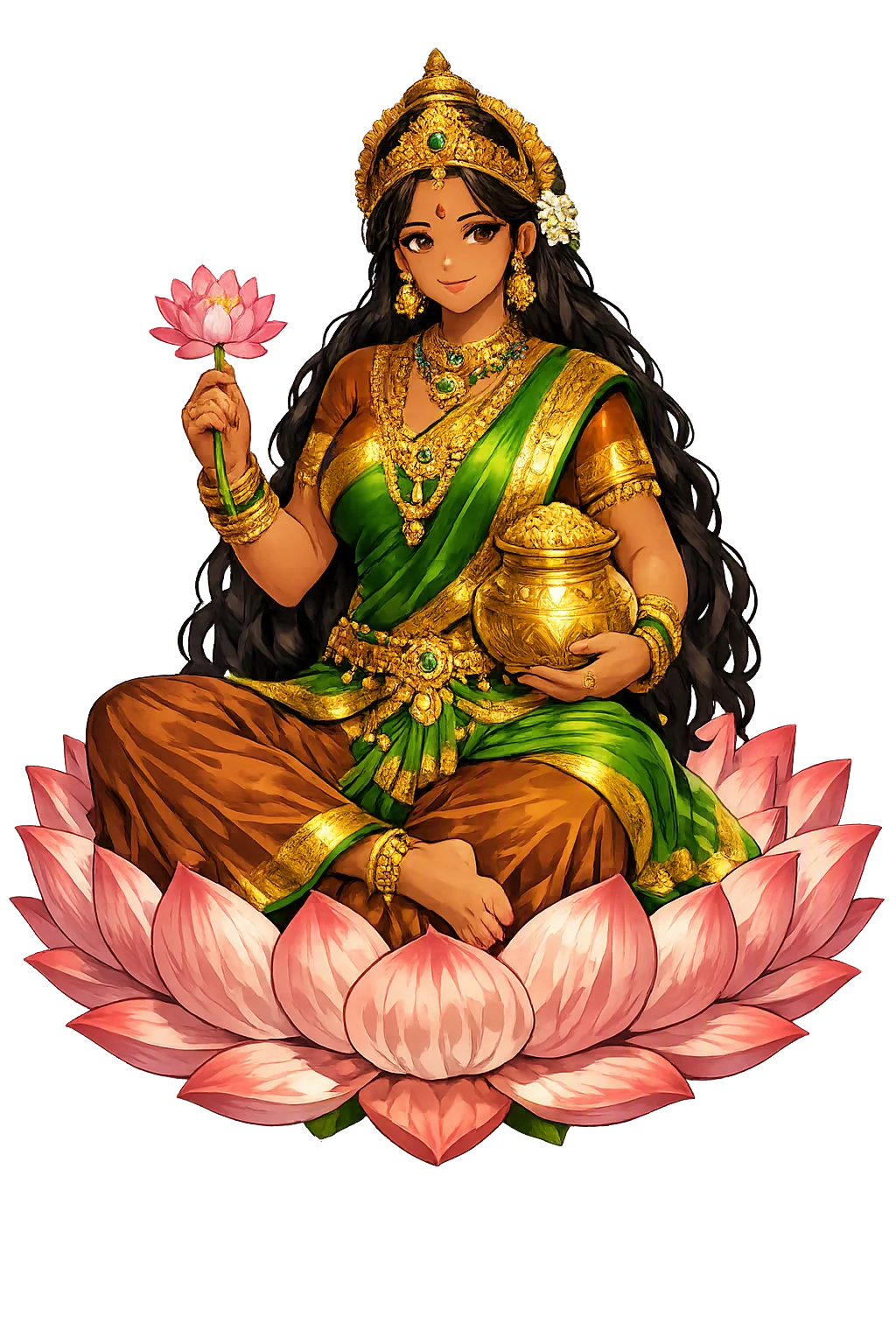
Earth, Fertility, Sustenance · Earth goddess; seated on a lotus, holding a vessel of grain
Stories of Bhūdevī
Bhūdevī's mythology is a mythology of rescue and provision. The earth is not inert matter; she is a living goddess who can be stolen, rescued, milked, and petitioned. Her stories — Varāha's dive, Sītā's furrow, Pṛthu's chase — insist that the ground beneath every kingdom has a will of its own.
In an early cosmic age, the demon Hiraṇyākṣa — 'golden-eyed' — dragged Bhūdevī herself down into the primordial waters and held her on the ocean's floor. With the earth stolen, the sun, moon, and stars lost their footing and the devas lost their offerings. Viṣṇu took the form of a boar, Varāha, vast as a mountain, and plunged into the abyss. The Bhāgavata Purāṇa (3.18–19) tells how he slew the demon after a battle that shook creation, set Bhūdevī on the point of his tusk, and raised her through the waters as the gods sang his praise — while she, the Purāṇas insist the earth is alive here, trembled and recovered like a woman lifted from drowning. The Viṣṇu Purāṇa (1.4) adds that he then levelled her and made her fit for creatures to dwell upon. The myth makes its theological claim as narrative: the earth is not property but a person, and her rescue is the first of Viṣṇu's descents, because nothing else can matter until she is safe.
King Janaka of Mithilā was ploughing a sacrificial field when his blade struck something that was not soil: a baby girl lying in the fresh furrow, shining like a seam of gold. Because she came from the sītā, the furrow, he named her Sītā — and the Rāmāyaṇa's tradition calls her bhūmi-jā, earth-born, a daughter of Bhūdevī (Vālmīki Rāmāyaṇa, Bālakāṇḍa; sarga numbering varies by recension). The goddess's motherhood is the moral spine of the epic: Sītā's patience under trial, her fidelity, and her final act all belong to the element that bore her. In the Uttarakāṇḍa, when the earth takes her back, Sītā calls on Bhūdevī as mother — the ground opens, a throne of light rises, and the daughter sinks into the mother's arms while a storm of flowers seals the wound. The myth closes its own circle: what the plough revealed, the earth reclaimed. The furrow was a door both ways.
When King Pṛthu found the earth barren and his people starving, he took his bow against the being that had fled the world's hunger and refused to yield her milk. He pursued her; she turned and begged to be spared, promising instead to be milked for every creature's need. On her back Pṛthu levelled the mountains, set the gods, ancestors, demons, and sages to milking her each into their own vessel — the gods into cupped hands, the sages into the bowl of ritual, the trees into their leaves — and from the milk came grain, herbs, and every means of life (Viṣṇu Purāṇa 1.13; the Mārkaṇḍeya Purāṇa tells the same tale). The myth is the charter of agriculture: cultivation is a negotiated settlement, not a conquest, and the earth feeds humankind by consent — a consent that must be renewed by the restraint of kings. Pṛthu's name itself was given to the earth, pṛthivī, 'the broad one,' in honour of his people.
Long before Bhūdevī had temples, she had the ground itself. The Atharvaveda's twelfth book is her hymn, the Pṛthivī-sūkta (AV 12.1): 'Earth, in which the waters flow common to all men... on whom the forests stand... bear me up, O Earth, in all my ways.' Every Vedic sacrifice required a levelled plot of earth; every temple since has begun with a bhūmi-pūjā, the propitiation of the site, and a foundation deposit laid while the goddess is asked forgiveness for the digging. Even building a house in classical India required rites to pacify the soil. The tradition understood what the myth of Varāha says outright: to build, to plough, or to bury is to touch a body that is also a person. Bhūdevī is the theological ground of all Hindu sacred geography — every temple is her house that the gods are invited to share, and every footprint is a debt incurred on her substance.
Fertility, Sustenance, and the Patience of the Soil
Bhūdevī is the earth beneath your feet made divine. She is the soil that feeds, the ground that bears, the patient mother who provides without demand. Seated on a lotus and holding a vessel of grain, she is the agricultural and ecological heart of Hindu cosmology.
The power of seed, sprout, and harvest that sustains all life.
She provides food, water, and the material basis of existence.
The earth bears the weight of all beings and all histories.
Every temple, river, and field participates in her body.
From the original script to the living URL
भूदेवी
The name in its original Sanskrit form. Bhūdevī (भूदेवी) is attested in the source tradition — “Earth goddess; seated on a lotus, holding a vessel of grain”. Its macron-length vowels carry the full phonetic and orthographic weight of the source tradition.
bhudevi
Reduced to plain bhudevi, the name loses everything that made it specific: macron-length vowels. What remains is an ASCII string that machines can parse but that no longer speaks with its original voice.
Bhūdevī
The Unicode restoration recovers what ASCII flattened. Bhūdevī restores macron-length vowels, returning the name to its original written dignity. The domain encodes to Punycode, but the browser displays the truth.
Bhūdevī.com → xn--bhdev-q3a85b.com
The non-ASCII characters in Bhūdevī are encoded while the ASCII remains visible. To the DNS, it is Punycode. To humanity, it is Bhūdevī.
Owned, ideal, and ASCII forms of Bhūdevī
Bhūdevī
Restores भूदेवी. The live temple domain — bhūdevī.com.
bhudevi
Flattens भूदेवी. The plain ASCII fallback — what DNS and legacy systems see.
How Bhūdevī was spoken
How Bhūdevī travels from ancient script to the modern URL
The lore you have read is the living myth. Extended Lore opens the scholarly vault beneath it: the cult and its material remains, a history of the image, the name after antiquity, a meditation on what the name still means, and the full scholarly apparatus — etymology, orthography, sources.
Enter Extended Lore