The Living Myth
Healing, Medicine, Lapis-Lazuli Light · Medicine master
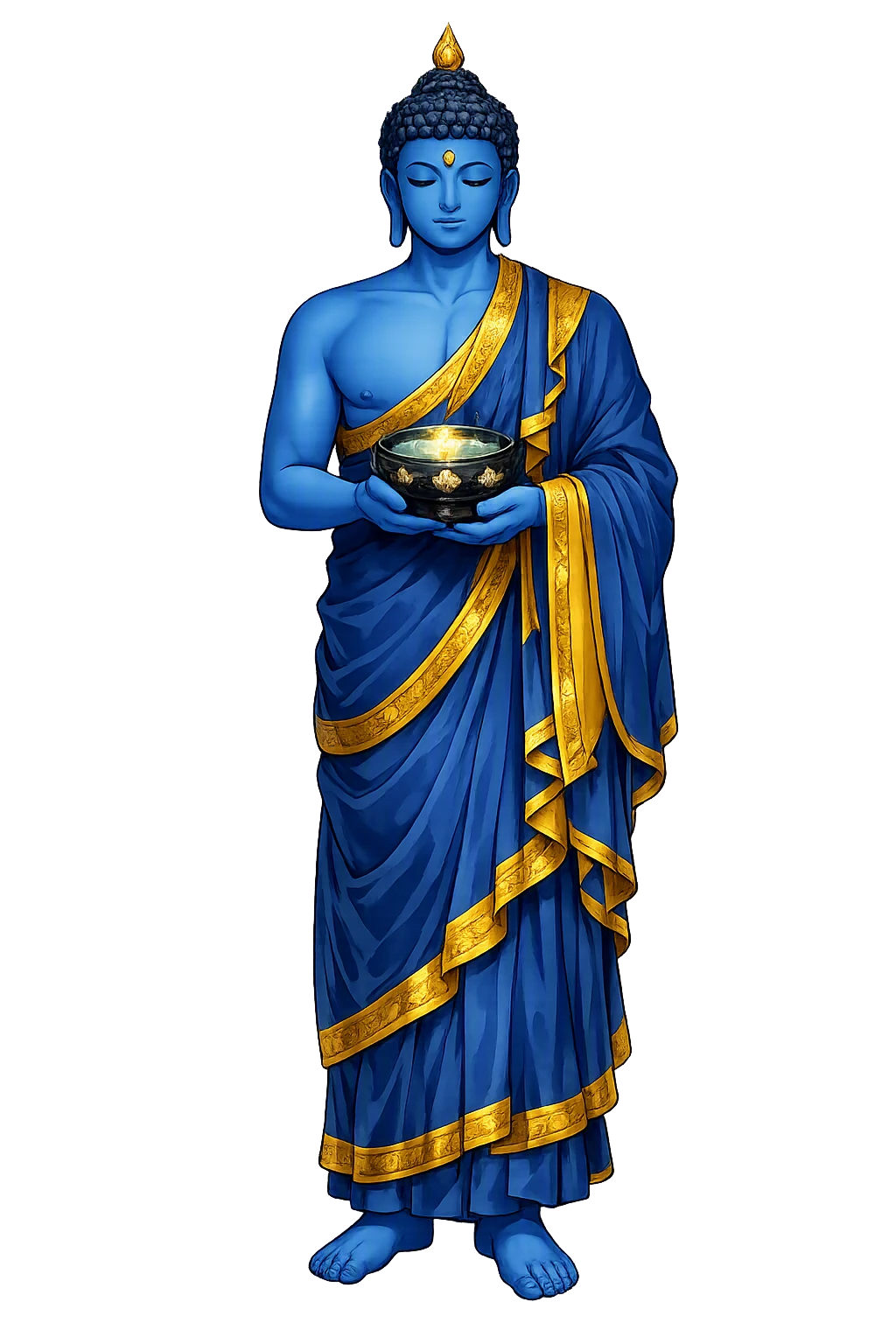
Stories of Bhaiṣajyaguru
The stories of Bhaiṣajyaguru are sutras, not epics: scripture built from his twelve vows, his lapis-lit eastern paradise, and the liturgy of healing his name still powers across Asia.
The Bhaiṣajyaguruvaidūryaprabhārājasūtra — in Xuanzang's Chinese translation of 650 CE (T. 450), the standard form in East Asia — first tells what the future Medicine Buddha swore as a bodhisattva: twelve vows. He would make his body shine like lapis lazuli to dispel the darkness of ignorance; he would give beings 'inexhaustible' wealth of goods; he would set those on false paths on the bodhisattva road; he would restore broken precepts and heal 'bodies incomplete' — the blind, the lame, the deaf; he would cure the destitute sick and free the imprisoned from their chains; he would feed the hungry and clothe the naked. One vow — that women who wish it be reborn as men — belongs to its century, and modern translators note it without flinching.
The list is the myth: a buddha defined entirely by his promises, and a definition of healing broad enough to include poverty, fear, and error along with disease.
Having fulfilled the vows, Bhaiṣajyaguru presides over the eastern pure land the sutras call Vaidūryanirbhāsa — 'Pure Lapis-Lazuli Radiance'. Its ground is vaidūrya itself, transparent as glass; its avenues are bounded by cords of jewels; streams run through it sounding the teaching, and music plays without any musician touching an instrument — Yijing's longer translation of 707 (T. 451) spells the geography out in loving detail. There is no trace of the lower destinies — no hells, no hungry ghosts, no animal births — and beings in difficulty who hear his name and remember it are, the sutra promises, rescued at the moment of death. Devotees who wish it may also choose rebirth in Amitābha's western paradise; the two buddhas are colleagues, not rivals.
If Amitābha's west is the sunset of this life's grief, Bhaiṣajyaguru's east is its remedy: a paradise designed like a hospital, staffed like a pharmacy.
The cult rode translation. Xuanzang brought the shorter Sutra of the Merit of the Original Vows of Bhaiṣajyaguru back from India and rendered it in 650, fixing the Chinese name Yàoshī Liúlíguāng Rúlái — 'Medicine Master, Lapis-Lazuli Light, Thus-Come-One.' A generation later, in 707, the pilgrim Yijing translated a longer sibling text (T. 451), the Sutra of the Seven Medicine Buddhas, which surrounds Bhaiṣajyaguru with six other healing buddhas and preserves his healing dhāraṇī — a string of Sanskrit syllables still recited over the sick in Tibetan, Chinese, and Japanese monasteries. From China the sutra passed to Korea and, by the early seventh century, to Japan, where the Medicine Master's name contracted to the two syllables every Japanese still knows: Yakushi.
A name's journey is the tradition's own map: Sanskrit to Chinese to Japanese in three generations, with the pharmacy intact at every border.
Bhaiṣajyaguru never travels alone. The triad tradition gives him two bodhisattvas — Sūryaprabha, 'Solar Radiance,' and Candraprabha, 'Lunar Radiance' (Nikkō and Gakkō in Japan) — the sun and moon standing at a healer's shoulders. Below them serve twelve yakṣa generals, each commanding seven thousand spirit troops, who swore before the Buddha to protect anyone who keeps the sutra: Kumbhīra, Vajra, Mihira, and nine more, their rolls recited in the liturgy to this day. Iconography fixed the ensemble early: the Medicine Buddha sits in monk's robes, his right hand in the gesture of gift-giving or holding a sprig of myrobalan, his left cradling the medicine bowl — the only major buddha whose standard attribute is a drug.
Solar light, lunar light, and a dozen bodyguards: the myth's arithmetic says healing is never a private act — it comes escorted, lit, and guarded.
Healing, Medicine, Lapis-Lazuli Light
Bhaiṣajyaguru is the Buddha of medicine — the Medicine Master whose eastern paradise glows with lapis-lazuli light and whose twelve great vows promise healing not only for the sick but for the poor, the imprisoned, and the misled. In a Buddhist cosmos crowded with transcendent realms, his is the one built like a hospital.
The central domain: his twelve vows promise to cure disease and deformity — and the poverty that makes sickness fatal.
The name means "Medicine Master" — guru of bhaiṣajya, the healer's art, from bhiṣaj "healer."
The restoration Bhaiṣajyaguru recovers what plain ASCII bhaisajyaguru flattens.
Attested in Sanskrit manuscripts in Devanāgarī as भैषज्यगुरु; carried to China as Yàoshī, to Japan as Yakushi.
From the original script to the living URL
भैषज्यगुरु
The name in its original Buddhist form. Bhaiṣajyaguru (भैषज्यगुरु) is attested in the source tradition — “Medicine master”. Its emphatic consonants and palatal/retroflex sibilants carry the full phonetic and orthographic weight of the source tradition.
bhaisajyaguru
Reduced to plain bhaisajyaguru, the name loses everything that made it specific: emphatic consonants and palatal/retroflex sibilants. What remains is an ASCII string that machines can parse but that no longer speaks with its original voice.
Bhaiṣajyaguru
The Unicode restoration recovers what ASCII flattened. Bhaiṣajyaguru restores emphatic consonants and palatal/retroflex sibilants, returning the name to its original written dignity. The domain encodes to Punycode, but the browser displays the truth.
Bhaiṣajyaguru.com → xn--bhaiajyaguru-6g5f.com
The non-ASCII characters in Bhaiṣajyaguru are encoded while the ASCII remains visible. To the DNS, it is Punycode. To humanity, it is Bhaiṣajyaguru.
Owned, ideal, and ASCII forms of Bhaiṣajyaguru
Bhaiṣajyaguru
Restores भैषज्यगुरु. The live temple domain — bhaiṣajyaguru.com.
bhaisajyaguru
Flattens भैषज्यगुरु. The plain ASCII fallback — what DNS and legacy systems see.
How Bhaiṣajyaguru was spoken
How Bhaiṣajyaguru travels from ancient script to the modern URL
The lore you have read is the living myth. Extended Lore opens the scholarly vault beneath it: the cult and its material remains, a history of the image, the name after antiquity, a meditation on what the name still means, and the full scholarly apparatus — etymology, orthography, sources.
Enter Extended Lore