
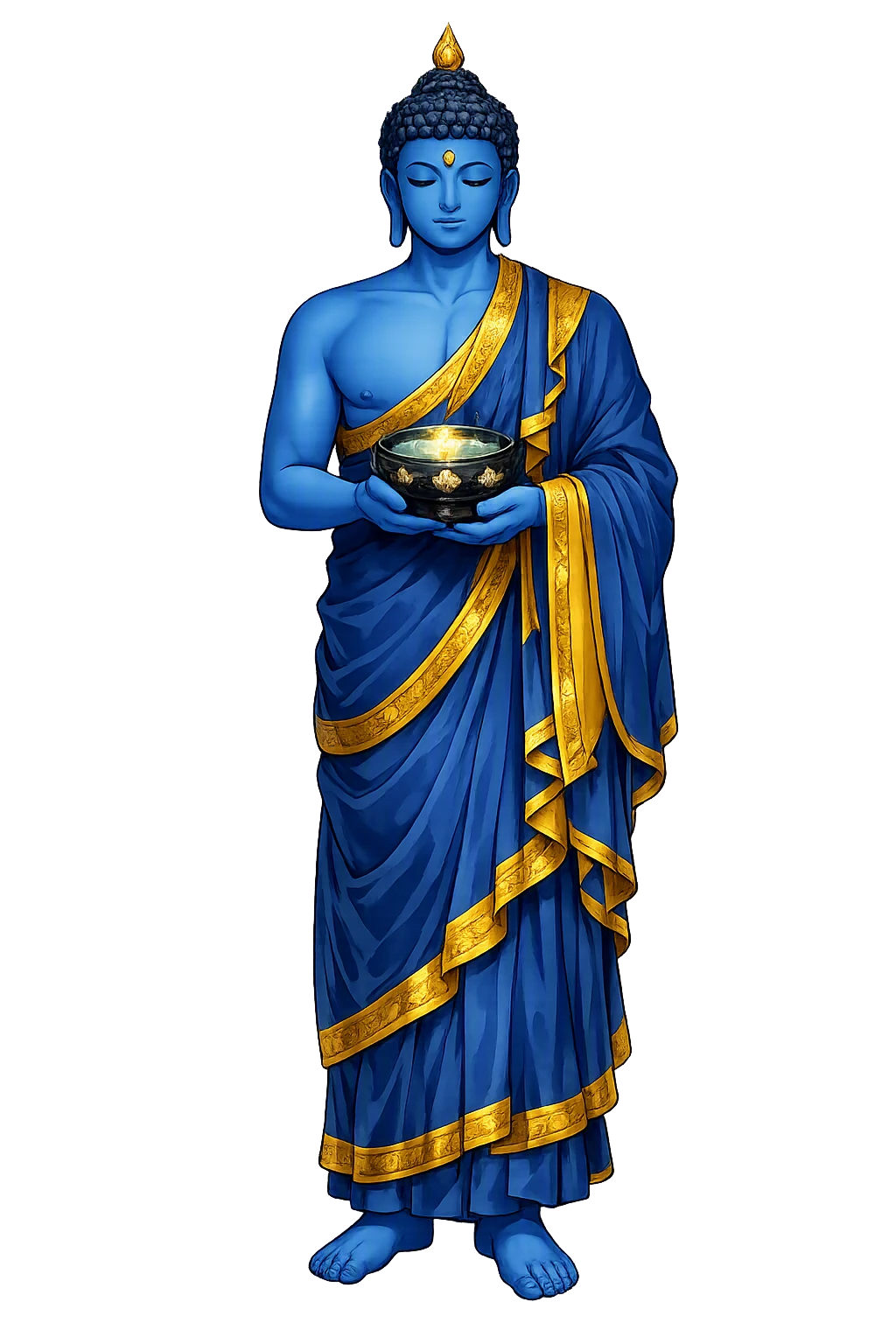
How Bhaiṣajyaguru was rebuilt, mark by mark
Bench notes, Bhaiṣajyaguru: what we found, what we rejected, and what we finally set down. Kept in the open, because a restoration you cannot audit is just a spelling with confidence.
What We Found
The attestation, as Bhaiṣajyaguruvaidūryaprabhārājasūtra, trans. Xuanzang (T. 450, 650 CE) and Sutra of the Seven Medicine Buddhas, trans. Yijing (T. 451, 707 CE) record: भैषज्यगुरु. Meaning: "Medicine master".
The figure behind the name: The stories of Bhaiṣajyaguru are sutras, not epics: scripture built from his twelve vows, his lapis-lit eastern paradise, and the liturgy of healing his name still powers across Asia.
What the Name Carried In
What He Promised Before He Was Buddha. The Bhaiṣajyaguruvaidūryaprabhārājasūtra — in Xuanzang's Chinese translation of 650 CE (T. 450), the standard form in East Asia — first tells what the future Medicine Buddha swore as a bodhisattva: twelve vows.
The World of Lapis Light. Having fulfilled the vows, Bhaiṣajyaguru presides over the eastern pure land the sutras call Vaidūryanirbhāsa — 'Pure Lapis-Lazuli Radiance'. Its ground is vaidūrya itself, transparent as glass; its avenues are bounded by cords of jewels; streams run through it sounding the teaching, and music plays without any musician touching an instrument — Yijing's longer translation of 707 (T.
A spelling that has to carry stories like these is not a label. It is equipment.
Where It Stood Before Us
The iconographic record is rich and datable. Dunhuang's Mogao caves preserve Tang-dynasty wall paintings of the Bhaiṣajyaguru paradise — lapis ground, jewel cords, celestial musicians — among the most complete sutra illustrations surviving. In bronze, gilt-copper Yakushi triads of the Asuka and Hakuho periods mark the cult's arrival in Japan; the Yakushi-ji founding of 680 under Emperor Tenmu is documented in the Nihon Shoki, and the temple's excavated foundations and surviving East Pagoda anchor the tradition in seventh-century fact. Shin Yakushi-ji in Nara preserves its eighth-century Twelve Generals in near-original clay — the single most important sculptural set of the cult. Dedicatory inscriptions across northern China and the Korean peninsula record the sutra's recitation for named donors, giving the healing cult thousands of individual faces. The bench inherits all of it — the web temple is the newest site, not the first.
What We Rejected
Any form invented for availability. The rule on the bench: if the evidence does not carry it, the domain does not get it — whatever the registrar has in stock.
What We Set Down
Bhaiṣajyaguru — Tier-1 is not a compliment; it is a measurement. This restoration keeps something the ASCII form provably loses, and the measurement is repeatable.
For the voice: 'BY-shaj-yah-GOO-roo' — the 'sh' is retroflex, tongue curled back; the first syllable is aspirated and the last is lengthened.
The temple stands at /bhaisajyaguru/ — the notes above are public in its Scholarly Edition, sources and all.
At a Glance
- Restored name: Bhaiṣajyaguru
- ASCII form: bhaisajyaguru
- Meaning: "Medicine master"
- Domain of influence: Healing, Medicine, Lapis-Lazuli Light
- Pantheon: Buddhist
- Classification: Tier 1
- Original script: भैषज्यगुरु
- Series: The Restoration Files, No. 87 of 548
The File Continues
The temple's founding dispatch tells the name's story; its Resonance File reads the myths into the industries; the blog index holds the whole archive.
Continue the series — previous file: Bestla (read it here) · next file: Bhūdevī (read it here).
The Restoration Files are written from the same canonical record as the temples themselves: the lexicon, the lore catalog, the pattern atlas, and the cited scholarly sources. If a file ever disagrees with its temple, the temple is right — tell us, and the file will be corrected.