
Bs: the stories first, then the spelling
Before the spelling, the story. Bs earns its restoration the old way — through what was actually told.
The Stories That Carry the Name
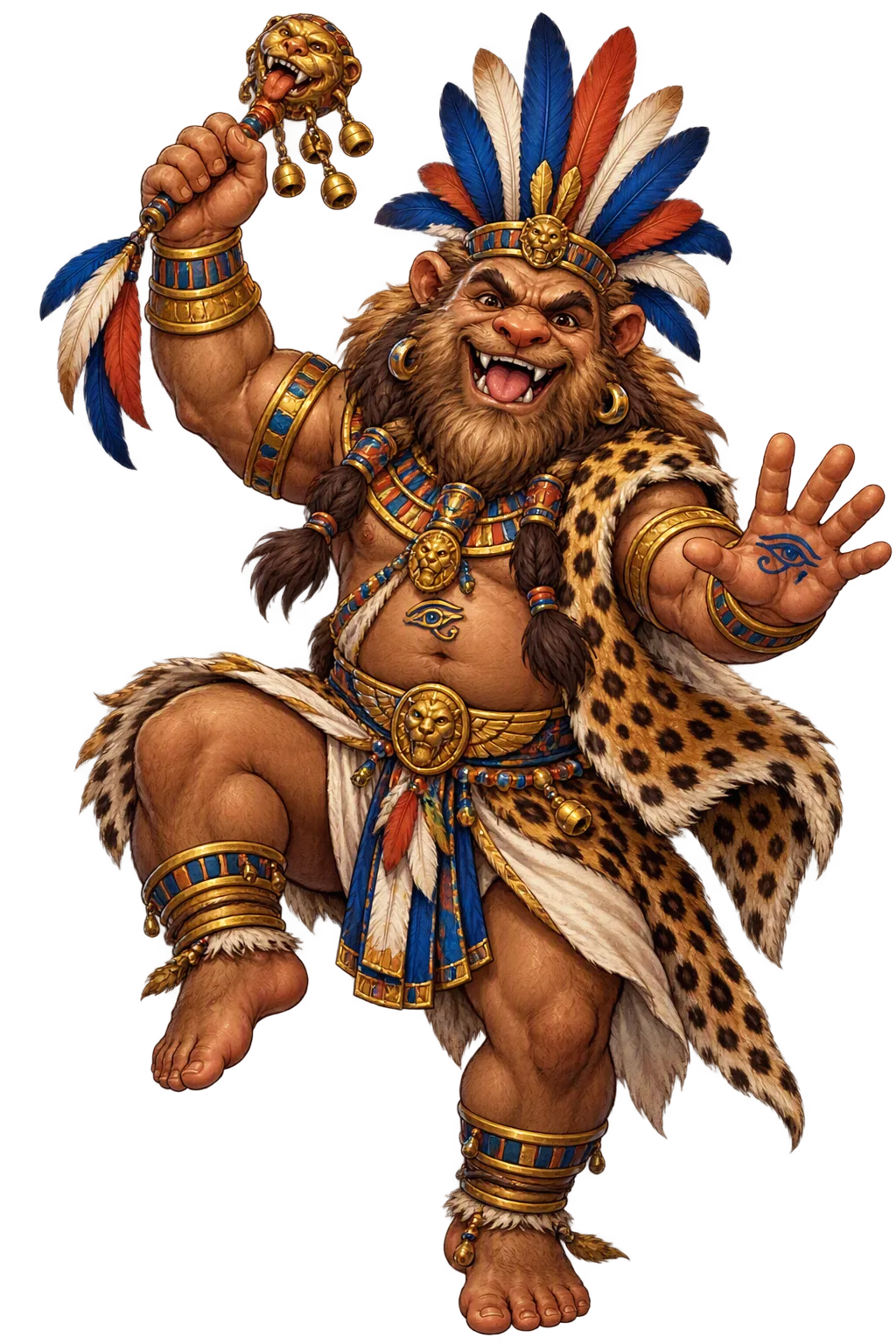
The Mask of the Midwife. In the birth-chamber, the midwife donned the Bes-mask and danced his dance; his grimace drew the malign spirits’ attention onto himself and away from mother and child. The Beset-amulets and the ‘Bes-chamber’ scenes of Deir el-Medina show the rite in domestic detail.
The Dwarf Who Amuses the Gods. The Westcar Papyrus’ wonder-tale of the dwarf Dedi, who dances and performs before the court, is read as Bes’ narrative shadow — the small deformed being whose skill and humour carry more power than the great. Bes never speaks in the texts; he dances.
Bes the Pantheos. By the Late Period, Bes absorbed attributes of every major god — the wings of Horus, the crown of Amun, the snakes of Mehen — becoming the ‘Pantheos-Bes’, one dwarf wearing the whole pantheon’s power. The type, with its many arms and animal faces, spread through the Greco-Roman world as an amulet-image.
And Here Is What the Spelling Preserves
At a Glance
- Restored name: Bs
- ASCII form: bes
- Meaning: "The protector"
- Domain of influence: Protection, Childbirth, Joy
- Pantheon: Egyptian
- Restoration: ASCII-equivalent form
- Original script: 𓃀𓋴𓄜
- Series: The Restoration Files, No. 89 of 597
The Name Travels
Bes is the great syncretic absorber of the late period: Pantheos-Bes carries the attributes of all gods. The Greeks equated him with their own apotropaic dwarves and the Pataikos figures, and Roman soldiers carried his amulets across the empire — the household god travelled as military gear.
The Address It Earned
The temple of Bs stands at /bes/ — lore, scholars, patterns — because a name carrying this much story deserves more than a parking page. aSCII-equivalent form
The Sources Are Open
The myths above are retold from the temple's record; the primary voices are in the Sacred Texts: The Book of the Dead. Nothing in this file outranks them.
The Emblems
The name does not travel alone. Guardian of the Hearth — His image watched over beds, births, and mirrors — the god of the domestic threshold.; The Dancer-Demon — His terrifying face and acrobatic dance frighten away the demons of childbirth and sleep.; Lord of Childbirth — The birth-brick and the Bes-mask of the midwife: he presided over every Egyptian child’s first hour.. Each emblem is filed in the temple's record with its own provenance, the same discipline the spelling gets.
For the Voice
“BESS” The reconstructed line runs `/bɛs/ (conventional)` — the temple's pronunciation atlas carries the phonemes one by one.
The Discipline It Answers To
This restoration belongs to Egyptian, a tradition that treated names as operational magic, not labels. The rules that govern it are not house style; they are the tradition's own scholarship, applied with the same care here as in any edition — and published, with the sources, so the file can be checked the way an edition can be checked. aSCII-equivalent form
The File Continues
Read the founding dispatch for the name's full story, the Resonance File for the archetype at work — or the whole archive in one sitting.
Continue the series — previous file: Benzaiten (read it here) · next file: Bestla (read it here).
The Restoration Files are written from the same canonical record as the temples themselves: the lexicon, the lore catalog, the pattern atlas, and the cited scholarly sources. If a file ever disagrees with its temple, the temple is right — tell us, and the file will be corrected.