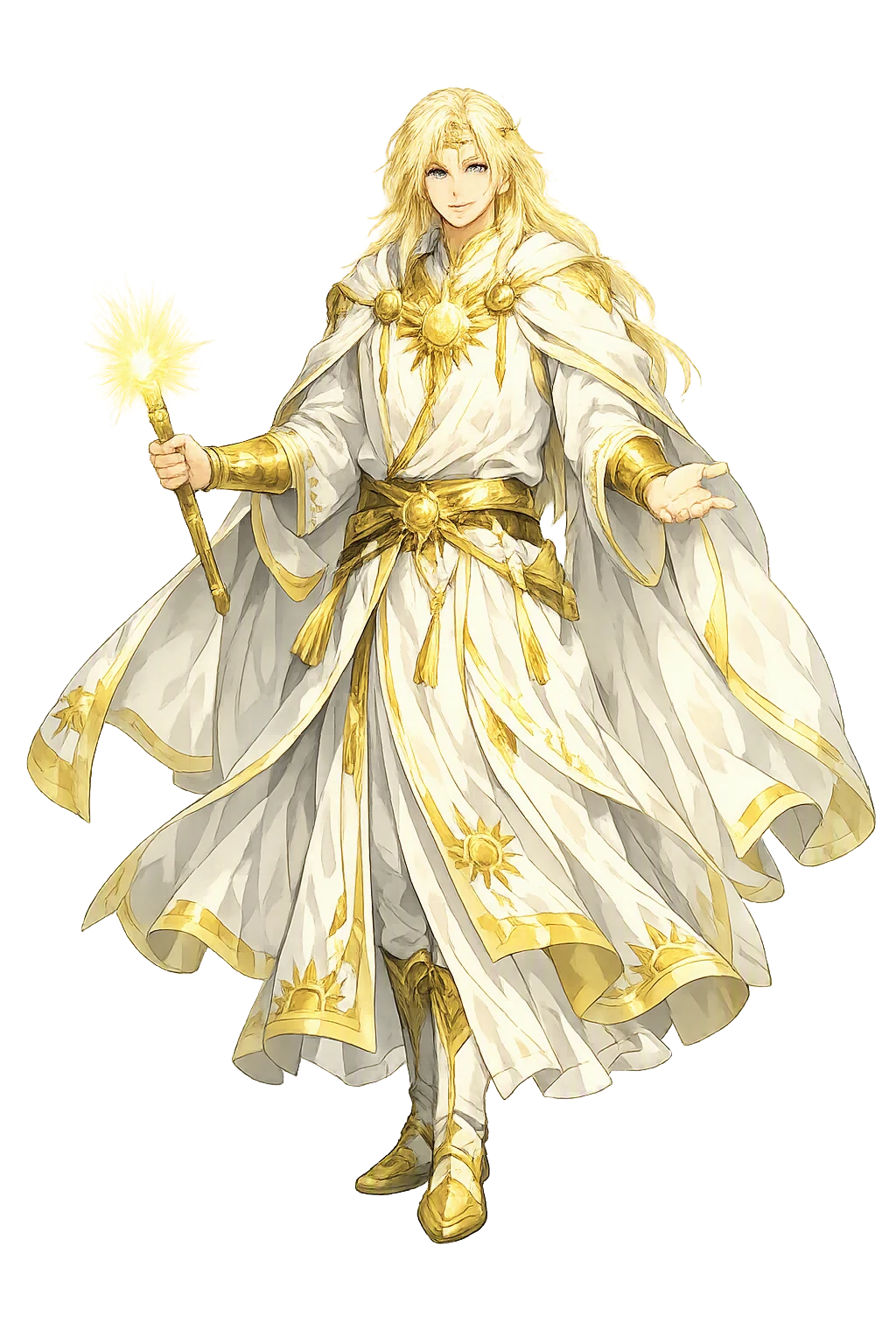
Stories of Baldr
Baldr has the thinnest dossier and the heaviest role of any god in the Edda: he acts in almost nothing, and his death sets everything in motion. The sources agree on the shape — the dreams, the oath, the mistletoe, the blind brother's throw, the burning ship, the failed ransom, the promised return — and almost nothing else about him survives at all.
Snorri introduces him in the catalogue of the Æsir with a formula the tradition never varies: Baldr the Good, second son of Óðinn, and 'he is the best, and all praise him'. He is so fair of face and bright that a splendour radiates from him, and one plant is so white that it takes its name from his eyelash — baldrs brá, the daisy, whitest of all plants. He is the wisest of the Æsir, the most beautifully spoken, and the most merciful — yet Snorri adds the one shadow across the portrait: none of his judgments holds; nothing he decides can stand.
His dwelling is Breiðablik, the broad-gleaming, and Grímnismál says of that land that the fewest bale-runes lie there — the place in heaven where impurity has least footing. The Edda paints the perfect god first so that everything after reads as loss.
It begins with dreams. Baldr dreams baleful dreams for his life, and the Æsir take counsel. In Baldrs draumar — the whole poem is this one episode — Óðinn himself saddles Sleipnir, rides down the dark road to Niflhel, and raises a dead völva from her grave east of Hel's gate with spells. She answers unwilling: the benches of Hel are strewn and shining, the mead brewed — for Baldr. Höðr will be his slayer; Váli, born to Óðinn, will avenge him one night old, unwashed and uncombed until he brings Baldr's foe to the pyre. And at the end she names the refusal to come: Þökk will weep dry tears for the burning; let Hel hold what she has.
Völuspá gives the same knowledge to its seeress: 'I saw for Baldr, the bleeding victim, Óðinn's child, what was fated.' The mistletoe stood slim and very fair, high-grown — and from that slender shoot came a dangerous dart of sorrow, and Höðr shot it. Baldr's death is the only event in the Edda told as prophecy before it is told as history: the gods know, and it happens anyway.
Frigg takes the foreseen answer and fights it: she travels the world and exacts an oath from all things — fire and water, iron and every metal, stones, earth, trees, sicknesses, beasts, birds, poison, serpents — that they will not harm Baldr. Only the mistletoe, growing west of Valhǫll, seemed too young to demand the oath of. When this was done, the gods' pastime at the assembly was to stand and shoot at Baldr, hurl stones, strike him — and nothing hurt him, and all thought it a great glory.
Loki, Snorri says, could not bear it. In a woman's shape he drew from Frigg the single omission, pulled up the mistletoe, and put it in the hand of Höðr, Baldr's blind brother, who stood at the edge of the circle because he could see nothing and had no weapon. 'Do as the others do,' Loki said; 'I will show you where he stands.' Höðr threw, and the shaft went through Baldr, and he fell dead to the earth — 'the most ill-fated deed,' Snorri writes, 'done among gods and men.' The Æsir could not even take vengeance there, in the sanctuary; they could only weep, and when they found their voices, Frigg asked who would ride to Hel to ransom him.
The Æsir carried Baldr to the sea and brought out Hringhorni, his ship, the greatest of all ships, meaning to give him a pyre at sea — and they could not move it. A giantess named Hyrrokkin was summoned from Jötunheimr, riding a wolf with vipers for reins, and she launched the ship with one shove so that fire flew from the rollers and the lands quaked. On the pyre they laid Baldr, and when Nanna, his wife, daughter of Nepr, saw him, her heart burst with grief and she was laid on the fire beside him. Óðinn laid the ring Draupnir on the pyre; Þórr hallowed it with Mjölnir, and as he did he kicked the dwarf Litr, who ran before his feet, into the flames.
Then comes the errand every Norse listener knew by heart: Hermóðr rode nine nights to Hel and begged her to let Baldr go, and Hel set the condition — if all things in the world, living and lifeless, weep for him, he shall return. Messengers went through all the world, and all things wept: men and beasts, earth and stones, trees and every metal — 'as you have surely seen these things weep when they come from frost into warmth'. Only one giantess in a cave, who called herself Þökk, Thanks, wept dry tears: 'Let Hel hold what she has.' The Æsir believed Þökk was Loki. Baldr stayed, and the gods' first grief became the first certainty of Ragnarǫk.
Saxo Grammaticus, writing a generation before Snorri's Edda reached its final form, tells the same death as Danish heroic history. His Balderus is a demigod, son of Odin, whose body no ordinary steel can wound; his rival is not a blind brother but a human prince, Høtherus, and they contend not in a game at the assembly but for the hand of Nanna, whom Høtherus loves and Balderus covets. The supernatural edge of the Edda survives in fragments: Høtherus wins from the wood-satyr Mimingus the sword Mimming and a bracelet; strange forest maidens give him food that steals the gods' strength; and when at last Høtherus wounds Balderus, the demigod lingers three days, dies, and is buried in a barrow. Vengeance follows the old pattern: Bous — Saxo's form of Váli — son of Odin and Rinda, is begotten for the purpose and kills Høtherus, dying himself of his wounds.
Where Snorri's Baldr is innocence murdered by malice, Saxo's is a lover destroyed by rivalry — the euhemerized reading strips the myth of its cosmic grief and keeps its skeleton: the invulnerable man, the one weapon that can harm him, the rival's hand, the begotten avenger. The two accounts are the tradition's own proof that the Baldr story was old, northern, and told in more than one key.
The Best and Fairest of the Æsir
Baldr is the shining son of Óðinn and Frigg — the god Snorri calls simply the best: so fair of face and bright that light itself streams from him, so wise and gracious that his judgments cannot be undone. His hall is Breiðablik, the broad-gleaming, where nothing impure may dwell; his death by the mistletoe shaft is the first grief of the gods and the herald of Ragnarǫk.
The one shoot too young to swear Frigg's oath — slender, fair, and fatal. From it came the dart that felled the god no weapon could wound.
Baldr's ship, greatest of all ships, launched for his pyre by the giantess Hyrrokkin while the Æsir themselves could not shift it.
The drip-gold ring Óðinn laid on the pyre beside his son — the treasure the dead god sent back from Hel as proof the errand reached him.
'Baldr's eyelash' — the whitest of all plants, the daisy, so named because the god's brightness was the measure of whiteness itself.
From the original script to the living URL
ᛒᛅᛚᛏᚱ
The name in its original Norse form. Baldr (ᛒᛅᛚᛏᚱ) is attested in the source tradition — “Lord, prince (from *balþraz)”. Its original diacritics and script distinctions carry the full phonetic and orthographic weight of the source tradition.
baldr
The plain baldr form is identical to the Unicode restoration. Because this name is already written in Latin letters, no diacritics, stress, or script information were lost — only capitalization differs.
Baldr
The Unicode restoration does not need to recover lost marks for Baldr. Its value is canonical spelling and consistent cataloguing, not the reconstruction of erased orthography. The domain is readable as-is to both DNS and humanity.
Baldr.com
This restoration is written entirely in ASCII letters — no Punycode encoding stands between Baldr and the DNS. The domain reads identically to machines and to human eyes.
Owned, ideal, and ASCII forms of Baldr
Baldr
Restores ᛒᛅᛚᛏᚱ. The full Unicode restoration. baldr.com is not in the PuniCodex collection — it is watched for release; if it drops, this temple upgrades to an owned flagship.
How Baldr was spoken
How Baldr travels from ancient script to the modern URL
The lore you have read is the living myth. Extended Lore opens the scholarly vault beneath it: the cult and its material remains, a history of the image, the name after antiquity, a meditation on what the name still means, and the full scholarly apparatus — etymology, orthography, sources.
Enter Extended Lore