PuniCodex

Extended Lore

Baiame

Etymology · Orthography · Cult · Iconography · Reception · Sources

Tier 2 Baiame
Baiame — Sky Father, Creator
01

Quick Facts

Essential information about Baiame, Sky Father, Creator

Scholarly TransliterationBaiame
Unicode RestorationBaiame
Reconstructed Pronunciation/ˈbajaˌmi/
PantheonAboriginal
DomainSky Father, Creator
MeaningThe maker
ClassificationTier 2
Primary DomainBaiame
Sacred SymbolsThe Emu in the Sky, Bullroarer, Stone arrangements and bora rings, Stone axes
02

Etymology & Word Family

From original script to Unicode restoration

Scholarly Transliteration Baiame Baiame — "The maker"
Unicode Restoration Baiame Canonical scholarly spelling — ASCII-identical
Modern ASCII baiame Plain-ASCII fallback

The name Baiame reaches the modern world through scholarly transliteration of the aboriginal tradition. Because the conventional spelling uses only Latin letters, its Unicode and ASCII forms coincide — the tradition it carries is in the name itself, not in diacritics.

03

Unicode Character Breakdown

Character-by-character philological analysis

CharacterUnicodeNameBlockPhonetic Role
BU+0042Latin Capital Letter BBasic LatinSame, capitalized
aU+0061Latin Small Letter ABasic LatinSame
iU+0069Latin Small Letter IBasic LatinSame
aU+0061Latin Small Letter ABasic LatinSame
mU+006DLatin Small Letter MBasic LatinSame
eU+0065Latin Small Letter EBasic LatinSame

The Tier 2 classification here reflects fidelity to the attested tradition, not recovered diacritics: every character of Baiame already survives in ASCII. What the restoration preserves is the canonical spelling itself — the form scholarship standardised.

04

Cult & Worship

How the sacred was kept — rites, sanctuaries, remains

The Cult

Baiame's 'cult' was the law itself, enacted rather than attended. There were no temples, no priestly caste, no idols: worship took the form of the ceremony complex the early ethnographers could only skirt — above all the bora, the initiation ground, a cleared ring with its carved trees and stone arrangements across Wiradjuri and Gamilaraay country, where the bullroarer's hum carried Daramulum's voice and Baiame's law passed to each generation of men. Parker (1905) and Elkin (1938) record the surrounding practice: song cycles that traverse the country he made, increase rites tied to the Emu in the Sky, and sacred sites — Baiame Cave near Milbrodale, with its great painted figure, chief among them — visited under custodianship and strict protocol. Much of the ceremonial detail was and remains restricted knowledge, which is why the written record reads thin: the cult did not lack depth, it lacked outsiders. Where the old ceremonies survived into living memory, Aboriginal communities hold them still; that continuity, not reconstruction, is the cult's modern form.

In the Earth

The material record of Baiame-related belief includes stone arrangements, bora (initiation) grounds, rock engravings, and rock shelters across the Wiradjuri and Gamilaraay countries of New South Wales. Notable sites include Baiame Cave near Milbrodale in the Hunter Valley, which contains a large painted figure sometimes identified with Baiame, and numerous carved and painted emus that reference the Emu in the Sky. These sites are protected under Aboriginal cultural-heritage law and are best understood in consultation with the traditional custodians.

05

Iconography

How Baiame was imaged across the ages

The Image

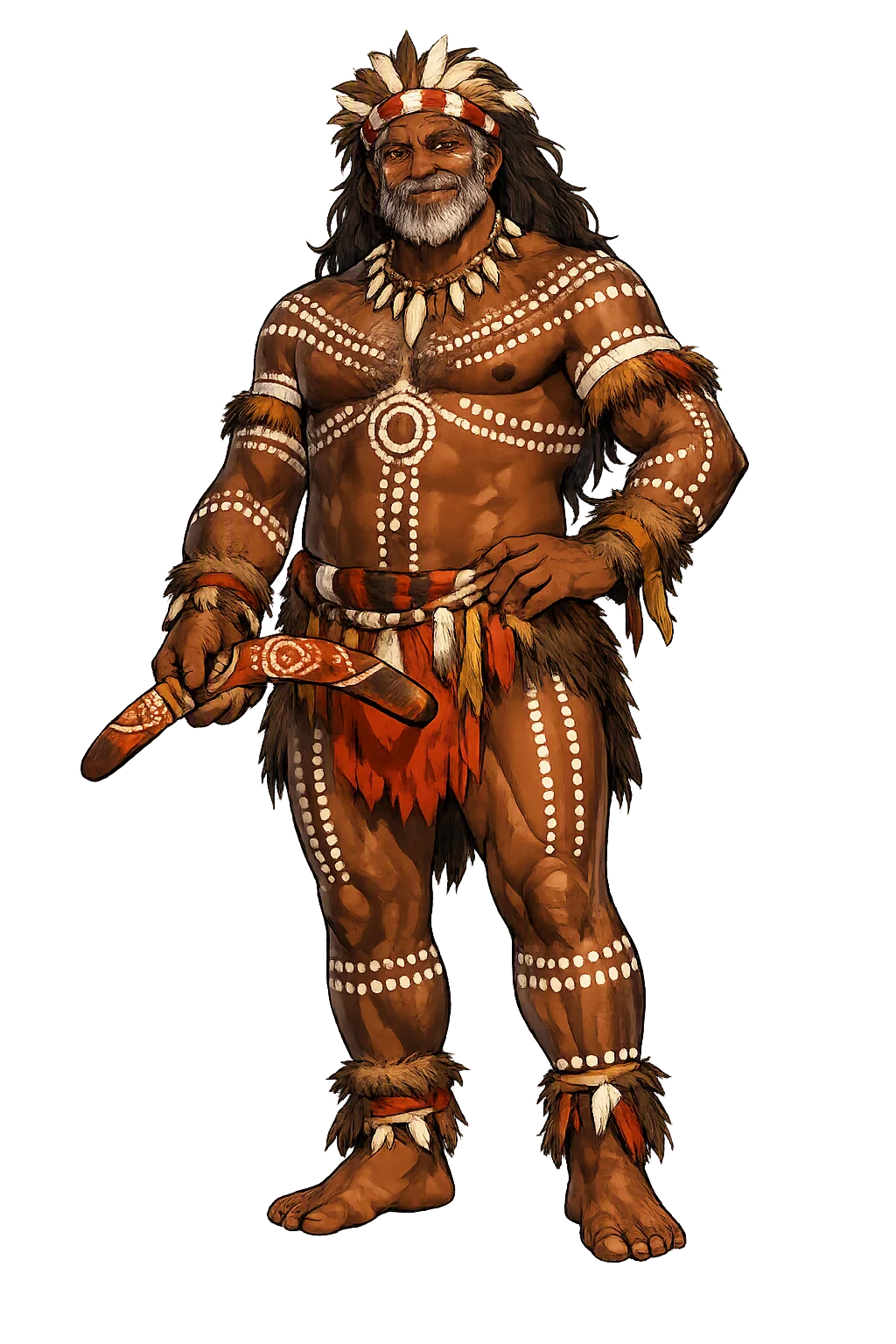
Baiame's oldest portraits are on sandstone. The type-site is Baiame Cave near Milbrodale in the Hunter Valley, where a shelter wall carries a large painted male figure — arms thrown wide, limbs striped, the head crowned with projections, the body filled with ochre — identified in the regional tradition as the maker himself. How old the painting is cannot be said with confidence: the pigment art of New South Wales resists direct dating, and the honest claim is attribution by tradition rather than chronology by science. Around it lies a broader corpus: thousands of pecked and grooved engravings across the southeast, emu and kangaroo tracks, and the carved trees (dendroglyphs) of the bora grounds, their diamond and spiral cuts marking the ceremony ground itself. The aniconic register mattered as much: the bullroarer, whirled at initiation, was the god's heard-not-seen body. No figurative sculpture and no portable idol survive — the image was the country, and the country is still there.

06

Reception & Transformation

The name after its own age — transmission, translation, survival

Afterlives

Baiame's journey into the written record is a case study in how colonial scholarship both saved and strained a tradition. Nineteenth-century collectors filed fragmentary mentions; the first full portrait came from an unlikely hand — K. Langloh Parker, whose The Euahlayi Tribe (1905) recorded the Baayami cycle at New Angledool with a fidelity later fieldwork has broadly vindicated. R. H. Mathews's dense ethnographic papers documented the bora ceremony complex in the same years, and A. P. Elkin's The Australian Aborigines (1938) set the Sky Father inside a comparative framework that dominated for a generation. Ronald and Catherine Berndt's The World of the First Australians (1964) carried the tradition into the academic mainstream, and the founding of AIATSIS gave it an institutional home in which Aboriginal voices increasingly steer the record. The newest chapter is disciplinary rather than colonial: archaeoastronomy's recognition of the Emu in the Sky, led from the 2000s by Ray Norris and collaborators, put a Baiame story at the centre of the global dark-sky movement. The transmission now runs in both directions — communities teaching the archive back to itself.

Identifications Across Traditions

Early colonial observers sometimes compared Baiame to the Christian God, and some recorded traditions show signs of post-contact reinterpretation. Modern scholarship, led by Berndt and Berndt and by AIATSIS, treats Baiame as a specifically Aboriginal Sky Father whose identity is tied to country, kinship, and initiation rather than to any universal deity. He is not interchangeable with the biblical creator, and each nation retains its own protocols for how his name and stories may be used.

Modern Legacy

Baiame remains a powerful symbol of Aboriginal sovereignty over country and culture. His name appears in place names, in rock art and stencil sites, and in contemporary Aboriginal art and literature. The Emu in the Sky is now widely recognised as one of the best-known Aboriginal astronomical traditions. At the same time, Aboriginal custodians have rightly insisted that Baiame's sacred aspects — especially those connected with men's law and initiation — are not open-source material for casual adaptation. PuniCodex presents only the publicly documented, scholarly record and directs readers to AIATSIS and to the relevant Aboriginal communities for authoritative teachings.

07

The Meditation

What Baiame means — beyond the dictionary

Baiame asks the modern reader to think about creation as responsibility. The world is not a finished product handed to humanity; it is a country made by an ancestor and entrusted to his descendants. To speak the name Baiame is therefore to remember a covenant: the land, the water, the animals, and the sky are kin, and the law that governs them is older than any statute.

That is why the restoration matters. The plain ASCII form flattens the name into a string of letters with no memory of the languages that carried it. The Unicode restoration Baiame does not add diacritics, because the original sources were oral, but it does reclaim the capitalized, scholarly citation form by which the figure is named in museums, universities, and Aboriginal-studies curricula. The name is Tier 2 not because it is less important, but because the DNS-friendly ASCII form already encodes the same phonemic sequence. The work of preservation here is cultural and historical, not diacritical.

08

Frequently Asked Questions

Common questions about Baiame, Sky Father, Creator, and Unicode restoration

01How do you pronounce Baiame?

In reconstructed pronunciation, Baiame is /ˈbajaˌmi/ — approximately 'BYE-ah-meh' — stress the first syllable, keep the vowels open, and avoid turning the final vowel into a long English 'ee'.

02What does Baiame mean?

Baiame means The maker in the aboriginal tradition.

03What are the symbols of Baiame?

Baiame is associated with The Emu in the Sky (The dark constellation of the Milky Way, a celestial marker of Baiame's camp and of the emu he created), Bullroarer (A sacred sound-maker used in men's initiation; its voice is associated with Baiame and his son Daramulum), Stone arrangements and bora rings (Earth-and-stone ceremonial sites where initiation and law are enacted under Baiame's authority), Stone axes (Often linked to Baiame as tools of creation and as sacred objects exchanged across southeast Australia).

04Why restore Baiame in Unicode?

Baiame is written entirely in ASCII letters, so its restoration is about canonical fidelity rather than recovered diacritics: the temple fixes the name in its scholarly standard spelling, attested in the source tradition, instead of leaving it to drift.

05What is the most important myth about Baiame?

“The Making of the World” — the Creation story that anchors the mythology of Baiame, told in full on the lore page.

09

Scholarly Sources

The philological foundations of this restoration

Every claim on this page is grounded in established scholarship. The orthographic restorations follow disciplinary convention. The etymological chain follows the best available reference works. This is not invention — it is resurrection through scholarship.

◈

Lexicography & Philology

  • AIATSIS
  • Parker
◎

Primary Texts

  • Primary sources in the aboriginal tradition for Baiame.
◉

Archaeology & Art History

  • Material evidence — iconography, inscriptions, and temple archaeology — for Baiame and related cults.
✦

Religious Studies

  • AIATSIS (Australian Institute of Aboriginal and Torres Strait Islander Studies)
  • K. Langloh Parker, The Euahlayi Tribe: A Study of Aboriginal Life in Australia, 1905
  • Ronald M. Berndt and Catherine H. Berndt, The World of the First Australians, 1964
  • A. P. Elkin, The Australian Aborigines: How to Understand Them, 1938; later editions
  • T. G. H. Strehlow, Aranda Traditions, 1947 (comparative southeastern Australian creator/sky-being context)
Return

The Surface Awaits

You have traced the name from its earliest attestation to its Unicode restoration. Now return to the myth. The story is where the name lives.

Back to Lore
Baiame mascot