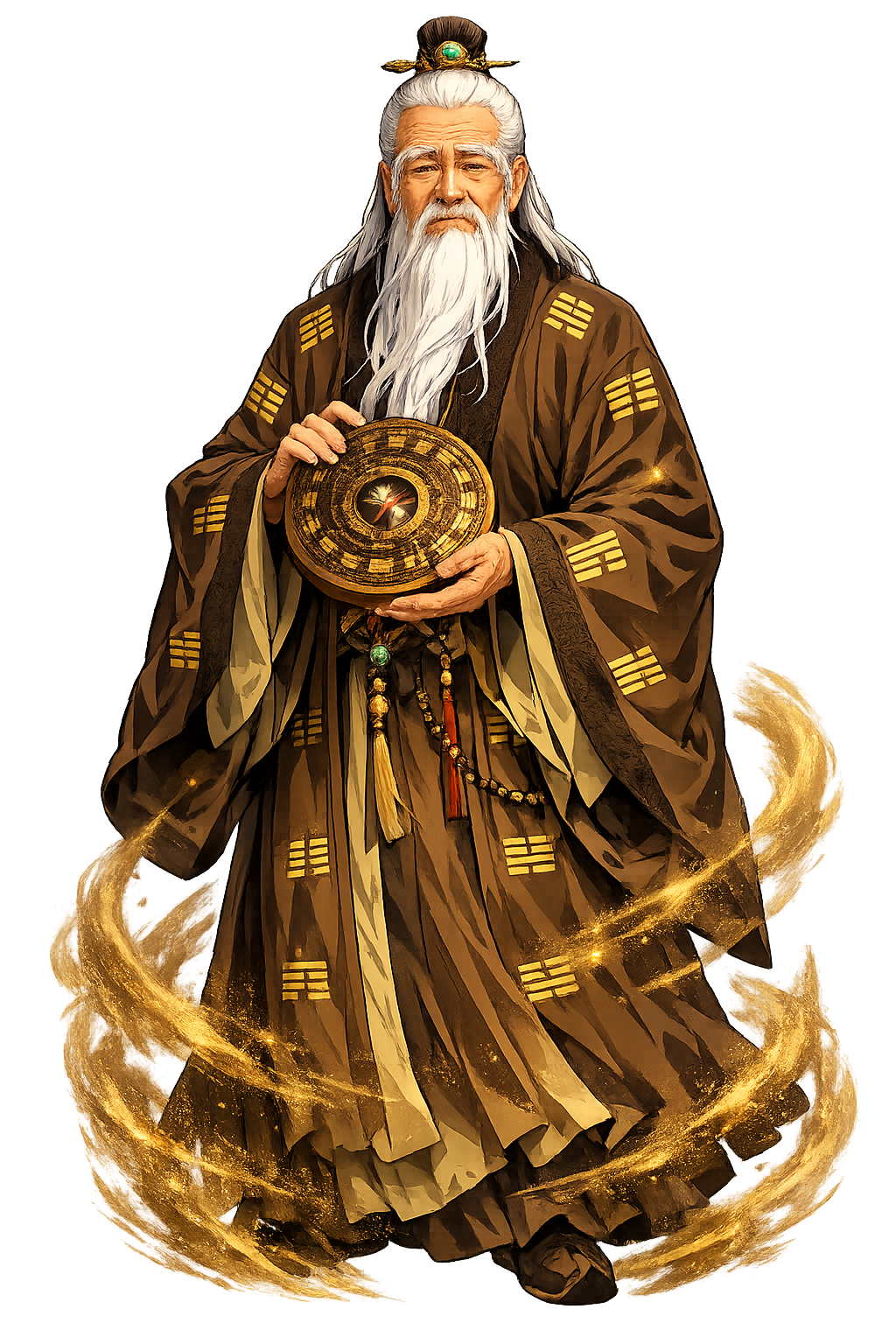
Stories of Bāguà
The Bāguà are surrounded by origin stories that credit culture heroes and sages with their discovery. Fuxi reads the patterns of the world; King Wen elaborates the Changes in a Shang prison; the sages of the Xici invent the book as they invented writing and agriculture — in answer to human need. Whether history, legend, or mythic shorthand, the stories agree on one thing: the eight trigrams are a key to cosmic order, perfected at great cost.
The oldest account of the trigrams' invention is not a story about a river monster but a sentence in the Xici zhuan (Appended Statements II): 'In ancient times, when Bao Xi (Fuxi) ruled the world, he looked up and contemplated the patterns of heaven, looked down and contemplated the patterns of earth; he observed the markings of birds and beasts and the adaptations of the land. Near at hand he took patterns from his own body, far off he took them from things — and so he created the eight trigrams to communicate with the virtue of the gods and to categorize the feelings of all things.' Later legend embroidered the contemplation into a marvel: a dragon-horse emerged from the Yellow River bearing the Hétú chart, and a divine turtle from the Luo bore the Luoshu writing, and from these the sage read the trigrams. The tradition itself (Xici I) preserves the kernel: 'The river produced the chart, the Luo produced the document; the sage modelled himself on them.' Either way, the claim is identical: the trigrams were not invented but noticed — the cosmos already written, waiting only to be read.
When King Wen of Zhou was imprisoned by the tyrant Zhòu of Shang — the tradition recorded by Sima Qian — he did not plot escape but divination: 'King Wen was imprisoned and elaborated the Zhōuyì' (Shiji 130). In captivity he doubled the eight trigrams into sixty-four hexagrams and wrote a statement for each, a one-line oracle distilled from the history and ethics of a people living under an oppressive dynasty. His son, the Duke of Zhou, is credited with the line statements, the judgements within each hexagram; Confucius or his school, centuries later, added the Ten Wings, turning a manual of milfoil divination into a philosophy of change. Sima Qian's sentence has carried enormous weight: it makes the Yijing literally a prison book, written by a condemned man mapping the one freedom no cell can close — the freedom to read the moment. The sequence of authorship — king, duke, sage — also quietly encodes the book's social range: ruler, minister, teacher.
The Xici appendix imagines human technology not as a fall but as a series of sages answering crises. When rule by knotted cords became inadequate, a later sage replaced them with written characters; before that, another sage taught agriculture when birds and beasts dwindled under bad kings. In the same passage, the author explains the Yijing's purpose: the sages made the eight trigrams and 'exposed the auspicious and inauspicious in them,' so that the people could meet each situation as it arose. Change (yi) is the one constant; the book exists because human beings need a grammar for situations that have never occurred before. This is why the Yijing never gives straight predictions — it gives structures for reflection. The myth of sage-invention dignifies the diviner: to consult the book is to join a long chain of sage problem-solvers, from Fuxi, who fished and hunted, through Shennong, who sowed, to King Wen, who suffered and saw.
In Chinese popular religion the eight trigrams descend from the scholar's desk to the lintel. The bāguà jìng — an octagonal mirror ringed with the trigrams around a taiji emblem at its centre — is hung above doorways across China and the diaspora to deflect harmful qi. A flat mirror confronts what comes straight; a concave mirror gathers and neutralizes; a convex mirror scatters 'poison arrows' from rooflines, sharp corners, and aggressive neighbours. Priests of the Daoist liturgical tradition also deploy the trigrams spatially: ritual registers assign each trigram a direction and a gate, and the complete octagonal arrangement claims the whole of space and time in a single emblem. The practice compresses the entire cosmology into household hardware — heaven, earth, thunder, wind, water, fire, mountain, and lake standing sentinel over a family's doorway. Whatever else it does, the mirror announces that the cosmos has a shape, and that a household can align itself with it.
Yijing Cosmology and Divination
Bāguà is the Chinese universe reduced to eight three-line figures. Each trigram — 乾 Qián, 坤 Kūn, 震 Zhèn, 巽 Xùn, 坎 Kǎn, 離 Lí, 艮 Gèn, 兌 Duì — stacks yin and yang lines in every possible combination of three, producing a complete symbolic alphabet for describing situations, forces, and transformations. From the trigrams come the sixty-four hexagrams of the Yijing, the oldest continuously used divination manual in the world.
Bāguà is not only a fortune-telling tool. It is a map of reality: directions, seasons, family roles, body parts, and moral qualities all attach to the eight figures.
A solid line is yang; a broken line is yin. Three lines yield 2³ = 8 trigrams, the elementary vocabulary of change.
Qián ☰, three solid lines, is heaven and creative power; Kūn ☷, three broken lines, is earth and receptive yielding.
The Later Heaven arrangement assigns each trigram to a direction, a season, and a domain of human life.
Yarrow stalks, coins, and milfoil turn trigrams into hexagrams, turning a question into a reading of timing and transformation.
From the original script to the living URL
八卦
The name in its original Chinese form. Bāguà (八卦) is attested in the source tradition — “Eight trigrams”. Its macron-length vowels carry the full phonetic and orthographic weight of the source tradition.
bagua
Reduced to plain bagua, the name loses everything that made it specific: macron-length vowels. What remains is an ASCII string that machines can parse but that no longer speaks with its original voice.
Bāguà
The Unicode restoration recovers what ASCII flattened. Bāguà restores macron-length vowels, returning the name to its original written dignity. The domain encodes to Punycode, but the browser displays the truth.
Bāguà.com → xn--bgu-cla6n.com
The non-ASCII characters in Bāguà are encoded while the ASCII remains visible. To the DNS, it is Punycode. To humanity, it is Bāguà.
Owned, ideal, and ASCII forms of Bāguà
Bāguà
Restores 八卦. The live temple domain — bāguà.com.
bagua
Flattens 八卦. The plain ASCII fallback — what DNS and legacy systems see.
How Bāguà was spoken
How Bāguà travels from ancient script to the modern URL
Chinese 八卦 Bāguà; from 八 bā “eight" + 卦 guà “trigram"; the eight trigrams of the Yijing.
Cosmology, Divination
The Unicode restoration Bāguà preserves the Mandarin tone mark; the ASCII form loses tone.
The lore you have read is the living myth. Extended Lore opens the scholarly vault beneath it: the cult and its material remains, a history of the image, the name after antiquity, a meditation on what the name still means, and the full scholarly apparatus — etymology, orthography, sources.
Enter Extended Lore