PuniCodex

Extended Lore

अवलोकितेश्वर Avalokiteśvara

Etymology · Orthography · Cult · Iconography · Reception · Sources

Tier 1 Avalokiteśvara.com
Avalokiteśvara — Compassion, Mercy, Bodhisattva
01

Quick Facts

Essential information about Avalokiteśvara, Compassion, Mercy, Bodhisattva

Original Scriptअवलोकितेश्वर
Unicode RestorationAvalokiteśvara
Reconstructed Pronunciation/ɐ.ʋɐ.loː.kɪ.teː.ɕʋɐ.ɾɐ/
PantheonBuddhist
DomainCompassion, Mercy, Bodhisattva
MeaningLord who looks down in compassion
ClassificationTier 1
Primary DomainAvalokiteśvara.com
Sacred SymbolsThe lotus, The vase of amrita, Thousand arms with an eye in each palm, Om Mani Padme Hum, The blue throat of Nīlakaṇṭha
02

Etymology & Word Family

From original script to Unicode restoration

Original Script अवलोकितेश्वर Avalokiteśvara — "Lord who looks down in compassion"
Unicode Restoration Avalokiteśvara Restored stress, length, and script
Modern ASCII avalokiteshvara Plain-ASCII fallback

Sanskrit Avalokiteśvara, from avalokita 'beheld, looked down upon' + īśvara 'lord'; the bodhisattva of compassion, source-form of Guānyīn and Kannon.

03

Unicode Character Breakdown

Character-by-character philological analysis

CharacterUnicodeNameBlockPhonetic Role
AU+0041Latin Capital Letter ABasic LatinSame, capitalized
vU+0076Latin Small Letter VBasic LatinSame
aU+0061Latin Small Letter ABasic LatinSame
lU+006CLatin Small Letter LBasic LatinSame
oU+006FLatin Small Letter OBasic LatinSame
kU+006BLatin Small Letter KBasic LatinSame
iU+0069Latin Small Letter IBasic LatinSame
tU+0074Latin Small Letter TBasic LatinSame
eU+0065Latin Small Letter EBasic LatinSame
śU+015BLatin Small Letter S with AcuteLatin Extended-AŚ: palatal sibilant, atomic letter (IAST ś)
—N/ADropped characterBuddhist orthographyNot written: sh digraph realized as single letter ś
vU+0076Latin Small Letter VBasic LatinSame
aU+0061Latin Small Letter ABasic LatinSame
rU+0072Latin Small Letter RBasic LatinSame
aU+0061Latin Small Letter ABasic LatinSame

The Tier 1 classification reflects how much of the original phonology this restoration preserves — stress and vowel length for Greek names, distinctive letters and diacritics for every other tradition.

04

Cult & Worship

How the sacred was kept — rites, sanctuaries, remains

The Cult

Avalokiteśvara's cult is practice before it is place. Its oldest stratum is textual: reciting the Lotus Sūtra's twenty-fifth chapter as a protective liturgy, a rite attested from early medieval China and still heard in East Asian temples, and copying the Great Compassion dhāraṇī for merit. The Kāraṇḍavyūha Sūtra added the six-syllable mantra — oṃ maṇi padme hūṃ — which in Tibet became the most recited formula on earth, turned by hand, wheel, and windmill. Sacred geography then claimed the name: Potalaka, his mountain home in Indian scripture, was identified in China by the ninth century with Mount Putuo off the Zhejiang coast, still the foremost Guanyin pilgrimage site, joined by Japan's Kannon temples and the circuits of thirty-three stations. Chinese communities marked his feast on the nineteenth day of the second lunar month. His votaries ranged from emperors commissioning thousand-armed icons to illiterate chanters whose entire liturgy was his name.

In the Earth

Avalokiteśvara enters art early and never leaves: the fifth- and sixth-century cave paintings at Ajanta give him some of his oldest monumental images, compassionate bodhisattvas looming over the chaitya halls. The Library Cave at Dunhuang (sealed c. 1000, opened 1900) yielded painted banners of Guanyin among the most exquisite Buddhist paintings surviving — several now in the British Museum and Musée Guimet. At Borobudur in Java the Śailendra dynasty carved Lokeśvara into the monument's galleries in the eighth and ninth centuries, and the Kathmandu valley's Licchavi-period inscriptions invoke him by name. From Gandhāra's earliest standing bodhisattvas to the colossal Song dynasty Guanyin at Dazu, his is the longest continuous iconographic career of any Buddhist figure.

05

Iconography

How Avalokiteśvara was imaged across the ages

The Image

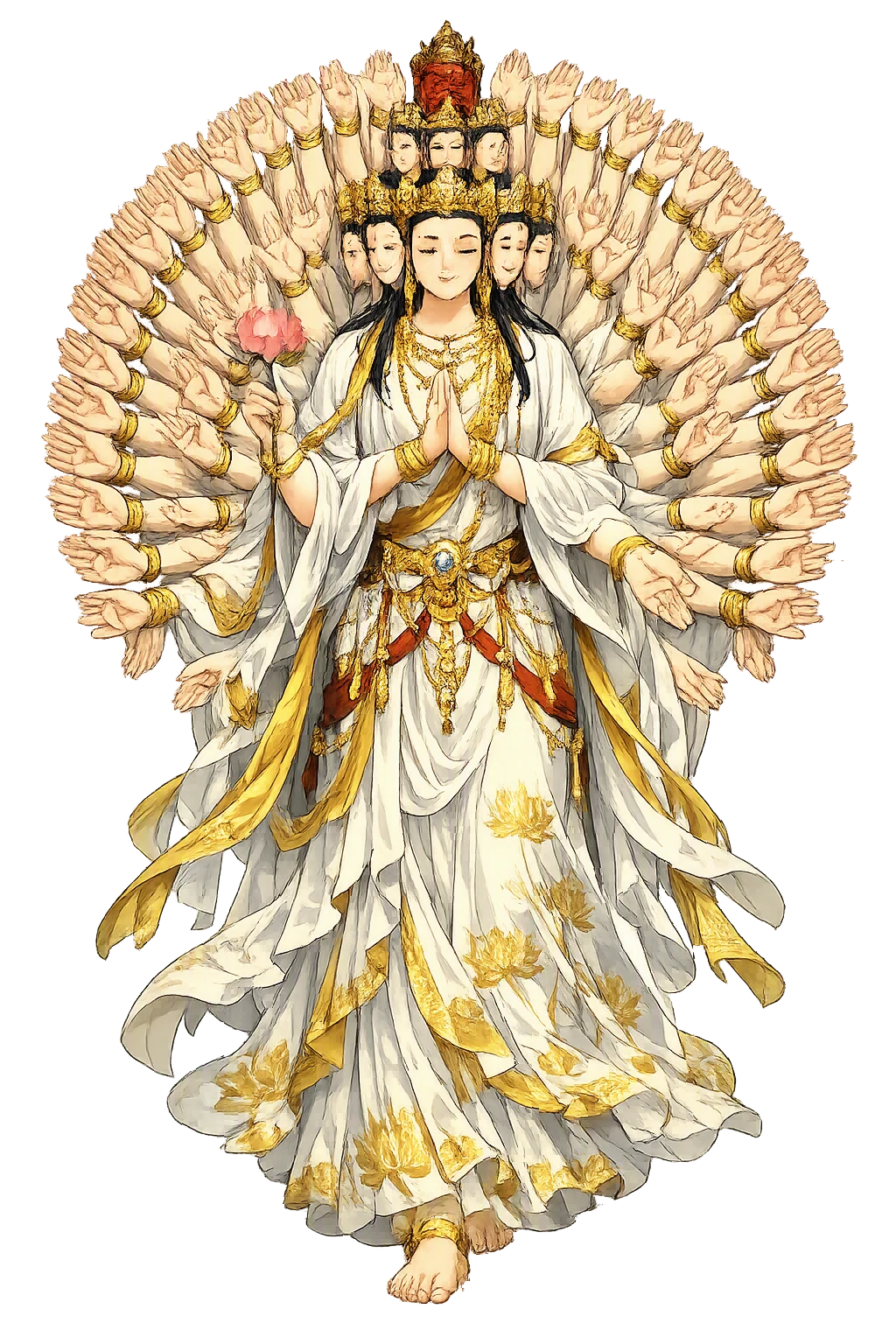
Learn the crown and you will never lose him: from roughly the Gupta period onward, a small image of Amitābha set into the headdress identifies Avalokiteśvara beyond argument, joined by the lotus he bears and the water-flask of compassion. The Indian types multiplied with the dhāraṇī sūtras of the seventh century — eleven heads stacked to survey all directions, then the thousand-armed form codified by the Great Compassion scripture, each palm opening with an eye so that seeing and saving are one motion. East Asia froze a different canon: the white-robed Guanyin, seated on a rocky ledge above the sea with a willow spray and a pure-water vase, perfected in Southern Song painting — Mu Xi's thirteenth-century White-Robed Guanyin, preserved at Daitoku-ji in Kyoto, is the type's supreme survival. Where India multiplied arms, China reduced him to stillness, water, and one lowered gaze.

06

Reception & Transformation

The name after its own age — transmission, translation, survival

Afterlives

His name traveled as fast as any in Buddhism. Kumārajīva's Chinese Lotus Sūtra (406 CE) recast him as Guanshiyin, 'Perceiver of the World's Sounds' — the translation that redirected the entire East Asian cult; Xuanzang's seventh-century versions, including the Heart Sūtra in which he instructs Śāriputra, fixed his scriptural authority. In Tibet the late-compiled Kāraṇḍavyūha Sūtra made his mantra a national practice and the origin myths made him an ancestor. Europe met him through philology: Eugène Burnouf's Introduction à l'histoire du Buddhisme indien (1844) and his French Lotus Sūtra (1852) presented Avalokiteçvara to Western scholarship just before the Dunhuang finds flooded museums with his images. Modern research has fussed productively over his very name — whether it parses as 'lord who looks down' or preserves the older form Avalokitasvara, 'the one who looks down upon sound.' No other bodhisattva carries so much of the tradition in a single compound.

Identifications Across Traditions

In China the lord became a lady: by the Song dynasty Guanyin was predominantly female, and her cult absorbed the island goddess Mazu and the water-and-child-bestowing Songzi Guanyin, so that the Indian bodhisattva now answers a grandmother's prayer in a Fujian dialect. Japan received Kannon, patron of the great thirty-three-temple pilgrimage circuits (Saigoku, Bandō, Chichibu) and of sacred sites like Kiyomizu, 'pure water,' where her spring still runs. Tibet made Chenrezig the patron deity of the land and the source of the Dalai Lama lineage, each holder revered as his emanation. And in seventh-century Java the Śailendra kings named themselves servants of Lokeśvara — Avalokiteśvara by his older title — carving him at Borobudur before the Sanskrit name had finished traveling. One bodhisattva, five civilizations, each certain he had been theirs all along.

Modern Legacy

Avalokiteśvara is, by nearly any measure, the most venerated bodhisattva on earth. His chapter of the Lotus Sūtra is chanted as a protective rite across East Asia; his mantra turns the prayer wheels of the entire Himalaya; and the Guanyin temples of the Chinese diaspora — from Putuo Island to San Francisco — count their visitors in the tens of millions. Japan's thirty-three Kannon pilgrimage circuits are walked today as they were in the Heian period. Modern culture keeps finding him: the Dalai Lama's name is Chenrezig's in translation, and the phrase 'compassion' in contemporary mindfulness and hospice movements is, knowingly or not, Avalokiteśvara's old gaze still lowered on the suffering.

07

The Meditation

What Avalokiteśvara means — beyond the dictionary

Avalokiteśvara begins with an embarrassing question for the rest of us: when did you last actually look at the person suffering next to you? His name is not a compliment but a job description — the Lord Who Looks Down — and his myths anatomize the looking: the gaze that scans crowds, that multiplies arms so no cry goes unanswered, that takes the sufferer's own form as the only form that will do. In this he is Buddhism's answer to a problem the philosophers struggled with: how compassion can be both boundless and particular. His solution is attention. He does not love humanity in general; he hears one drowning sailor, one prisoner, one frightened child, and the hearing is total. The Lotus Sūtra's promise that the name itself saves is the practical corollary: anyone can borrow the gaze by borrowing the name. To recite it is to practice looking until the looking becomes involuntary — until, like the eye in the palm, seeing and reaching are a single motion.

08

Frequently Asked Questions

Common questions about Avalokiteśvara, Compassion, Mercy, Bodhisattva, and Unicode restoration

01How do you pronounce Avalokiteśvara?

In reconstructed pronunciation, Avalokiteśvara is /ɐ.ʋɐ.loː.kɪ.teː.ɕʋɐ.ɾɐ/ — approximately 'uh-vuh-LOH-kee-TAY-shvuh-ruh' — the ś is the soft 'sh' of 'ship'; hold both long vowels; the name ends lightly.

02What does Avalokiteśvara mean?

Avalokiteśvara means Lord who looks down in compassion in the buddhist tradition.

03What are the symbols of Avalokiteśvara?

Avalokiteśvara is associated with The lotus (Purity rising unstained from the mud of samsara — the flower on which he stands above the world he refuses to leave), The vase of amrita (The nectar of compassion in his left hand, poured out drop by drop on the burning places of beings), Thousand arms with an eye in each palm (His vow rendered anatomically: a hand for every cry, an eye in every palm so that seeing and saving are one motion), Om Mani Padme Hum (The six-syllable mantra — 'the jewel in the lotus' — recited across Tibet, Mongolia, and the Himalaya for a thousand years), The blue throat of Nīlakaṇṭha (The wrathful form's throat stained blue from drinking the world's poison — compassion willing to take on even Śiva's darkest work).

04Why restore Avalokiteśvara in Unicode?

Plain ASCII avalokiteshvara strips the stress, length, and script that make the name specific. Unicode restoration returns the name to its original written dignity.

05What is the most important myth about Avalokiteśvara?

“The Lord Who Looks Down” — the The Name story that anchors the mythology of Avalokiteśvara, told in full on the lore page.

09

Scholarly Sources

The philological foundations of this restoration

Every claim on this page is grounded in established scholarship. The orthographic restorations follow disciplinary convention. The etymological chain follows the best available reference works. This is not invention — it is resurrection through scholarship.

◈

Lexicography & Philology

  • Lotus Sutra
  • Mahayana texts
◎

Primary Texts

  • The Larger Sukhāvatī-vyūha Sūtra; the Smaller Sukhāvatī-vyūha Sūtra; the Amitāyurdhyāna Sūtra; the Lotus Sūtra.
◉

Archaeology & Art History

  • Material evidence — iconography, inscriptions, and temple archaeology — for Avalokiteśvara and related cults.
✦

Religious Studies

  • Saddharma-puṇḍarīka Sūtra (Lotus Sūtra), ch. 25
  • Nīlakaṇṭha-dhāraṇī Sūtra (Xuanzang's translation)
  • Sūtra of the Great Compassionate One of a Thousand Hands and Eyes
  • Xiangshan baojuan (Precious Scroll of the Fragrant Mountain)
  • Mani bka' 'bum
  • Williams, Mahāyāna Buddhism
Return

The Surface Awaits

You have traced the name from its earliest attestation to its Unicode restoration. Now return to the myth. The story is where the name lives.

Back to Lore
Avalokiteśvara mascot