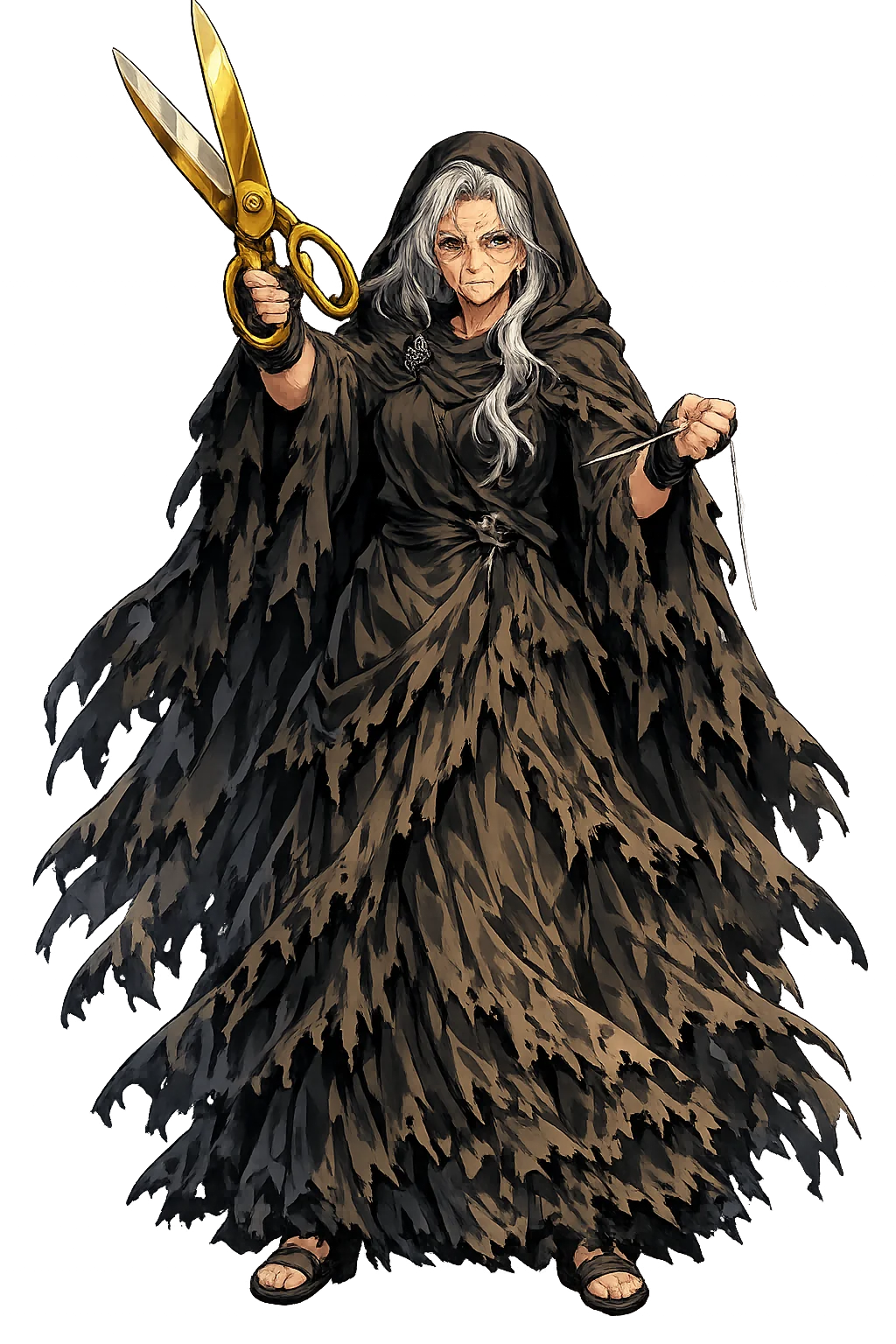
Stories of Átropos
Hesiod names her with her sisters in the Theogony: Klōthṓ, Láchesis, and Átropos, “who give mortals good and evil when they are born.” Of the three, she alone never appears as a character with dialogue — she is the act, not the actor. Her myths are therefore told at one remove: in a log of firewood, a spindle of adamant, and the single bargain the gods ever drove with Necessity herself.
Hesiod gives her two genealogies, and the doublet is the message. In the Theogony’s first account (217) the Moirai — Klōthṓ, Láchesis, and Átropos, “who give mortals good and evil when they are born” — are fatherless daughters of Nyx, Night, sisters of Death and Sleep: older than Zeus, bound to no one’s throne. In the second account (904–906) they are daughters of Zeús and Themis, Law, born after the Titanomachy to give ordinance to the assemblies of gods and men. Greek literature never reconciled the two pedigrees, because it never could: Homer has Zeus himself complain that Moira beside him has fixed what he would undo (Iliad 22.179), while Pindar and Aeschylus make even the immortals tread the path the Fates set. Átropos inherits both genealogies at once — necessity as the oldest thing in the universe, and necessity as Zeus’s own administration of it.
Seven days after Méleagros was born, the three sisters came to his mother Althaia in her chamber. Klōthṓ and Láchesis promised the child strength and daring; Átropos, pointing to the brand blazing on the hearth, pronounced that he would live only until it was wholly burned. Althaia snatched the log from the fire, quenched it, and hid it in a chest — and so the sentence hung suspended, for as long as wood keeps. Years later, when Méleagros killed his mother’s brothers in the quarrel over the Calydonian boar’s hide, grief turned Althaia vengeful: she drew the brand from its hiding place and fed it to the flames, and far away on the battlefield her son felt the fire take hold of his life. “By the threads of the Moirai and their implacable sister,” Ovid has him cry (Metamorphoses 8.451ff), the timetable written in firewood ran out. The myth gives the Fates a rare domestic form: destiny not as decree from heaven but as an object a grieving mother can hold in her hands.
At the end of Plato’s Republic, Er the Pamphylian tells of the meadow where souls choose their next lives, and of what lies beyond it. There stands Anánkē, Necessity herself, and her three daughters, the Moirai, “white-robed, with garlands on their heads,” seated on thrones around the spindle of heaven. Láchesis sings of the past, Klōthṓ of the present, Átropos of the future (Republic 617c–d) — and on the eight rings of the spindle the Sirens take up the song, one voice to each sphere, so that the whole cosmos turns to a single harmony. The daughters are not grudges of an old religion but the music of a machine: what was, what is, and what must be, sounded together on the same axis. To Plato’s generation, grown sceptical of ancestral gods, the spindle made necessity thinkable — and he gave the future its own voice. Her song is the last one: the one that cannot yet be argued with.
Apollo, sentenced to a mortal servitude, was bound to King Admetus of Pherae and served him so well that he won from the Fates a concession “not to be believed” (Apollodorus, Bibliotheca 1.9.15): Admetus would be released from death itself if, at his appointed hour, someone else freely consented to die in his place — a boon Hyginus says the god extracted by getting the grey sisters drunk (Fabulae 50). The king’s aged parents refused; his wife Alcestis agreed. Yet when Heracles came to visit and found the house in mourning, he wrestled Death at the grave and forced the release — and even the Fates’ exemption, the myth insists, could be out-wrestled at the boundary. This is the only surviving Greek myth in which the Moirai are successfully bargained with, and it reads like Apolline propaganda: the god of Delphi, their great rival in foreknowledge, can make even Necessity tipsy. Átropos’s economy survives the anecdote untouched, though — what was granted was a transfer, never a cancellation.
Fate, Necessity, and the Cut Thread
Átropos is the third of the three Moirai: Klōthṓ spins the thread, Láchesis measures it, and Átropos cuts it. Her name is a verdict — "she who cannot be turned aside" — and Greek literature treats her not as a villain but as the grammar of endings itself.
Her attribute from Hellenistic art onward: the blades that end the measured span.
In Plato's Republic she turns the future on the cosmic spindle her mother Anánkē holds.
The log whose burning measured a hero's life — her timetable written in firewood.
The alkaloid of deadly nightshade, Atropa belladonna, named for the cut she delivers.
From the original script to the living URL
Ἄτροπος
The name in its original Greek form. Átropos (Ἄτροπος) is attested in the source tradition — “Inflexible, inevitable”. Its acute accents carry the full phonetic and orthographic weight of the source tradition.
atropos
Reduced to plain atropos, the name loses everything that made it specific: acute accents. What remains is an ASCII string that machines can parse but that no longer speaks with its original voice.
Átropos
The Unicode restoration recovers what ASCII flattened. Átropos restores acute accents, returning the name to its original written dignity. The domain encodes to Punycode, but the browser displays the truth.
Átropos.com → xn--tropos-ota.com
The non-ASCII characters in Átropos are encoded while the ASCII remains visible. To the DNS, it is Punycode. To humanity, it is Átropos.
Owned, ideal, and ASCII forms of Átropos
Átropos
Restores Ἄτροπος. The live temple domain — átropos.com.
atropos
Flattens Ἄτροπος. The plain ASCII fallback — what DNS and legacy systems see.
How Átropos was spoken
How Átropos is preserved in writing
A bespoke provenance study for Átropos is being prepared by the PUNICODEX scholarly team.
Contribute scholarly provenance →The lore you have read is the living myth. Extended Lore opens the scholarly vault beneath it: the cult and its material remains, a history of the image, the name after antiquity, a meditation on what the name still means, and the full scholarly apparatus — etymology, orthography, sources.
Enter Extended Lore