The Living Myth
Bearer of the Heavens · The World-Bearer · Guardian of the Western Edge
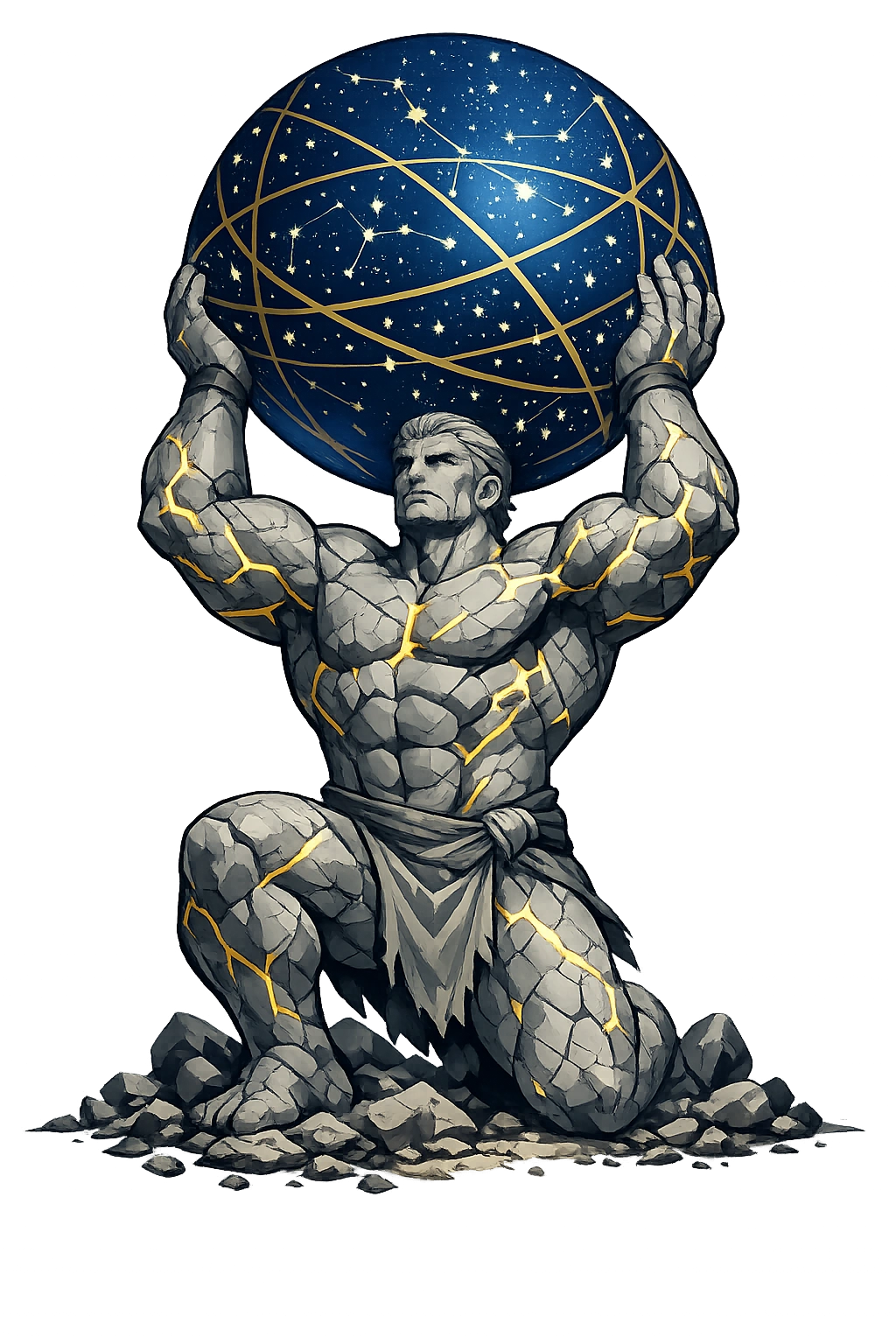
Stories of Átlas
Atlas belongs to the defeated generation of gods, yet his punishment became Greece's image of endurance itself: the rebel turned load-bearer, the edge of the world where sky meets sea. His myths are few — a war, a labor, a petrification — but they carry an entire cosmography, and a name the Renaissance would place on every book of maps.
Atlas fought on the Titans' side in the war against the Olympians, and when the war was lost the punishments were apportioned: most rebels went down to Tartarus, but Atlas received a perpetual assignment — to hold the sky itself (Hesiod, Theogony 744-750). Homer already knows him there: in the Odyssey (1.52-54) Atlas 'knows all the depths of the sea, and holds the tall pillars which keep earth and sky apart,' a figure at the western edge of the world, near the isle where the nymph Calypso dwells. Later tradition pictures the labor as conscious, unceasing, and utterly solitary — the one punishment Zeus could not delegate to a pit. The sentence is a kind of inverted mercy: not thrown beneath the world like the other defeated, but made into its load-bearing wall. The rebel is converted into infrastructure, and the cosmos rests on his endurance whether anyone watches or not.
One of Herakles' labors was to fetch the golden apples from the garden of the Hesperides — daughters of Atlas at the world's western rim (Apollodorus, Library 2.5.11). Herakles offered to hold the sky while Atlas fetched the fruit, or, in Diodorus' variant (4.26.2-3), Atlas proposed the exchange himself. The famous moment of cunning follows: Atlas returns with the apples and offers to deliver them to Eurystheus personally, clearly intending never to resume the burden; Herakles pretends to agree, asks only to be eased for a moment — 'let me put a pad on my shoulders first,' he says — and walks away. In some accounts he leaves the Pillars standing as permanent props. The myth turns brute endurance over to intelligence: the strongest mortal survives by out-thinking the strongest Titan, and the sky learns to rest on columns instead of a conscience.
Later tradition gave Atlas a stone ending. When Perseus flew past on his way home with the Gorgon's head, he asked the Titan for rest and hospitality; Atlas, remembering an oracle that a son of Zeus would one day rob him of his golden apples, refused and tried to drive the hero off (Ovid, Metamorphoses 4.627-662; Hyginus, Fabulae 150). Perseus did not draw his sword — he turned his face away and held up the head of Medusa, and Atlas 'became a mountain; his hair and beard became woods, his shoulders and hands ridges, his head the summit.' The Atlas range of North Africa was read as his petrified body, and heaven, the poets said, still rests on its ridge-line. The myth closes his story with the very immobility he was condemned to: hospitality refused at the edge of the world becomes landscape, and the guest he turned away becomes the constellation beside him.
Greek historians tried to give Atlas a biography. Diodorus Siculus (3.60.1-3) reports that the Atlantians honored a wise king Atlas — son of a local Uranus — who was the first to discourse on the celestial sphere, 'which is why the myth,' he writes, 'shows him bearing the heavens on his shoulders'; his daughters, named Hesperides, inherited the royal garden at the world's edge. The genealogy is already Hesiodic in its confusion: the Hesperides 'with the fair golden apples' are daughters of Night in the Theogony (215), but the Hesiodic Catalogue made them Atlas's own daughters. Diodorus' rationalizing is not idle antiquarianism: it preserves the intuition that star-knowledge and world-bearing are the same metaphor — to hold the sky is to know it. The Titan's punishment and his wisdom turn out to be one image seen from two sides, and both sides point west.
Strength, Endurance, Astronomy, and the Western Edge
Átlas is the Titan who holds up the sky. He is not a villain but a defeated rebel, condemned to bear the celestial sphere on his shoulders for eternity. His endurance becomes a kind of heroism: he does not triumph, but he does not collapse.
He holds the sky aloft on its pillars, keeping heaven and earth apart so that the cosmos can exist (Homer, Odyssey 1.52-54).
His punishment is eternal labor, singled out from the Titans cast into Tartarus — forced usefulness instead of oblivion (Hesiod, Theogony 744-750).
Diodorus makes him the first to discourse on the celestial sphere; his daughters the Hesperides tend the garden of the western sky (3.60.1-3).
He stands at the edge of the known world, where the Pillars still bear his name and the sun goes down (Herodotus 4.42).
From the original script to the living URL
Ἄτλας
The name in its original Greek form. Átlas (Ἄτλας) is attested in the source tradition — “Enduring, suffering (from τλάω)”. Its acute accents carry the full phonetic and orthographic weight of the source tradition.
atlas
Reduced to plain atlas, the name loses everything that made it specific: acute accents. What remains is an ASCII string that machines can parse but that no longer speaks with its original voice.
Átlas
The Unicode restoration recovers what ASCII flattened. Átlas restores acute accents, returning the name to its original written dignity. The domain encodes to Punycode, but the browser displays the truth.
Átlas.com → xn--tlas-4na.com
The non-ASCII characters in Átlas are encoded while the ASCII remains visible. To the DNS, it is Punycode. To humanity, it is Átlas.
Owned, ideal, and ASCII forms of Átlas
Átlas
Restores Ἄτλας. The live temple domain — átlas.com.
atlas
Flattens Ἄτλας. The plain ASCII fallback — what DNS and legacy systems see.
How Átlas was spoken
How Átlas travels from ancient script to the modern URL
Greek Ἄτλας; from τλάω “to endure, suffer"; the Titan who holds up the heavens.
Bearer of the Heavens
The Unicode restoration Átlas preserves Greek stress and length; the ASCII form atlas loses these features.
The lore you have read is the living myth. Extended Lore opens the scholarly vault beneath it: the cult and its material remains, a history of the image, the name after antiquity, a meditation on what the name still means, and the full scholarly apparatus — etymology, orthography, sources.
Enter Extended Lore