
The register rules: Athēnai
Evidence dossier 064 — Athēnai. Every exhibit catalogued, every ruling stated with its grounds.
At a Glance
- Canonical form: Athēnai
- Original script: Ἀθῆναι
- Pantheon: Greek-location
- Convention: the tradition’s own scholarly transliteration standard
- False forms on record: 2
- Contested forms: none attested
- Series: The Canonical Register, No. 64 of 546
The Evidence
Exhibit 1 — the attestation. The name is attested as Ἀθῆναι, on the evidence Apollodorus, Bibliotheca 3.14–3.15 and Herodotus, Histories 8.55 set down. On the evidence, it means "Of Athena". The canonical transliteration is Athēnai.
Exhibit 2 — the preserved marks. e → ē (Eta: long epsilon). Each is verifiable against the sources named in the attestation.
Exhibit 3 — the flattened form. The plain form athenai is not false — it is a fallback, and the register is exact about what that means. In systems that cannot carry diacritics (legacy databases, older tooling, parts of the address-bar pipeline) the flattened form is the accepted vehicle, and the rulebook names it explicitly as the final rung of the fallback hierarchy: full restoration first, circumflex where attested, macron-only by the academic standard, an attested variant, and only then plain ASCII.
What the fallback status forbids is promotion: athenai may carry the name where marks are impossible, but it may not represent the name where marks are possible. Every mark it drops — e → ē — is a fact the sources recorded. A fallback is a vehicle, never the primary.
Exhibit 4 — struck from the record: Athenai. Origin: the publisher compromise — older books and hurried websites that print the "English equivalent" as if it were the name itself. Grounds: every substitution here (ē→e) is a romanization of convenience, not an attested spelling — it teaches the reader to guess, not to read.
Exhibit 5 — struck from the record: atenai. Origin: the anglicized respelling — the name written the way English guesses it sounds. Grounds: rewrites attested consonant clusters to fit English spelling habits; every cluster simplified this way erases a letter the sources write.
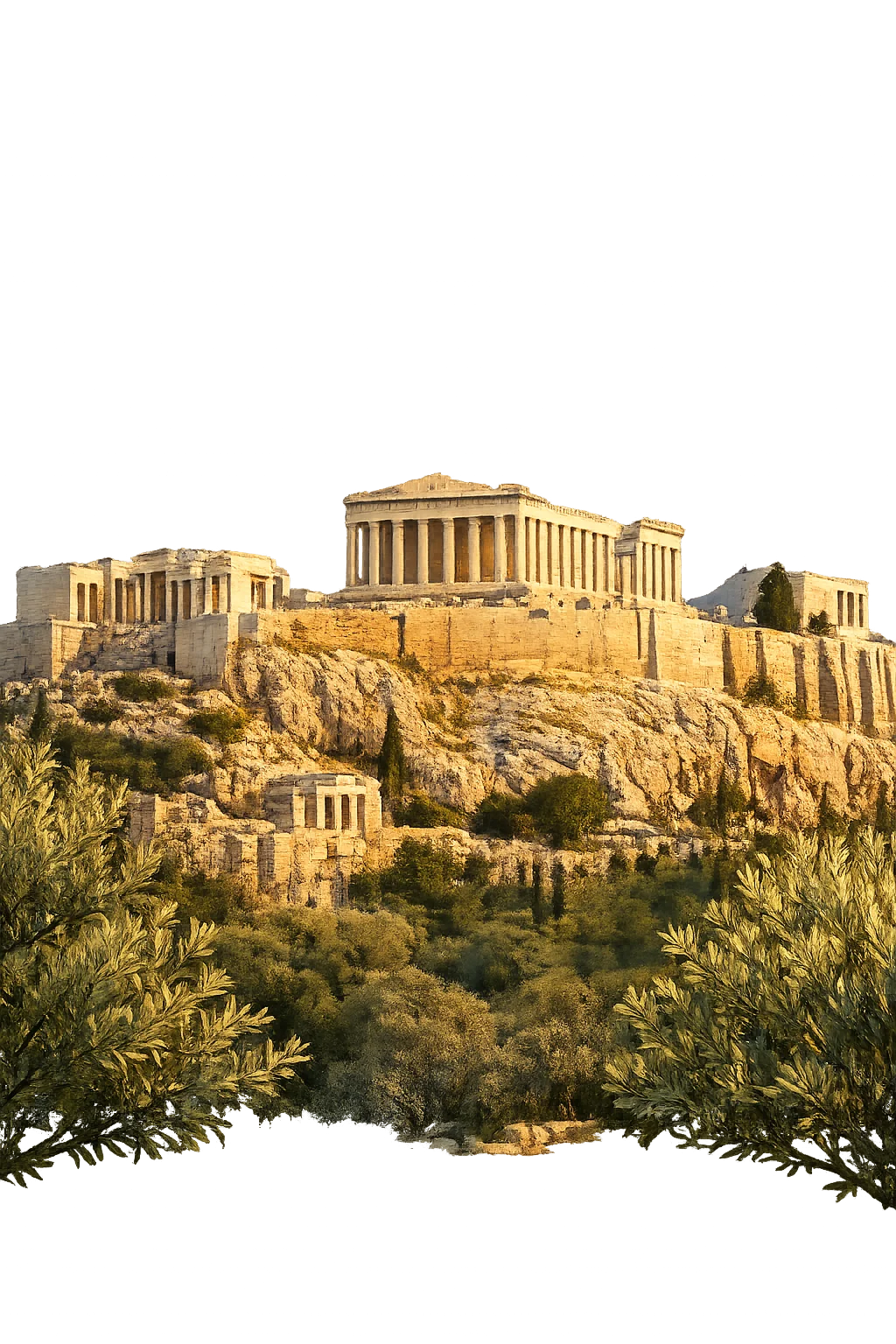
Exhibit 6 — the physical record. The Athenian Acropolis has yielded Mycenaean palace remains, Archaic korai, and the Periclean building program documented by the Acropolis Restoration Service. The Agora excavations of the American School of Classical Studies uncovered the Stoa of Attalos, the Bouleuterion, and the Tholos. Kerameikos preserves the Dipylon Gate and Demosion Sema, while the Long Walls and Piraeus harbor installations trace the city's maritime infrastructure.
Exhibit 7 — the continuing record. Few city-names carry as much ideological weight as Athēnai. The city's invented traditions — democracy, tragedy, philosophy, rhetoric, and the ideal of the citizen — became the common property of later Europe and the Americas.
The Convention's Own History
Every tradition in this register has its own scholarly transliteration standard, built by its own specialists over decades or centuries, and the register follows each on its own terms: the tradition’s own standard. The principle that unifies them is the one the whole project stands on: a name is evidence, and evidence is not negotiable — not for keyboards, not for convenience, not for anyone.
The Protocol's Position
Can the canonical form live in the address bar? Almost always, yes. IDNA 2008 admits every mark this register defends — the DNS stores them as `xn--` punycode and modern browsers render them natively. The real frictions are practical, not legal: some registrars stock only part of the IDN space, so a theoretically valid name can be temporarily unbuyable; and stacked combinations (an acute riding a macron) remain awkward to type on mobile keyboards even where the protocol accepts them.
The project's answer is a ranked ladder, not a compromise: the full restoration first, then attested fallbacks in descending order of completeness. The ladder's lowest rung, plain ASCII, is a vehicle for legacy systems — sanctioned, but never presented as the scholarly form.
The Verdict
Case closed on Athēnai: canonical, cited, and defended. The keyboard form athenai rides as the sanctioned fallback — and stays in that lane. The register's files remain open: if a source surfaces that changes any line of this entry, the entry changes. Until then, the temple at /athenai/ holds the canonical form.
The docket for this ruling: 2 false forms ruled against, Athenai first on the docket; 1 preserved mark verified: e → ē; no contested forms attested; the attestation rests on 6 cited sources — Apollodorus, Bibliotheca 3.14–3.15, Herodotus, Histories 8.55, Thucydides, Histories 2.15, 2.36.
The Register Continues
Entry 64 of 546 in the Canonical Register. Around it: the temple's founding dispatch, the Restoration File on the marks themselves, the Resonance File on the archetype at work, and the Rulebook behind all of it.
Continue the register — previous entry: Athēnâ (read it) · next entry: ʾAṯiratu (read it).
The Canonical Register is written from the same canonical record as the lexicon itself. If a false form is missing from this page, it is because the evidence does not support calling it false — or because we have not seen it yet. Show us, with a citation, and the register will answer.