PuniCodex

Extended Lore

𒀭𒀸𒋩 Aššur

Etymology · Orthography · Cult · Iconography · Reception · Sources

Tier 1 Aššur.com
Aššur — War, Kingship, Assyrian Patron
01

Quick Facts

Essential information about Aššur, War, Kingship, Assyrian Patron

Original Script𒀭𒀸𒋩
Unicode RestorationAššur
Reconstructed Pronunciation/aʃˈʃuːr/
PantheonMesopotamian
DomainWar, Kingship, Assyrian Patron
MeaningNational god of Assyria (Akkadian Aššur)
ClassificationTier 1
Primary DomainAššur.com
Sacred SymbolsWinged sun disc with archer, Horned crown, Bow and arrow, Triangle or mountain, Lightning and storm
02

Etymology & Word Family

From original script to Unicode restoration

Original Script 𒀭𒀸𒋩 Aššur — "National god of Assyria (Akkadian Aššur)"
Unicode Restoration Aššur Restored stress, length, and script
Modern ASCII ashur Plain-ASCII fallback

The name Aššur carries the orthographic signature of the mesopotamian tradition: 𒀭𒀸𒋩. Unicode restoration recovers what ASCII flattens.

03

Unicode Character Breakdown

Character-by-character philological analysis

CharacterUnicodeNameBlockPhonetic Role
AU+0041Latin Capital Letter ABasic LatinSame
šU+0161Latin Small Letter S with CaronLatin Extended-AS-caron: voiceless postalveolar /ʃ/
šU+0161Latin Small Letter S with CaronLatin Extended-AS-caron: doubled consonant
uU+0075Latin Small Letter UBasic LatinSame
rU+0072Latin Small Letter RBasic LatinSame

The Tier 1 classification reflects how much of the original phonology this restoration preserves — stress and vowel length for Greek names, distinctive letters and diacritics for every other tradition.

04

Cult & Worship

How the sacred was kept — rites, sanctuaries, remains

The Cult

Aššur's cult was the state at prayer. His temple crowned the citadel of his own city, Assur on the Tigris — Qal'at Sherqat — rebuilt by nearly every great king from Shalmaneser I to Ashurbanipal; Tukulti-Ninurta I built him a second house in the new royal city Kar-Tukulti-Ninurta across the river, and booty from every campaign flowed into the treasury as the tithe of empire. Daily offerings were maintained by prebendaries, a high priest — the šangû — stood at the god's head, and a ritual text from Assur prescribes the coronation in which the king stands before the divine statue to receive his regalia. From Sennacherib's reign the Babylonian New Year festival, the akitu, was celebrated for Aššur at a festival house outside the walls — the national god newly enthroned at the year's turning, and the king present as his steward.

In the Earth

Aššur's primary cult center was the city of Assur (modern Qal'at Sherqat) on the Tigris, where German, Iraqi, and international teams excavated the Aššur temple, its ziggurat, and the surrounding palace and residential quarters. Royal inscriptions from Assur, Nimrud, Khorsabad, and Nineveh document repeated rebuilding of the temple and the deposition of booty. The wall reliefs of Neo-Assyrian palaces — lions, sieges, tribute processions — are visual propaganda of Aššur's empire. Foundation tablets, royal annals, and prism inscriptions from Nineveh's library preserve the theological claims that made Assyria a sacred project.

05

Iconography

How Aššur was imaged across the ages

The Image

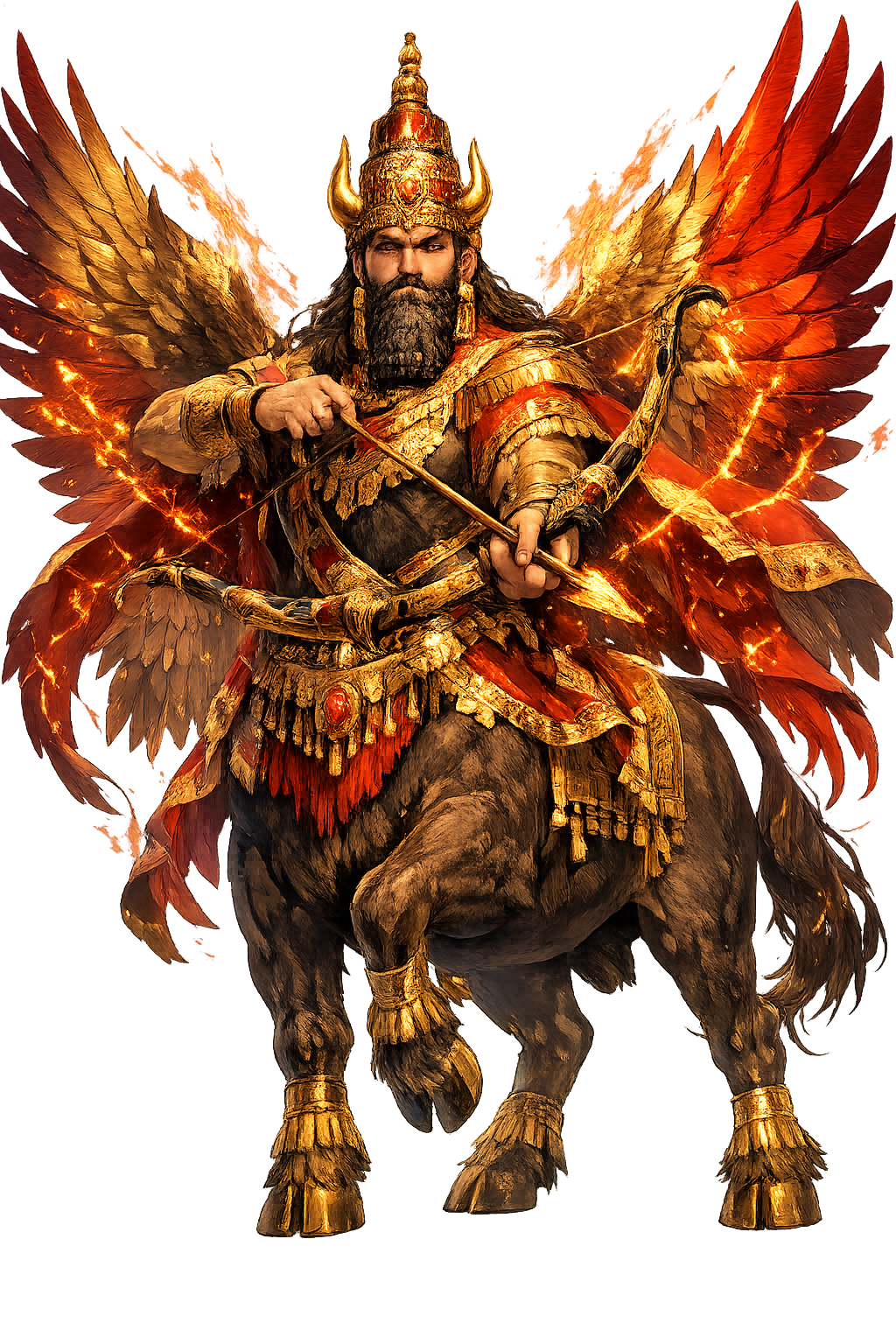
Aššur was present everywhere and almost never shown. Official art preferred the emblem: the winged sun-disc that hovers above the king and the sacred tree on palace reliefs, sometimes with the god inside the orb as a small archer drawing his bow — a reading familiar from Middle Assyrian seal impressions. Fully anthropomorphic images were rare enough to be remarked on: the cult statue stood in the cella, while divine symbols did public duty on stelae. The Zincirli stela of Esarhaddon, now in Berlin, sets the horned crown of Aššur on a pedestal between the winged disc of Shamash and the crescent of Sin, theology arranged as heraldry. The restraint was deliberate: a god identical with the land and its sky was more plausibly present as light over everything than as one more body in the crowd of statues.

06

Reception & Transformation

The name after its own age — transmission, translation, survival

Afterlives

The fall of Nineveh in 612 BCE ended the cult but not the name. As a theonym Aššur faded into 'Assyria' — in the Hebrew Bible, in Herodotus' Assyrian logoi — while as a people the name outlasted the theology, passing into the Aramaic-speaking Assyrian communities of late antiquity and, remarkably, into the self-designation of the Syriac churches. The god himself slept under the mounds until the Deutsche Orient-Gesellschaft excavations of 1903–1914, directed by Walter Andrae, opened the ziggurat and the long sequence of temple rebuildings at Assur, reading three millennia of royal piety in its foundation courses. Assyriology then rebuilt the theology from texts: the Assyrian recension of the Enuma Eliš with Aššur in Marduk's role, the coronation ritual, the annals that open every campaign with his name. His city is now a UNESCO World Heritage site, inscribed in 2003 and on the danger list since; no other Mesopotamian national god kept a people, a church, and an archaeology.

Identifications Across Traditions

The Assyrians identified Aššur with the Sumerian sky-god Anšar (written AN.ŠAR₂, a Sumerian logogram read as Aššur) and, more influentially, with Enlīl, the old Sumerian king of the gods. By the Neo-Assyrian period, royal inscriptions often call Aššur 'Aššur-Enlil,' granting him the storm-wind, the Ekur's authority, and the Tablet of Destinies. This was partly a theological strategy to outrank Babylon's Marduk: if Aššur absorbs Enlīl's cosmic kingship, then the Assyrian king legitimately rules over Babylon. Some scholars have also compared Aššur to Canaanite Ēl because both are paternal high gods tied to a national identity, though the connection remains debated. In later periods, after the fall of Assyria, Aššur survived as a name for the land and people rather than as an active cult.

Modern Legacy

Aššur did not vanish when Nineveh fell in 612 BCE; he became a name. The land of Assyria, the Aramaic-speaking Assyrians, and eventually the Christian Assyrian communities preserved the identity while transforming its theology. Modern Assyrian nationalism, Syriac Christianity, and the memory of ancient empires all orbit the old divine name. In popular culture, 'Assyria' evokes lion hunts, winged bulls, and relentless armies — a legacy Aššur would have recognized and approved, since his power was always visible in the might of the state.

07

The Meditation

What Aššur means — beyond the dictionary

Aššur is the most political of gods because he is a polity. Other deities have temples; Aššur had an empire. Other gods grant kingship; Aššur granted nationhood. The boundary between worship and statecraft was not blurred in Assyria — it was erased by design. The king was priest, the army was congregation, and the annual campaign was pilgrimage.

This makes Aššur uncomfortable to the modern imagination, which likes to separate religion from nationalism. Yet he is also brutally honest: he names the sacral dimension that empires have always claimed, whether they invoke a sun-god, a tribal ancestor, or a modern ideology. Aššur forces us to ask what happens when a people identifies its highest value with its collective power.

To pronounce Aššur — with that doubled, held š — is to feel the pressure of a name that wants to be a place, a people, and a destiny all at once. He is the god who does not travel as a missionary; he travels as an army. And when the army stopped, the name kept marching through history under new banners.

08

Frequently Asked Questions

Common questions about Aššur, War, Kingship, Assyrian Patron, and Unicode restoration

01How do you pronounce Aššur?

In reconstructed pronunciation, Aššur is /aʃˈʃuːr/ — approximately 'ahsh-SHOOR' — start with 'ahsh,' hold the sh slightly, then draw out the 'oor'.

02What does Aššur mean?

Aššur means National god of Assyria (Akkadian Aššur) in the mesopotamian tradition.

03What are the symbols of Aššur?

Aššur is associated with Winged sun disc with archer (The Assyrian adaptation of the solar disc, sometimes showing Aššur as a bowman within the winged orb), Horned crown (The tiered crown of divine kingship, marking him as supreme among the gods), Bow and arrow (The weapons of the divine warrior-king; Assyrian armies fought under his archery), Triangle or mountain (The stylized mountain of Assur and the cosmic peak on which his temple stood), Lightning and storm (His assimilation to Enlīl brought the storm-wind and thunderbolt into his iconography).

04Why restore Aššur in Unicode?

Plain ASCII ashur strips the stress, length, and script that make the name specific. Unicode restoration returns the name to its original written dignity.

05What is the most important myth about Aššur?

“Aššur and the Enuma Eliš” — the Cosmogony story that anchors the mythology of Aššur, told in full on the lore page.

09

Scholarly Sources

The philological foundations of this restoration

Every claim on this page is grounded in established scholarship. The orthographic restorations follow disciplinary convention. The etymological chain follows the best available reference works. This is not invention — it is resurrection through scholarship.

◈

Lexicography & Philology

  • CAD
  • AHw
◎

Primary Texts

  • Hebrew Bible, Genesis 10:11; 2 Kings 18–19; Isaiah 36–37
◉

Archaeology & Art History

  • George, House Most High: The Temples of Ancient Mesopotamia
  • Royal Inscriptions of Mesopotamia, Assyrian Periods (RIMA)
✦

Religious Studies

  • Chicago Assyrian Dictionary (CAD), Aššur
  • Black & Green, Gods, Demons and Symbols of Ancient Mesopotamia
  • Pongratz-Leisten, Religion and Ideology in Assyria
  • Frahm, Assyria: The Rise and Fall of the World's First Empire
  • Enuma Eliš, Assyrian recension
  • Annals of Sennacherib (Rassam Cylinder)
Return

The Surface Awaits

You have traced the name from its earliest attestation to its Unicode restoration. Now return to the myth. The story is where the name lives.

Back to Lore
Aššur mascot