The Living Myth
War, Kingship, Assyrian Patron · The God of the Assyrian Spear
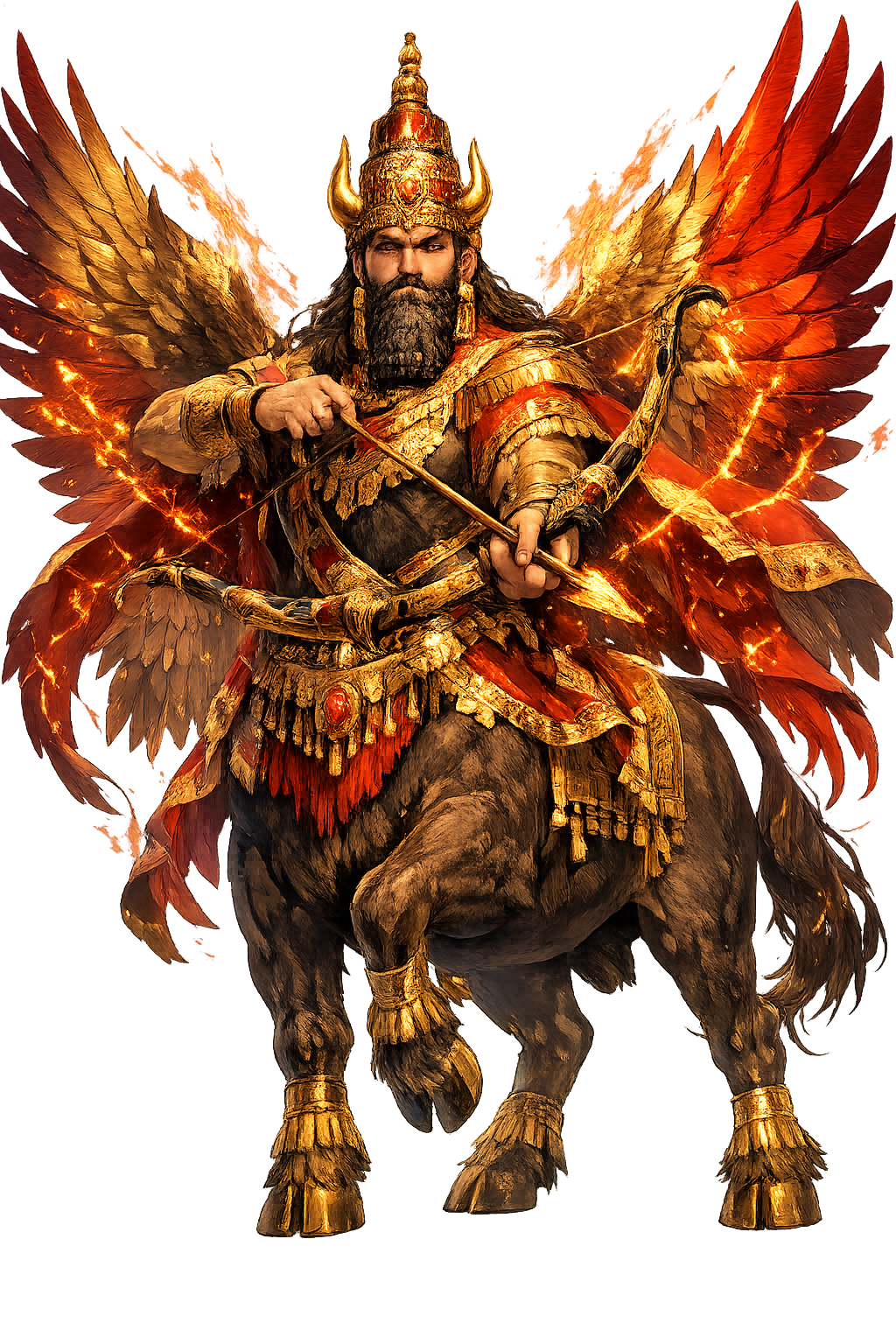
Stories of Aššur
Aššur's mythology is inseparable from Assyrian royal ideology. The king is his vicar; the empire is his estate; the annual campaign is an act of worship. The stories are told not in narrative epics but in royal inscriptions, temple hymns, and the state theology of a nation at war.
Assyrian scribes did to Babylon's epic what their kings did to Babylon's cities: they annexed it. Copies of the Enuma Eliš from Assur and Nineveh substitute Aššur for Marduk in the central role: it is Aššur who confronts Tiamat, who splits her body to make heaven and earth, who receives the fifty names of power and the Tablet of Destinies. The redaction survives on tablets found in the temple libraries of Assur and in Ashurbanipal's Nineveh collection, and its theology is stated as plainly as a land deed — the creator of the cosmos is the god of Assyria, therefore the king of Assyria rules by creation's own mandate. Modern scholarship (Pongratz-Leisten, Religion and Ideology in Assyria) reads the text as state theology at full volume: the hymn that Babylon sang to Marduk, Assyria re-sang with the national god's name in every line. The myth means that for Assyria cosmology was foreign policy — to rewrite the creation was to redraw the world's borders.
Every Assyrian royal inscription opens the same way: the king is Aššur's steward, given strength and trust — the formula runs ina tukulti Aššur, 'with the trust of Aššur' — to rule the god's estate. The royal annals collected in RIMA show what the estate meant: the god owned the land of Aššur, and rebellion anywhere was trespass on his property. Campaigns were audits. The king toured the god's holdings, punished defaulting vassals, and delivered the tribute to the temple treasury at Assur, as Esarhaddon's and Ashurbanipal's inscriptions describe in numbing, repeated detail. Victory proved the god's order; defeat, when it came, demanded theological repair. The king wore the god's authority in his regnal titulary and reported to heaven like a manager to a board. The ideology means that Assyrian imperialism had no secular corner: the tax register and the cult ledger were, by design, the same document.
Sennacherib's third campaign (701 BCE) against the rebellious west survives in his annals (the Rassam Cylinder) as a report filed with heaven. The account opens with the god's authority — the campaign is waged 'with the trust of Aššur' — and itemizes the march down the Levant: the storming of Lachish, commemorated in the great relief cycle of the Southwest Palace at Nineveh, and the blockade of Jerusalem, where Hezekiah, Sennacherib boasts, was shut up 'like a bird in a cage.' The biblical counter-account (2 Kings 18–19) remembers the same campaign and credits an angel, not Aššur — one war, two incompatible theologies of victory. Whether every claim is exact, the inscriptions show how tightly war, piety, and propaganda were woven: the annal is at once a military record and a temple offering. The myth means that for Assyria, conquest was liturgy, and the battle report was a form of prayer.
The Aššur temple at Assur was rebuilt by almost every great king from Shamshi-Adad I (c. 1800 BCE) onward, and Tukulti-Ninurta I even carried the statue of Marduk away from Babylon to his god's city in 1225 BCE. The boldest act, though, was Sennacherib's: he demolished the ancient temple entirely and raised in its place the Ešarra — 'House of the Universe' — a cosmic diagram in brick and cedar (George, House Most High, s.v. ēšarra). His building inscriptions answer, point by point, the priests' alarm at destroying the god's old house: the god himself, Sennacherib claims, commanded it, and the new temple surpassed the old as heaven surpasses earth. Gold, silver, and bronze flowed into the casting of its fittings; cedar became its doors. The project means that Assyrian religion could be as aggressive as its army — the holiest house in the land rebuilt as an act of imperial self-assertion, with the god's blessing solicited and, conveniently, received.
War, Kingship, Heaven
Aššur is the god who is the nation. His name is identical with the city of Assur, the land of Assyria, and the people who called themselves after both. Unlike Enlīl, whose cosmic kingship was rooted in the air and the Ekur, Aššur's sovereignty travels with the Assyrian army. He is the divine king-maker, the patron of archers and chariots, and the heavenly father who receives the king's report after every campaign.
Assyria itself is his body; to worship Aššur is to belong to the land and its king.
The king fights as Aššur's steward; victory in battle is proof of divine favor and cosmic order.
Identified with Enlīl and Anšar, Aššur becomes the summit of the Mesopotamian pantheon in Assyrian theology.
His house at Assur was rebuilt by every major king; tribute, booty, and prisoners flowed into its treasury.
From the original script to the living URL
𒀭𒀸𒋩
The name in its original Mesopotamian form. Aššur (𒀭𒀸𒋩) is attested in the source tradition — “National god of Assyria (Akkadian Aššur)”. Its original diacritics and script distinctions carry the full phonetic and orthographic weight of the source tradition.
ashur
Reduced to plain ashur, the name loses everything that made it specific: original diacritics and script distinctions. What remains is an ASCII string that machines can parse but that no longer speaks with its original voice.
Aššur
The Unicode restoration recovers what ASCII flattened. Aššur restores original diacritics and script distinctions, returning the name to its original written dignity. The domain encodes to Punycode, but the browser displays the truth.
Aššur.com → xn--aur-0zaa.com
The non-ASCII characters in Aššur are encoded while the ASCII remains visible. To the DNS, it is Punycode. To humanity, it is Aššur.
Owned, ideal, and ASCII forms of Aššur
Aššur
Restores 𒀭𒀸𒋩. The live temple domain — aššur.com.
ashur
Flattens 𒀭𒀸𒋩. The plain ASCII fallback — what DNS and legacy systems see.
How Aššur was spoken
How Aššur travels from ancient script to the modern URL
The name of the Assyrian national god is identical with the city Aššur and probably means “the leading one" or is derived from a mountain/sanctuary name; the god and city were mutually identified.
War, Kingship, Assyrian Patron
The Unicode restoration Aššur preserves vowel length; the cuneiform form is not registrable in .com.
The lore you have read is the living myth. Extended Lore opens the scholarly vault beneath it: the cult and its material remains, a history of the image, the name after antiquity, a meditation on what the name still means, and the full scholarly apparatus — etymology, orthography, sources.
Enter Extended Lore