The Living Myth
Mother Goddess, Lady of the Sea · She Who Treads the Sea · Mother of the Gods
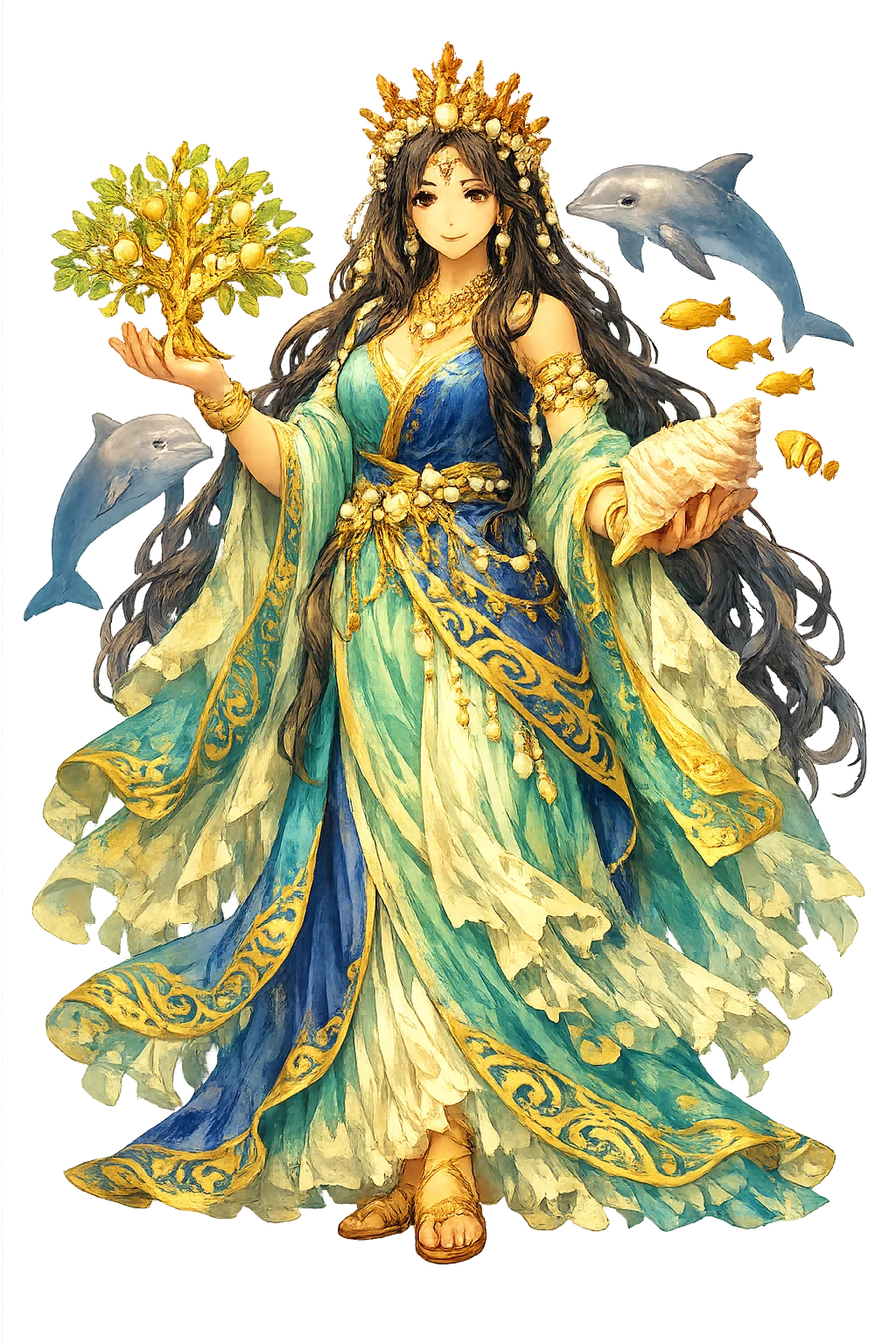
Stories of ꜥAsherah
ꜥAsherah does not star in the great combat myths; she rules by relationship. Her appearances in the Baꜥal Cycle show a goddess who can approach the high god, sway his decisions, and guarantee the succession of kings. She is the still center around which the violent younger gods revolve.
In KTU 1.4, Baꜥal longs for a palace but cannot win Ēl's approval directly. He turns to Asherah. She prepares herself with care — bathes, anoints herself, harnesses her donkey, saddles the ass — and travels to Ēl's tent at the source of the two divine rivers, in the midst of the sea's flood. There she prostrates herself, flatters the high god's wisdom ('your decree, Ēl, is wise; your wisdom is everlasting'), and asks that Baꜥal be granted a house 'like the gods'. Ēl laughs with delight, welcomes her, and consents — but not before she has reminded him of what refusal would cost the divine household. Without her diplomacy, Baꜥal would remain homeless, and the cosmos without a storm-god enthroned. The myth means that even the high god's decrees pass through domestic channels: cosmic order is negotiated, not commanded.
Asherah is repeatedly called qnyt ʾilm, 'Creatress of the Gods' (KTU 1.3 v 25–26; 1.4 i 23; iii 26) — and the epithet's very ambiguity is revealing, since qny can mean both 'create' and 'acquire, beget': either reading makes her the founder of the divine line. The 'seventy sons of Asherah' (KTU 1.4 vi 46) are the divine council itself — seventy being the round number of totality, so that the phrase is simply another name for the pantheon's full court. When Baꜥal later disappears into Mot's realm and heaven's throne stands empty, it is to her that the gods turn: 'let one of the sons of Asherah occupy his throne.' The crisis of Baꜥal's death is thus staged as a succession question inside her family. The myth means the pantheon is matrilineal at its root: the high god sits above it, but the mother of the gods owns its membership.
In KTU 1.23, the 'Birth of the Gracious Gods', Asherah stands in the background of a sacred-marriage and birth narrative. The fragmentary lines seem to open with a hieros gamos — Ēl, aroused by two goddesses on the seashore, begets the gracious gods Šaḥar and Šalim, Dawn and Dusk — and Asherah's presence frames the household into which they are born: the newborn gods drink and are suckled, and kings may be called her nurslings. The text is ritual through and through — birth, blessing, suckling performed as liturgy — so that her maternity here is not backstory but ceremony: the community re-enacts divine nursing to secure its own fertility and the king's legitimacy. The myth means the goddess's breast is a political institution — nourishment, once divine, becomes the charter of dynasty.
Her full title, rbt ʾaṯrt ym, 'Lady Asherah of the Sea', has been read two ways — 'Lady Asherah of the Sea' or 'Lady Asherah who treads on the sea' — and both may be true at once. Ugarit's position explains the title's force: the city lived from the sea, its purple dye, timber, and grain shipped to Cyprus, Egypt, and the Aegean, so a Lady of the Sea is patroness of the entire economy. But the older mythic hearing is eschatological: in the Hebrew Bible's reworking of Canaanite myth, it is still the sea that must be tamed before order can be built, and it is still a female power who stands between the waters and the world. Asherah is therefore a boundary-goddess: she walks where land and water meet and brings the wild under domestic sovereignty. The myth means the sea — commerce and chaos at once — has a mistress, and civilization is her dowry.
Mother of the Gods, Consort of Ēl
ꜥAsherah is the great mother of the Canaanite pantheon, the consort of Ēl and the goddess whose very treading calms the sea. Unlike the fierce maiden ꜥAnat, she moves through the myths as queen mother, intercessor, and source of divine legitimacy. Where Ēl is the distant father, Asherah is the active power broker who knows how to approach him.
Called qnyt ʾilm, 'Creatress of the Gods'; the seventy sons of Asherah populate the divine court.
Her epithet rbt ʾaṯrt ym links her to the Mediterranean, to fishing, and to the cosmic waters tamed by her presence.
It is Asherah who petitions Ēl on Baꜥal's behalf, securing permission for the storm-god's palace.
Spindle, weaving, and nursing imagery mark her as the divine model of women's work raised to cosmic scale.
From the original script to the living URL
𐎀𐎘𐎗𐎚
The name in its original Canaanite form. ꜥAsherah (𐎀𐎘𐎗𐎚) is attested in the source tradition — “Canaanite mother goddess, consort of Ēl and patroness of childbirth”. Its Egyptological ain and alef letters carry the full phonetic and orthographic weight of the source tradition.
asherah
Reduced to plain asherah, the name loses everything that made it specific: Egyptological ain and alef letters. What remains is an ASCII string that machines can parse but that no longer speaks with its original voice.
ꜥAsherah
The Unicode restoration recovers what ASCII flattened. ꜥAsherah restores Egyptological ain and alef letters, returning the name to its original written dignity. The domain encodes to Punycode, but the browser displays the truth.
ꜥAsherah.com → xn--asherah-dv2z.com
The non-ASCII characters in ꜥAsherah are encoded while the ASCII remains visible. To the DNS, it is Punycode. To humanity, it is ꜥAsherah.
Owned, ideal, and ASCII forms of ꜥAsherah
ꜥAsherah
Restores 𐎀𐎘𐎗𐎚. The live temple domain — ꜥasherah.com.
ʿAsherah
Restores 𐎀𐎘𐎗𐎚. Semitic ʿayin (ʿ) is ideal but not registrable at the DNS root. Not in the PuniCodex collection.
asherah
Flattens 𐎀𐎘𐎗𐎚. The plain ASCII fallback — what DNS and legacy systems see.
How ꜥAsherah was spoken
How ꜥAsherah travels from ancient script to the modern URL
Ugaritic ʾaṯrt, a common Semitic noun for “grove, sacred pole" and a divine title; the goddess is consort of Ēl and “lady of the sea".
Mother Goddess, Lady of the Sea
The Unicode restoration ꜥAsherah uses registrable Latin diacritics; the Ugaritic form is not registrable in .com.
The lore you have read is the living myth. Extended Lore opens the scholarly vault beneath it: the cult and its material remains, a history of the image, the name after antiquity, a meditation on what the name still means, and the full scholarly apparatus — etymology, orthography, sources.
Enter Extended Lore