PuniCodex

Extended Lore

𐤀𐤔𐤓𐤕 Ašeratu

Etymology · Orthography · Cult · Iconography · Reception · Sources

Tier 1 Ašeratu.com
Ašeratu — Sea, Mother Goddess
01

Quick Facts

Essential information about Ašeratu, Sea, Mother Goddess

Original Script𐤀𐤔𐤓𐤕
Unicode RestorationAšeratu
Reconstructed Pronunciation/ʔa.ʃe.ˈra.tu/
PantheonPhoenician
DomainSea, Mother Goddess
MeaningShe who treads on the sea
ClassificationTier 1
Primary DomainAšeratu.com
Sacred SymbolsSea, Tree or pole, Spindle, Donkey, Nursing breast
02

Etymology & Word Family

From original script to Unicode restoration

Original Script 𐤀𐤔𐤓𐤕 Ašeratu — "She who treads on the sea"
Unicode Restoration Ašeratu Restored stress, length, and script
Modern ASCII aseratu Plain-ASCII fallback

The name Ašeratu carries the orthographic signature of the phoenician tradition: 𐤀𐤔𐤓𐤕. Unicode restoration recovers what ASCII flattens.

03

Unicode Character Breakdown

Character-by-character philological analysis

CharacterUnicodeNameBlockPhonetic Role
AU+0041Latin Capital Letter ABasic LatinSame, capitalized
šU+0161Latin Small Letter S with CaronLatin Extended-ASpecial character
eU+0065Latin Small Letter EBasic LatinSame
rU+0072Latin Small Letter RBasic LatinSame
aU+0061Latin Small Letter ABasic LatinSame
tU+0074Latin Small Letter TBasic LatinSame
uU+0075Latin Small Letter UBasic LatinSame

The Tier 1 classification reflects how much of the original phonology this restoration preserves — stress and vowel length for Greek names, distinctive letters and diacritics for every other tradition.

04

Cult & Worship

How the sacred was kept — rites, sanctuaries, remains

The Cult

Here the evidence is thin, and honesty is owed. No excavated temple at Ugarit can be assigned to Ašeratu; her cult there is known almost entirely from the tablets themselves — the ritual god-lists and offering texts that count her among the honored recipients, and the Baal Cycle's portrait of a goddess who washes, anoints, and dresses in a weaver's brocade before approaching the high god's tent, which reflects court cult rather than a festival calendar. Beyond Ugarit the footprint widens. The fourteenth-century Amarna letters name a Syrian ruler Abdi-Ashirta, 'servant of Ašeratu,' proof that she was venerated across the Levant, and Phoenician inscriptions (KAI) invoke her for centuries after. No certain priesthood, festival day, or votive deposit survives under her name. The Hittite Elkunirša myth shows her as a weaving mother of scores of sons — a glimpse of household religion rather than state temple — but it is a literary adaptation, not a ritual text.

In the Earth

The Ugaritic tablets from Ras Shamra (KTU 1.3–1.4, 1.23) preserve Ašeratu's titles and intercessory role in alphabetic cuneiform, copied in the thirteenth–twelfth centuries BCE. The Hittite Elkunirša myth from Boğazköy-Hattusa adapts her as Ašertu, consort of Elkunirša and a weaver of divine children. Phoenician inscriptions (CIS/KAI) attest ʾšrt in theophoric names across the Levant and the Punic world. In Israel and Judah, the Kuntillet ʿAjrud (c. 800 BCE) and Khirbet el-Qom inscriptions, the Taanach cult stands, and the Jerusalem temple asherah (2 Kings 23) provide material and textual witnesses to her contested cult.

05

Iconography

How Ašeratu was imaged across the ages

The Image

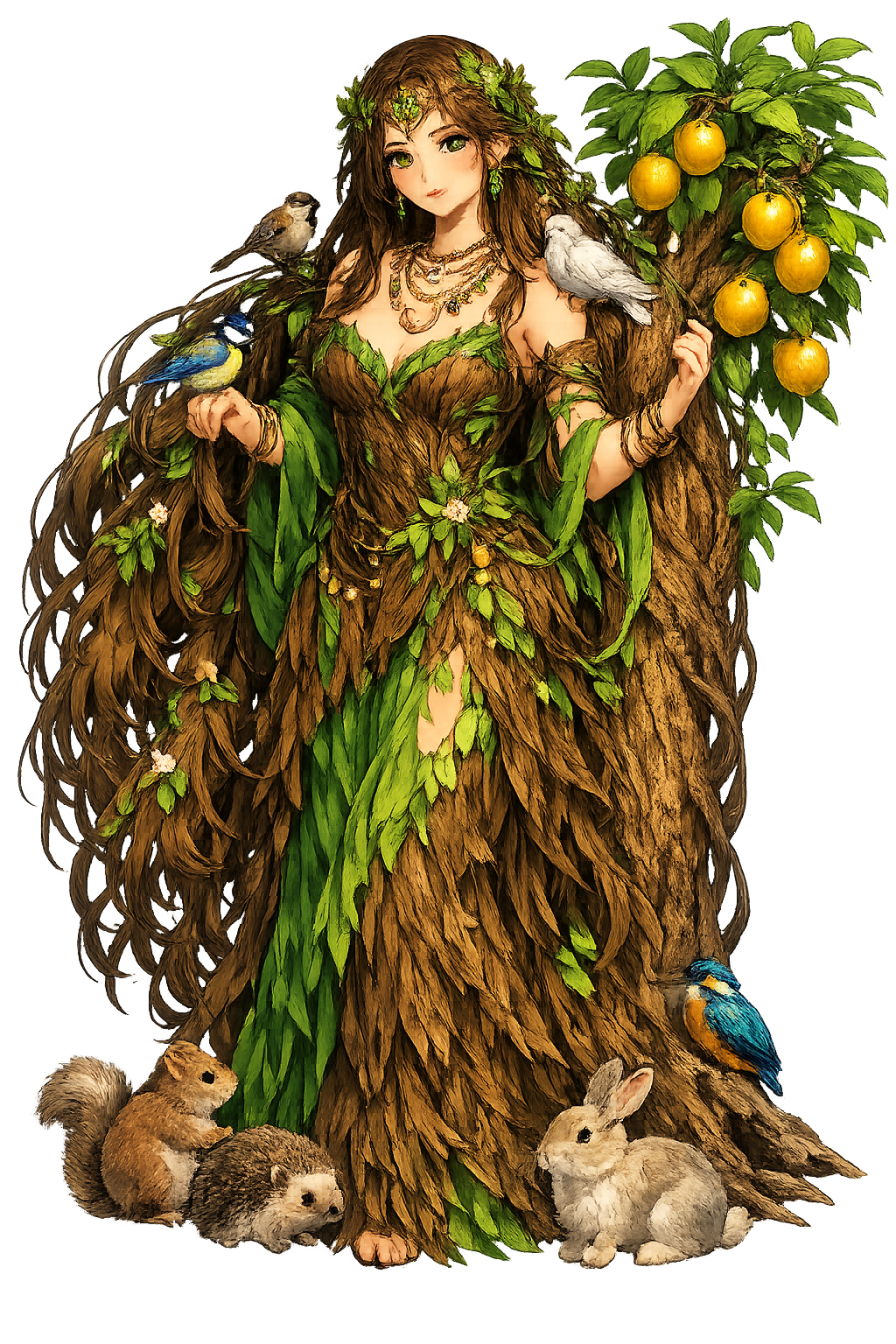
No certain image of Ašeratu survives from Ugarit itself; the texts give attributes, not portraits. She rides a donkey when she travels to Ēl's tent (KTU 1.4), she is a weaver — dressed in the brocade of the skilled worker — and she treads the sea of her own title. The clearest images come from Egypt, where the nineteenth Dynasty produced votive stelae for Qudšu, 'Holiness,' a goddess widely identified as Ašeratu: she stands frontal, crowned with the Hathor headdress, flanked by Min and Reshef, her feet on a lion — the most famous example in the Rijksmuseum van Oudheden, Leiden. The identification has been argued since the 1940s and is broadly accepted, though Qudšu also shades toward Astarte. At Ugarit, glyptic offers only candidates — seated goddesses, sacred trees — and the prudent verdict is that her image was botanical and domestic: the tree, the spindle, the sea, rather than a face.

06

Reception & Transformation

The name after its own age — transmission, translation, survival

Afterlives

Ašeratu's afterlife is the strangest of any goddess in this pantheon: forgotten for three thousand years, then read back into existence. Her name first re-entered the modern world through the Amarna correspondence, found in 1887 at el-Amarna and published in the 1890s, whose letters from Abdi-Ashirta of Amurru hinted at a great goddess behind the theophoric name. Then, in 1929, a plowman at Ras Shamra opened the royal archive, and the tablets of the Baal Cycle returned Ašeratu whole — her titles, her intercession, her treading of the sea. The decipherment of Ugaritic cuneiform became the celebrated race of 1930–31 among Bauer, Dhorme, and Virolleaud, and the standard editions — Herdner's CTA (1963), Gibson's Canaanite Myths and Legends (1978), Smith's Ugaritic Baal Cycle (1994) — fixed her place in the pantheon. The Hittite Elkunirša tablets from Boğazköy, known since the 1920s, showed her traveling north into Hattic myth. Biblical scholarship completed the retrieval: where the nineteenth century had read the Bible's asherah as a mere wooden pole, the Ugaritic parallels — carried into English debate by Patai's The Hebrew Goddess (1967), Day's Yahweh and the Gods and Goddesses of Canaan (2000), and Hadley's monograph (2000) — restored the goddess the reformers tried to erase.

Identifications Across Traditions

Ašeratu's reach extended across the ancient Near East. In Hittite treaties she appears as Ašertu, the consort of Elkunirša and a weaving goddess with dozens of divine children. In Egypt she was identified with Hathor and venerated as Qudšu, 'Holiness.' In Israel and Judah she became the Bible's most controversial goddess: the Asherah, the Queen of Heaven, perhaps the consort of Yahweh in inscriptions from Kuntillet ʿAjrud and Khirbet el-Qom. The Deuteronomistic reformers condemned her wooden pole and the women who baked cakes for her, but the very polemics testify to her persistent hold.

Modern Legacy

Ašeratu is the divine feminine the Hebrew Bible tried to erase and failed. Her tree, her pole, and her cakes survived in folk religion; her name survived in place names and theophoric roots; her image survived, some argue, in the Shekhinah and in the maternal iconography of the Virgin Mary. Modern feminist theologians and Canaanite- and Goddess-oriented movements have reclaimed her as a symbol of the sacred feminine suppressed by later monotheism. To restore her name with the Phoenician š and the Ugaritic nominative -u is to recover a sound that once rang in temples from Ras Shamra to Jerusalem.

07

The Meditation

What Ašeratu means — beyond the dictionary

Ašeratu teaches that power does not have to shout. She walks between sea and shore, between the high god's tent and the storm-god's need, between motherhood and sovereignty. Her influence is relational, patient, and therefore easy to discount — yet without her intercession, Baꜥal has no palace and the cosmos has no house for the rain.

In an age that rewards noise, Ašeratu is a reminder that the threads holding a world together are often invisible: a spindle, a whispered petition, a mother's milk, a tree by a shrine. To remember her is not to retreat into nostalgia; it is to recognize that the divine has never been exclusively masculine, and that the names we were taught to forget can still be spoken.

08

Frequently Asked Questions

Common questions about Ašeratu, Sea, Mother Goddess, and Unicode restoration

01How do you pronounce Ašeratu?

In reconstructed pronunciation, Ašeratu is /ʔa.ʃe.ˈra.tu/ — approximately 'ah-she-RAH-too' — begin with a slight catch in the throat, then 'she' with a crisp sh, roll or tap the r, and end with 'rah-too'.

02What does Ašeratu mean?

Ašeratu means She who treads on the sea in the phoenician tradition.

03What are the symbols of Ašeratu?

Ašeratu is associated with Sea (The waters she treads and tames, source of fertility and commerce for coastal Ugarit), Tree or pole (The biblical ʾăšērâ, a wooden cult object that represents or embodies her presence), Spindle (Her attribute in Ugaritic and Hittite iconography; symbol of feminine labor and cosmic order), Donkey (The beast she rides when approaching Ēl's tent in the Baꜥal Cycle), Nursing breast (The nourishment she gives to gods and kings; kings may be called her nurslings).

04Why restore Ašeratu in Unicode?

Plain ASCII aseratu strips the stress, length, and script that make the name specific. Unicode restoration returns the name to its original written dignity.

05What is the most important myth about Ašeratu?

“The Queen Mother's Journey” — the The Baal Cycle story that anchors the mythology of Ašeratu, told in full on the lore page.

09

Scholarly Sources

The philological foundations of this restoration

Every claim on this page is grounded in established scholarship. The orthographic restorations follow disciplinary convention. The etymological chain follows the best available reference works. This is not invention — it is resurrection through scholarship.

◈

Lexicography & Philology

  • Ugaritic texts
  • CIS
◎

Primary Texts

  • KTU 1.3–1.4 (Ugaritic Baal Cycle: Ašeratu's titles and intercession with El)
  • KTU 1.23 (Birth of the Gracious Gods)
  • Smith, Mark S., The Ugaritic Baal Cycle (Brill, 1994)
  • Hebrew Bible, Deuteronomy 16:21; Judges 6:25–26; 1 Kings 18:19; 2 Kings 23:4–7 (asherah poles and the Josianic reform)
◉

Archaeology & Art History

  • Material evidence — iconography, inscriptions, and temple archaeology — for Ašeratu and related cults.
✦

Religious Studies

  • Coogan, Michael D., Stories from Ancient Canaan (Westminster, 1978)
  • Day, John, Yahweh and the Gods and Goddesses of Canaan (Sheffield, 2000)
  • Hadley, Judith M., The Cult of Asherah in Ancient Israel and Judah (Cambridge, 2000)
  • Kuntillet ʿAjrud inscriptions (KH1–KH3: 'Yahweh and his Asherah')
  • Hittite Elkunirša myth (Ašertu, consort of Elkunirša), from Boğazköy-Hattusa
Return

The Surface Awaits

You have traced the name from its earliest attestation to its Unicode restoration. Now return to the myth. The story is where the name lives.

Back to Lore
Ašeratu mascot