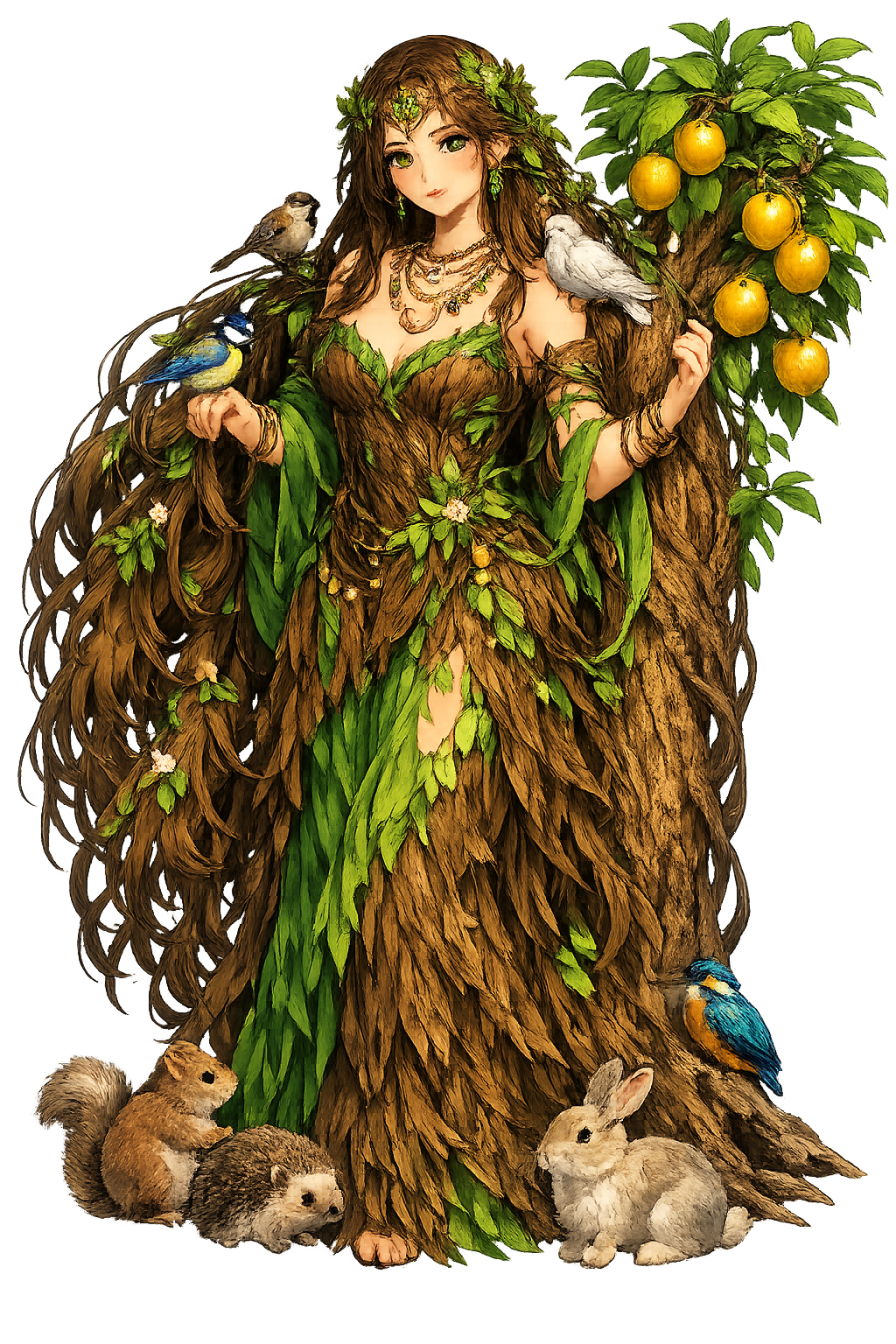
Stories of Ašeratu
Ašeratu's mythology is the mythology of influence. She does not fight; she intercedes. Her journeys to Ēl's tent, her titles as creatrix and nurse, and her treading of the sea all mark her as the figure who turns raw divine power into ordered legitimacy.
In KTU 1.4, Baꜥal longs for a palace but cannot win Ēl's approval directly. He turns to Ašeratu, and the Baꜥal Cycle slows to watch her prepare: she washes with soap of the sea, anoints herself, and dresses in the brocade of the skilled weaver — the goddess arraying herself for statecraft, not seduction. Then she harnesses her donkey, sets her servant on its back, and travels to the source of the rivers, to the meeting place of the two deeps. There she prostrates before Ēl in the dust, praises his wisdom, and asks that Baꜥal be granted a house 'like the gods'. Ēl laughs — 'my son Baꜥal rejoices me' — and consents. Without her diplomacy, the storm-god would remain homeless and the rain without a throne. The episode makes the point the whole cycle keeps returning to: the king of the gods rules, but the queen mother decides what gets ruled upon.
Ašeratu is repeatedly called qnyt ʾilm, 'Creatress of the Gods' (KTU 1.3 v 25–26; 1.4 i 23; iii 26) — a title with no parallel among the male gods of Ugarit. The seventy sons of Ašeratu (KTU 1.4 vi 46) are the divine council itself: when Baꜥal disappears into Mot's realm and the heavens shut, it is to her that the gods come, asking that she choose one of her sons as the next king. She refuses, knowing Baꜥal lives. The scene quietly assigns her the most dangerous power in the pantheon — the naming of a successor — and shows her declining to use it. In a religion whose god of creation is a remote patriarch, it is the mother who actually creates, in the literal sense: seventy gods, a whole pantheon, borne and raised by one name.
In KTU 1.23, the 'Birth of the Gracious Gods,' Ašeratu stands behind a sacred-marriage and birth narrative in which the newborn gods — the gracious ones, the princely ones — are suckled and nourished, and the text joins her nursing to the fruitfulness of flocks, wombs, and fields. Kingship drinks at the same breast as the rain. The motif carried far beyond Ugarit: Hittite ritual texts and Phoenician tradition remember her as the divine nurse, and in Judah the queen mother retained a court office of startling persistence — the gebirah, the 'great lady' — long after the goddess herself was condemned. To call kings her nurslings was to say that sovereignty itself was breast-fed: power, like every baby, begins at the mother's body. When the reformers of Judah finally cut down the asherah beside the temple altar, they were felling a tree whose roots ran back to this text.
Her title 'Lady Ašeratu of the Sea' (rbt ʾaṯrt ym) has been read two ways, and the sources let us keep both. If ym is 'sea', she is the one who treads the waters — the Mediterranean that fed Ugarit's fishing fleets, the cosmic deep that the storm-god must split with his club. If, as some philologists argue, the epithet is to be parsed with a place-name, she is the lady of a specific coastal shrine, a local goddess raised to cosmic rank. Either way, the title makes Ašeratu a boundary-goddess: she walks where land and water meet and brings the wild under domestic sovereignty. The sea that terrifies sailors is, to her, a road; the trade that feeds Ugarit sails on waters she has already trodden, and no storm is named in any text where she walks.
Mother of the Gods, Consort of Ēl
Ašeratu is the great mother of the Canaanite pantheon, the consort of Ēl and the goddess whose footsteps quiet the sea. Her full Ugaritic title rbt ʾaṯrt ym — “Lady Ašeratu of the Sea” — and the Phoenician form ʾšrt name her as both cosmic navigator and divine ancestress. Where Ēl is the distant father, Ašeratu is the active queen mother who knows how to approach him.
Called qnyt ʾilm, 'Creatress of the Gods'; the seventy sons of Ašeratu populate the divine council (KTU 1.4 vi 46).
Her epithet rbt ʾaṯrt ym links her to the Mediterranean, to fishing, and to the cosmic waters tamed by her presence.
In KTU 1.4 she travels to Ēl's tent, petitions on Baꜥal's behalf, and secures permission for the storm-god's palace.
Spindle, weaving, and nursing imagery mark her as the divine model of women's labor raised to cosmic scale.
From the original script to the living URL
𐤀𐤔𐤓𐤕
The name in its original Phoenician form. Ašeratu (𐤀𐤔𐤓𐤕) is attested in the source tradition — “She who treads on the sea”. Its original diacritics and script distinctions carry the full phonetic and orthographic weight of the source tradition.
aseratu
Reduced to plain aseratu, the name loses everything that made it specific: original diacritics and script distinctions. What remains is an ASCII string that machines can parse but that no longer speaks with its original voice.
Ašeratu
The Unicode restoration recovers what ASCII flattened. Ašeratu restores original diacritics and script distinctions, returning the name to its original written dignity. The domain encodes to Punycode, but the browser displays the truth.
Ašeratu.com → xn--aeratu-bkb.com
The non-ASCII characters in Ašeratu are encoded while the ASCII remains visible. To the DNS, it is Punycode. To humanity, it is Ašeratu.
Owned, ideal, and ASCII forms of Ašeratu
Ašeratu
Restores 𐤀𐤔𐤓𐤕. The live temple domain — ašeratu.com.
aseratu
Flattens 𐤀𐤔𐤓𐤕. The plain ASCII fallback — what DNS and legacy systems see.
How Ašeratu was spoken
How Ašeratu travels from ancient script to the modern URL
Phoenician ʾšrt, parallel to Ugaritic Athiratu; the name is connected with a root meaning “to stride, to tread" and with the sacred grove/pole.
Sea, Mother Goddess
The Unicode restoration Ašeratu supplies registrable vowel diacritics; the Phoenician consonantal form is not registrable in .com.
The lore you have read is the living myth. Extended Lore opens the scholarly vault beneath it: the cult and its material remains, a history of the image, the name after antiquity, a meditation on what the name still means, and the full scholarly apparatus — etymology, orthography, sources.
Enter Extended Lore