The Living Myth
Truth, Righteousness, Cosmic Order · The Order that Holds the Sky
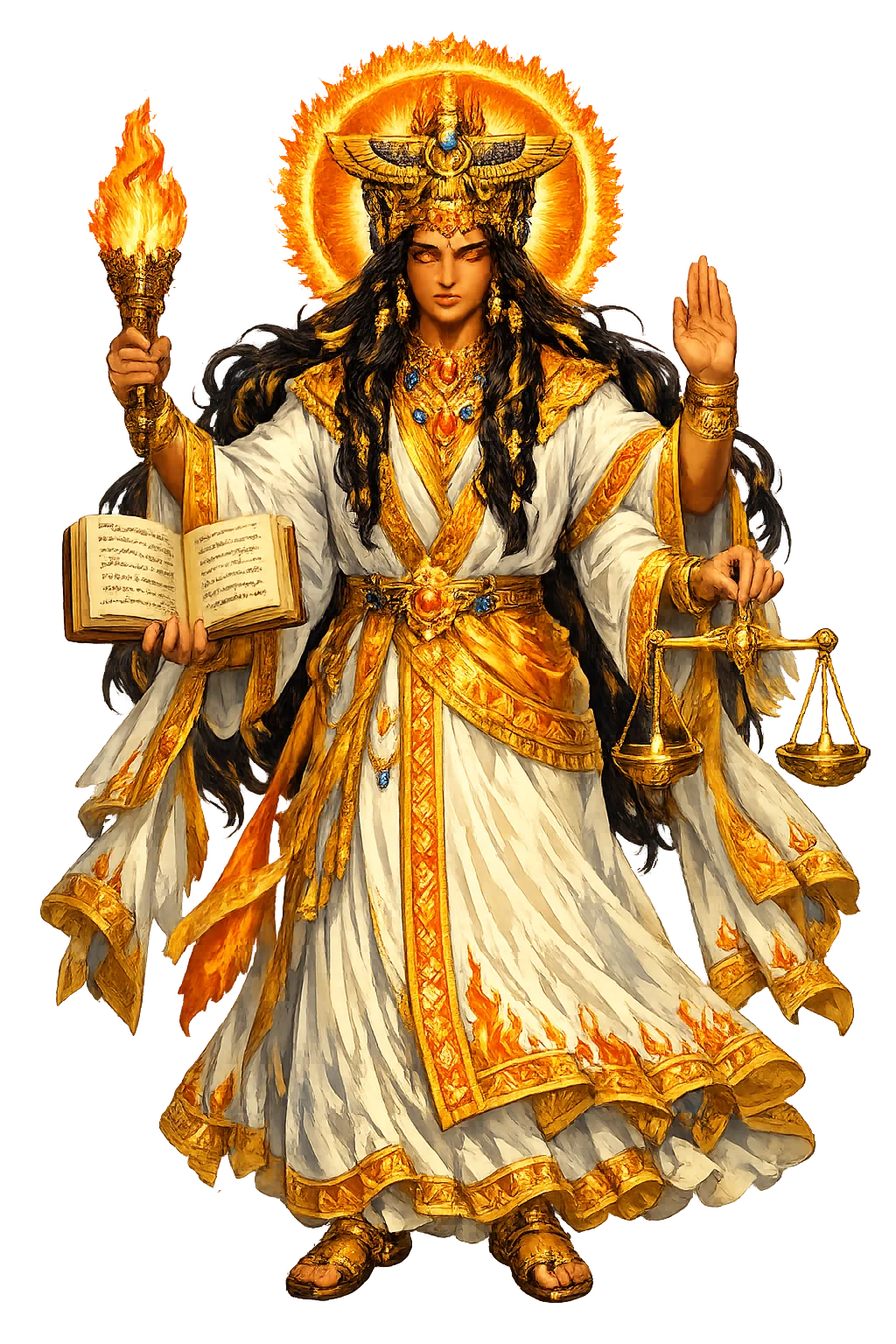
Stories of Aša
Aša is not a hero with a single epic; it is a cosmic principle dramatized across the whole Zoroastrian canon. The Gāthās of Zarathustra ask which power is greatest, and Aša is named among the first creations of Ahura Mazda. The Aməša Spənta Aša Vahišta — "Best Truth" — stands opposite the forces of Druj. Every moral choice, every liturgy, and every eschatological hope is a chapter in the myth of Aša.
The Gāthās are not stories but questions, and their first great question is about Aša. In Yasna 28 Zarathustra asks Ahura Mazda which power it is best to invoke; through the hymns the answer gathers: Aša — truth, order, the rightness of things — the power through which the sun travels and the moon waxes and wanes. Yasna 31 asks how creation was first set in order; Yasna 30 contemplates the two spirits, Beneficent and Harming, twin dreams between which good and evil choose; and throughout, the prophet pleads for the reward that comes 'through good purpose and truth.' The one thing needful is to align thought, word, and deed with the order that makes the world coherent. This is myth in the mode of metaphysics — no dragon, no flood, only the claim that the cosmos runs on a truth that can be sided with or against. The whole drama of Zoroastrianism is the drama of Aša: created first, attacked always, destined to win.
Later Zoroastrian tradition organizes the divine world into Ahura Mazda and six Aməša Spənta, 'Bounteous Immortals,' each paired with a created thing: Vohu Manah with the cattle, Aša Vahišta with fire, Xšaθra with the sky and metals, Spəntā Ārmaiti with the earth, Haurvatāt and Amərətāt with water and plants. Fire is the visible body of Aša in the world: it burns away falsehood, it cannot be deceived, and its light is the light by which truth is seen. The liturgy acts this out — in every Yasna service the priest feeds the fire with sandalwood and butter while praising 'Aša Vahišta, best of all truths.' Fire, chemistry aside, is not a mere symbol of the truth; in Zoroastrian perception it is the truth, burning in the hearth — the same order that set the stars in their courses, now warming the kettle.
Three days after death, in the Zoroastrian account preserved in the Vidēvdād (19) and the Hadōxt Nask, the soul comes to the Činwad Bridge, 'the bridge of the separator.' Its width is decided by the soul itself. For the righteous, a fair maiden — the soul's own store of good thought, good word, and good deed made visible — comes to meet it, and the bridge grows wide as a road; it crosses singing. For the wicked, the maiden is a grim hag, and the bridge narrows to the edge of a razor until the soul topples into the darkness below. The Gāthās already know the image (Yasna 46.10–11): the wrongdoer and the righteous come at last to this bridge as to the Requiter. The myth is exact psychology: what meets us after death is our own character, personified. The bridge is not God's arbitrary verdict; it is Aša, truth, made solid enough to stand on — or not.
Zoroastrian time ends not in cancellation but in repair. At the close of the world the prophet Saōšyant — born of the seed of Zarathustra preserved in a lake — will raise the dead and lead the final battle against the Lie. Then comes the flood of molten metal: the mountains will melt, says the tradition preserved in the Bundahišn and the Wīzīdagīhā ī Zādspram (35), and the metal will flow like a river over the whole earth. For the wicked it is torment; for the righteous it is warm as milk, a final bath of purification. Hell is emptied, the serpent Aži Dahāka is bound and destroyed, and Aša rules alone: frašō.kərəti, the 'making wonderful,' when even the carnivores lose their weapons and the plants grow without thorns. The myth of Aša's victory is also its definition: truth needs no hell to exist — only the removal of everything that was never true.
Cosmic Order, Righteousness, and Sacred Fire
Aša is not merely a moral idea; it is the architecture of reality. In Zoroastrian thought, Aša is the truth that makes the sun rise, the seasons turn, the crops grow, and the oath bind. It is the order that Ahura Mazda set against the lie (druj), and it is the fire that burns away falsehood. To live in Aša is to think good thoughts, speak good words, and do good deeds — the threefold path that keeps the world from sliding back into chaos.
Aša Vahishta is identified with fire itself — the visible presence of truth, the agent that purifies and illuminates.
The fixed pattern of sun, moon, stars, and seasons — the regularity that makes life predictable and civilization possible.
Good thoughts, good words, good deeds: the practical ethic by which mortals participate in Aša.
Aša underlies covenant, contract, and justice; the breaker of an oath is an ally of Druj, the Lie.
From the original script to the living URL
𐬀𐬴𐬀
The name in its original Zoroastrian form. Aša (𐬀𐬴𐬀) is attested in the source tradition — “Truth, righteousness, and the cosmic order. The central ethical and metaphysical principle of Zoroastrianism.”. Its original diacritics and script distinctions carry the full phonetic and orthographic weight of the source tradition.
asa
Reduced to plain asa, the name loses everything that made it specific: original diacritics and script distinctions. What remains is an ASCII string that machines can parse but that no longer speaks with its original voice.
Aša
The Unicode restoration recovers what ASCII flattened. Aša restores original diacritics and script distinctions, returning the name to its original written dignity. The domain encodes to Punycode, but the browser displays the truth.
Aša.com → xn--aa-lta.com
The non-ASCII characters in Aša are encoded while the ASCII remains visible. To the DNS, it is Punycode. To humanity, it is Aša.
Owned, ideal, and ASCII forms of Aša
Aša
Restores 𐬀𐬴𐬀. The live temple domain — aša.com.
asa
Flattens 𐬀𐬴𐬀. The plain ASCII fallback — what DNS and legacy systems see.
How Aša was spoken
How Aša travels from ancient script to the modern URL
Avestan aša; from the Old Iranian root *ṛta- “truth, order"; the central Zoroastrian principle of cosmic and ritual righteousness.
Truth, Righteousness, Cosmic Order
The Unicode restoration Aša uses registrable Latin diacritics; the Avestan script form is not registrable in .com.
The lore you have read is the living myth. Extended Lore opens the scholarly vault beneath it: the cult and its material remains, a history of the image, the name after antiquity, a meditation on what the name still means, and the full scholarly apparatus — etymology, orthography, sources.
Enter Extended Lore