
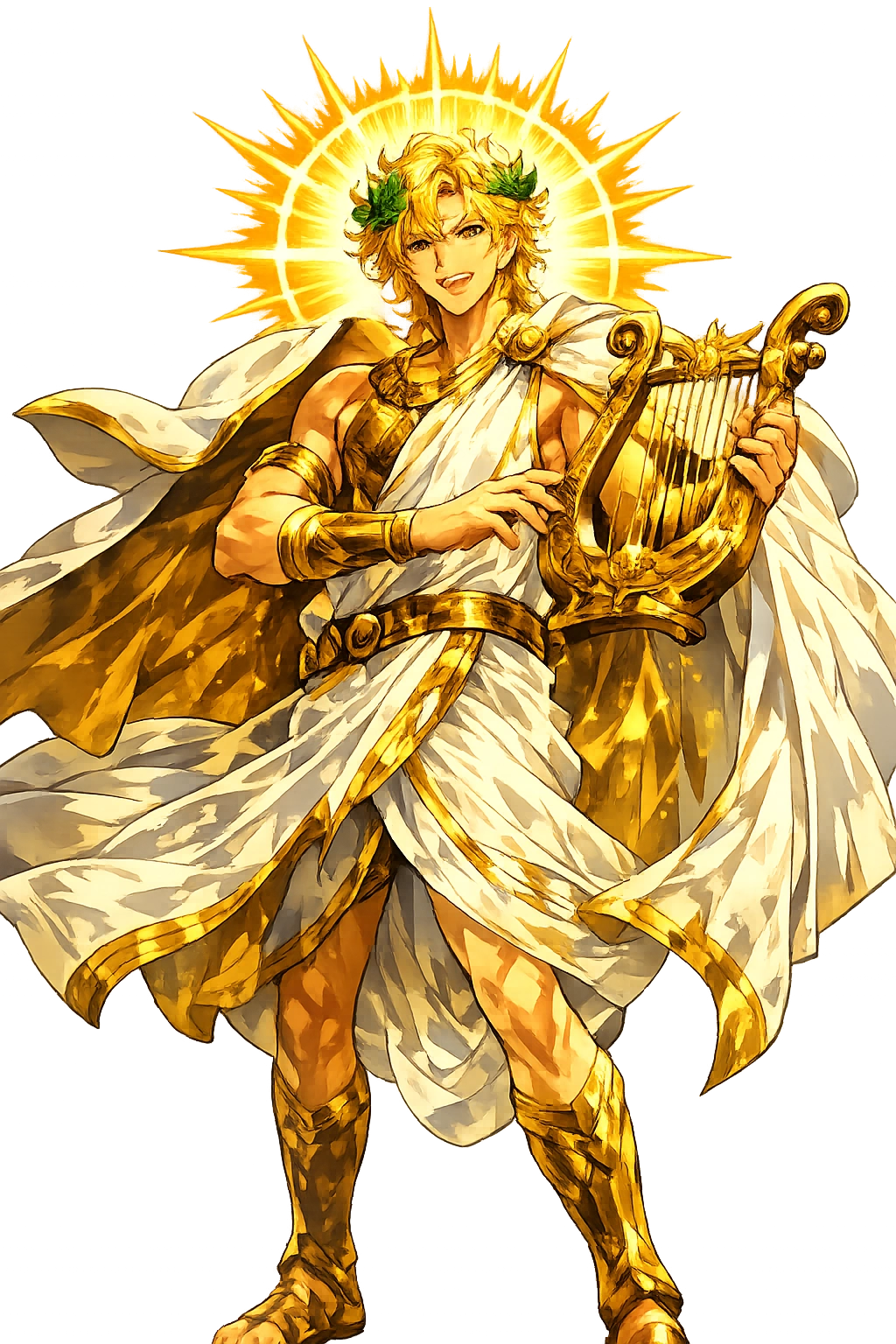
Why Apóllōn is spelled that way — and what it costs to get it right
There is a version of this name the early internet had to settle for: apollon. This is the file on how Apóllōn replaced it.
Apóllōn's myths are unusually coherent because they consistently dramatize the same theme: the distance between divine perfection and mortal limitation. He is never ridiculous, but he is often terrifying — and almost always far away.
At a Glance
- Restored name: Apóllōn
- ASCII form: apollon
- Meaning: "Possibly 'destroyer' or 'purifier' (from ἀπόλλυμι)"
- Domain of influence: Light, Music, Prophecy
- Pantheon: Greek
- Classification: Dual-Tier
- Original script: Ἀπόλλων
- Series: The Restoration Files, No. 43 of 546
The Name Before the Marks
The name is attested as Ἀπόλλων, in the attestation Homeric Hymn to Apollo (Delian and Pythian) and Homer, Iliad 24.602–617 give us. On the evidence, it means "Possibly 'destroyer' or 'purifier' (from ἀπόλλυμι)".
Strip Apóllōn to apollon and 2 pieces of evidence vanish:
- o → ó — Acute on omicron: the stress position the ASCII form cannot show.
- o → ō — Omega: long omicron: the vowel length the ASCII form cannot show.
These are the small, provable things a restoration is made of: not taste, not branding — attestation.
Spoken, the name runs `/a.pól.lɔːn/` — 'ah-POL-lone' — stress the second syllable and hold the final 'o' roughly twice as long as English allows.
The Temple That Stands Now
The restored name is not a plaque; it is an address. The temple of Apóllōn lives at /apollon/, with its mythology in the lore halls, its peer-reviewed record in the Scholarly Edition, and its place in the pattern atlas on the patterns floor.
Both features — the accent and the long vowel — survive, and the variants are not errors but attested alternatives. The temple holds the pair as a dual-tier restoration.
Where the Name Stood First
Delphi is Apollo's great archive: successive temples above the Castalian spring, the theatre and stadium of the Pythian Games, the treasuries of Greek cities, the polygonal wall bearing inscriptions including the rescued hymns to Apollo with musical notation, and the omphalos — the 'navel' of the world. Delos preserves his birth-cult: the sanctuary of Apollo with its three temples aligned to the altar, the Terrace of the Lions facing the sacred lake, and Mycenaean traces beneath the later city — the island's sanctity reaching back to the Bronze Age. At Didyma near Miletus the colossal archaic oracular temple stood unfinished for a thousand years; at Bassae the temple of Apollo Epikourios, attributed to Ictinus, crowns the Arcadian mountains; at Amyklai outside Sparta the Hyakinthia fused Apollo's cult with the mourning of Hyacinthus. His temples framed the Greek world's most consequential questions for over a millennium. The temple on the web is the newest of these addresses — the first one that fits in a pocket.
The Archetype at Work
The pattern atlas seats this temple in 4 industries, each match argued and weighted: AI, Data & Predictive Intelligence (god of prophecy whose oracle answered the ancient world’s hardest queries.); Music, Arts & Performance (god of music; the lyre is his attribute.); Space, Astronomy & Celestial Science (nASA’s Apollo program landed humans on the Moon under his name.). The Resonance File reads those seats through the myths themselves.
In the Sacred Texts
The Greek tradition is not a vibe; it is a library. The Sacred Texts collection holds Theogony, Homeric Hymns, and Works and Days — the primary sources the temple's scholarship is built on. The temple is the argument; the texts are the evidence.
The File Continues
The temple's founding dispatch tells the name's story; its Resonance File reads the myths into the industries; the blog index holds the whole archive.
Continue the series — previous file: Aphrodítē (read it here) · next file: Apsû (read it here).
The Restoration Files are written from the same canonical record as the temples themselves: the lexicon, the lore catalog, the pattern atlas, and the cited scholarly sources. If a file ever disagrees with its temple, the temple is right — tell us, and the file will be corrected.