PuniCodex

Extended Lore

Apóllōn — The Deeper Record

Etymology · Orthography · Cult · Iconography · Reception · Sources

Preserves stress & vowel length Apóllōn.com · Apollōn.com
Apóllōn — Light, Music, Prophecy
01

At a Glance

Apóllōn — every fact links to its home

PantheonGreek
DomainLight, Music, Prophecy
Original ScriptἈπόλλων →
Primary Sources5 cited →
02

Etymology & Word Family

From original script to Unicode restoration — the full etymology page →

Proto-indo-european *h₂epél-yōn destroyer, purifier
Original Script Ἀπόλλων Apóllōn — "Possibly 'destroyer' or 'purifier' (from ἀπόλλυμι)"
Unicode Restoration Apóllōn Restored stress, length, and script
Modern ASCII apollon Plain-ASCII fallback

Uncertain; possibly from ἀπόλλυμι "to destroy", or pre-Greek. Associated with Lycian god Apaliunas.

03

Unicode Character Breakdown

Character-by-character philological analysis

CharacterUnicodeNameBlockPhonetic Role
AU+0041Latin Capital Letter ABasic LatinAlpha
pU+0070Latin Small Letter PBasic LatinPi
óU+00F3Latin Small Letter O with AcuteLatin-1 SupplementAcute on omicron
lU+006CLatin Small Letter LBasic LatinLambda
ōU+014DLatin Small Letter O with MacronLatin Extended-AOmega: long omicron
nU+006ELatin Small Letter NBasic LatinNu

More than one historically valid Unicode spelling of Apóllōn exists — each variant is a real, attested restoration, and the owned forms live as temples.

04

Cult & Worship

How the sacred was kept — rites, sanctuaries, remains

The Cult

Apollo was worshipped wherever Greeks sailed, but his cult had two poles. At Delphi his priestess the Pythia, seated on the tripod above the chasm, delivered his oracles to cities and kings, and the sanctuary grew rich on their dedications — Croesus of Lydia sent gifts of beaten gold (Herodotus 1.50–51), and the Siphnian and Athenian treasuries still stand along the Sacred Way. Every four years the Pythian Games gathered the Greek world for contests of music and athletics. At Delos the Delia and the great penteteric festival marked his birth with choirs of maidens before the horned altar. Cities kept their own calendars: Athens sang paeans and, in the plague year, purified Delos (Thucydides 2.47); Sparta danced the Karneia for Apollo Karneios; and at Amyklai the Hyakinthia joined the god's crown to the mourning of Hyacinthus — a festival where celebration and grief shared one sanctuary.

In the Earth

Delphi is Apollo's great archive: successive temples above the Castalian spring, the theatre and stadium of the Pythian Games, the treasuries of Greek cities, the polygonal wall bearing inscriptions including the rescued hymns to Apollo with musical notation, and the omphalos — the 'navel' of the world. Delos preserves his birth-cult: the sanctuary of Apollo with its three temples aligned to the altar, the Terrace of the Lions facing the sacred lake, and Mycenaean traces beneath the later city — the island's sanctity reaching back to the Bronze Age. At Didyma near Miletus the colossal archaic oracular temple stood unfinished for a thousand years; at Bassae the temple of Apollo Epikourios, attributed to Ictinus, crowns the Arcadian mountains; at Amyklai outside Sparta the Hyakinthia fused Apollo's cult with the mourning of Hyacinthus. His temples framed the Greek world's most consequential questions for over a millennium.

05

Iconography

How Apóllōn was imaged across the ages

The Image

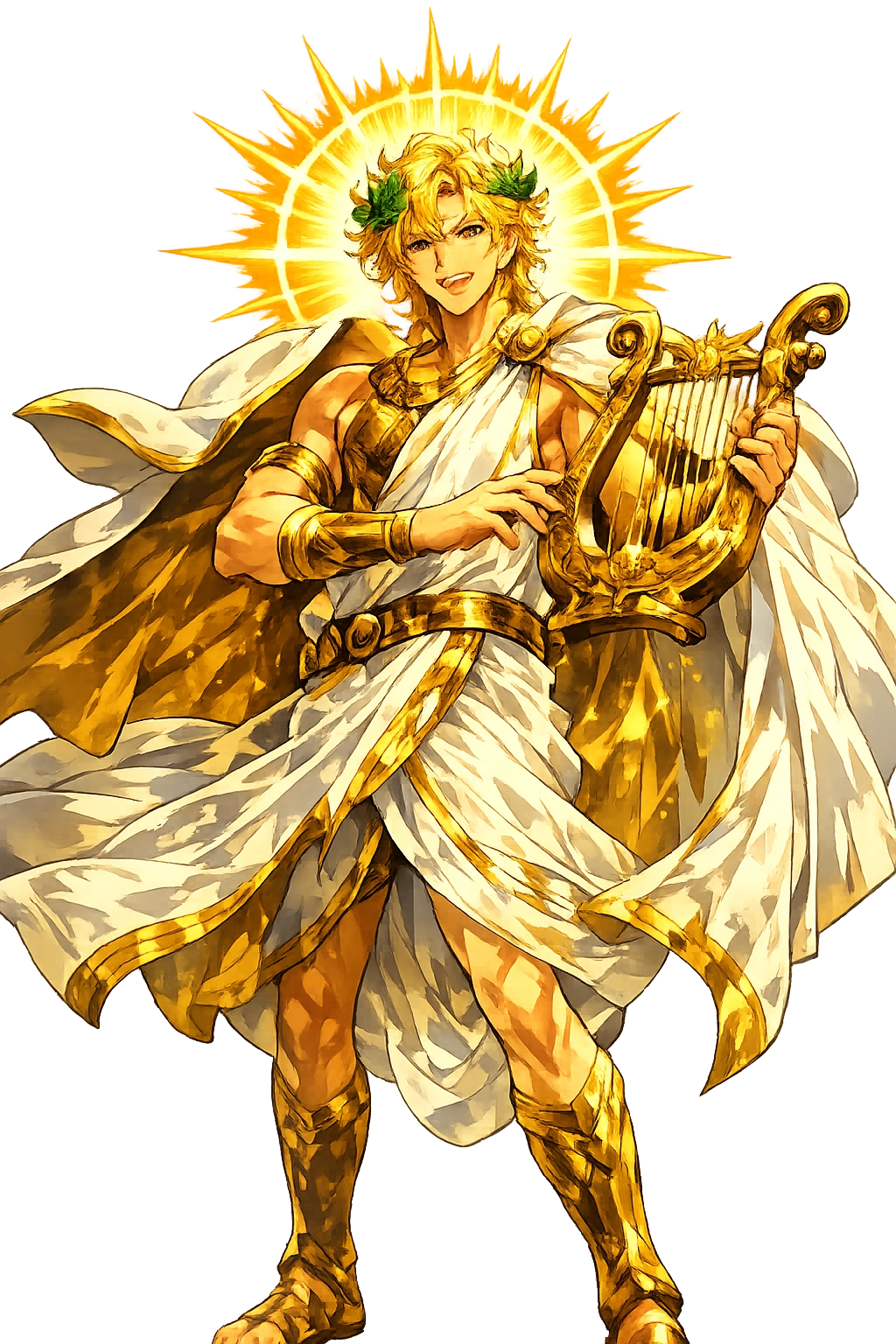
Apollo enters Greek art as the kouros perfected: the standing nude youth, left foot forward, hair in beaded locks — the Tenea Apollo (Munich) and a hundred brothers gave him his canonical body before any attribute identified him. Archaic painters added the bow and the lyre, and on black-figure vases he strides with drawn bow or judges the contest of Marsyas. In Etruria his colossal terracotta guarded the ridge of Veii, arms outstretched (c. 500 BCE, Villa Giulia). The classical centuries humanized him — the Apollo Lykeios type, leaning on his lyre, survives in dozens of Roman copies. The image that conquered posterity is Roman: the Belvedere Apollo in the Vatican, a marble copy of a fourth-century bronze perhaps by Leochares, rediscovered around 1489. Recognize him by youth, lyre, laurel, and the far-seeing gaze.

06

Reception & Transformation

The name after its own age — transmission, translation, survival

Afterlives

Apollo's oracle outlived his world. Delphi was still answering emperors in the fourth century CE when Theodosius's edicts closed the pagan sanctuaries, and the god's reported last verses — the hall fallen, no prophetic laurel, no spring that speaks — belong to Julian's failed attempt to reopen the spring. The texts travelled otherwise: the Homeric Hymns survived in Byzantine manuscripts, and Ovid's Metamorphoses, the most-read pagan book of the Middle Ages, kept Daphne and Marsyas in every literate mind. The Renaissance recovered the god's body first — the Belvedere Apollo, installed in the Vatican, drew Winckelmann's worship and became the most discussed statue in Europe; Bernini's Apollo and Daphne (1622–25, Galleria Borghese) gave Ovid marble again. In scholarship the Delphic god returned with Farnell's Cults of the Greek States and Parke and Wormell's history of the oracle, while Ficino's solar theology carried the name into European philosophy — a transmission as long as any in the classical tradition.

Identifications Across Traditions

Apóllōn was one of the most widely exported Greek gods. The Romans adopted him directly, without renaming — the only major Olympian so honored — and Augustus made him a patron of the Roman state, dedicating a splendid temple on the Palatine beside his own house. In Egypt he was identified with Horus; in Anatolia his name reaches back to Appaliunaš of Wilusa in the Hittite archives, making him one of the oldest traceable gods in the Greek pantheon. In Neoplatonism he became the principle of intellect and light; in Renaissance art, from the Apollo Belvedere onward, he embodied the ideal male form. Linguistically he survives in 'Apollo' programs, 'Apollonian' order, and the very idea of the luminous and rational.

Modern Legacy

Apóllōn never stopped shaping Western culture. The Pythian Games at Delphi were one of the four great Panhellenic festivals; the Delphic maxims carved at the temple — 'Know thyself,' 'Nothing in excess' — became the syllabus of Greek moral thought. In art the Apollo Belvedere was the canonical image of male beauty for four centuries. The name flies on NASA's lunar missions, plays through centuries of music, and structures Nietzsche's pairing of the Apollonian with the Dionysian — order against ecstasy — that still frames how we talk about art. To restore Apóllōn with its full Greek accents is to restore the original sound of this civilizing force.

10

The Original Script Note

What the written record preserves — and what it does not

Original Script

The Greek is Ἀπόλλων, smooth breathing, acute on the penult, and a long closing ω. He is absent from the Linear-B tablets — his name surfaces with Homer and the bards — and its meaning has been debated since antiquity: the link with ἀπόλλυμι, 'to destroy', fits his plague-shooting aspect only awkwardly, the Lycian god Apaliunas points east, and Beekes suspects a Pre-Greek name. The Homeric Hymn to Apollo celebrates his birth on Delos. PUNICODEX writes Apóllōn, restoring the acute and the long omega that the ASCII form flattens.

11

The Meditation

What Apóllōn means — beyond the dictionary

Apóllōn is the god who makes distance felt. His arrows come from far away; his oracle speaks in riddles; his music imposes pattern on emotion from above. He is not the warm sun but the clear, hard light that reveals every flaw. That is why he is both healer and destroyer: the same clarity that diagnoses disease also pronounces sentence.

In a digital age, Apóllōn's legacy is ambiguous. We have made machines that calculate, order, and predict with terrifying precision — Apollonian powers. Yet we have also learned that information without wisdom is a plague of arrows. The name Apóllōn, restored in Unicode, can remind us that light is not warmth, order is not kindness, and prophecy is not control.

12

Frequently Asked Questions

Deep-dives into the cult, attestation, reception, and sources of Apóllōn

01How do we know how Apóllōn was worshipped?

Delphi is Apollo's great archive: successive temples above the Castalian spring, the theatre and stadium of the Pythian Games, the treasuries of Greek cities, the polygonal wall bearing inscriptions including the rescued hymns to Apollo with musical notation, and the omphalos — the 'navel' of the world. The full cult record →

02Where do the earliest attestations of Apóllōn come from?

The record rests on Homeric Hymn to Apollo (Delian and Pythian), Homer, Iliad 24.602–617, Callimachus, Hymn to Delos, among 6 cited works. The full source apparatus →

03How did later traditions reinterpret Apóllōn?

Apollo's oracle outlived his world. Reception & transformation →

04What do the surviving images of Apóllōn actually show?

Apollo enters Greek art as the kouros perfected: the standing nude youth, left foot forward, hair in beaded locks — the Tenea Apollo (Munich) and a hundred brothers gave him his canonical body before any attribute identified him. The iconography →

05What does the written record of Apóllōn actually preserve?

The Greek is Ἀπόλλων, smooth breathing, acute on the penult, and a long closing ω. The Original Script note →

13

Scholarly Sources

The philological foundations of this restoration

Every claim on this page is grounded in established scholarship. The orthographic restorations follow disciplinary convention. The etymological chain follows the best available reference works. This is not invention — it is resurrection through scholarship.

◈

Lexicography & Philology

  • Liddell, H. G., Scott, R., & Jones, H. S. A Greek-English Lexicon. Oxford: Clarendon Press, 9th ed. 1996.
  • Pape, W., & Benseler, G. E. Wörterbuch der griechischen Eigennamen. Braunschweig: Vieweg, 1884.
  • Beekes, R. S. P. Etymological Dictionary of Greek. Leiden: Brill, 2010.
◎

Primary Texts

  • Homeric Hymn to Apollo (Delian and Pythian)
  • Homer, Iliad 24.602–617
  • Pseudo-Apollodorus, Bibliotheca 1.4.2
  • Ovid, Metamorphoses 1.452–567; 6.146–400
  • Pausanias, Description of Greece (Delphi and Delos)
◉

Archaeology & Art History

  • Boardman, J. Greek Sculpture: The Classical Period; Carpenter, T. H. Art and Myth in Ancient Greece.
✦

Religious Studies

  • Callimachus, Hymn to Delos
Return

The Surface Awaits

You have traced the name from its earliest attestation to its Unicode restoration. Now return to the myth. The story is where the name lives.

Back to Lore
Apóllōn mascot