
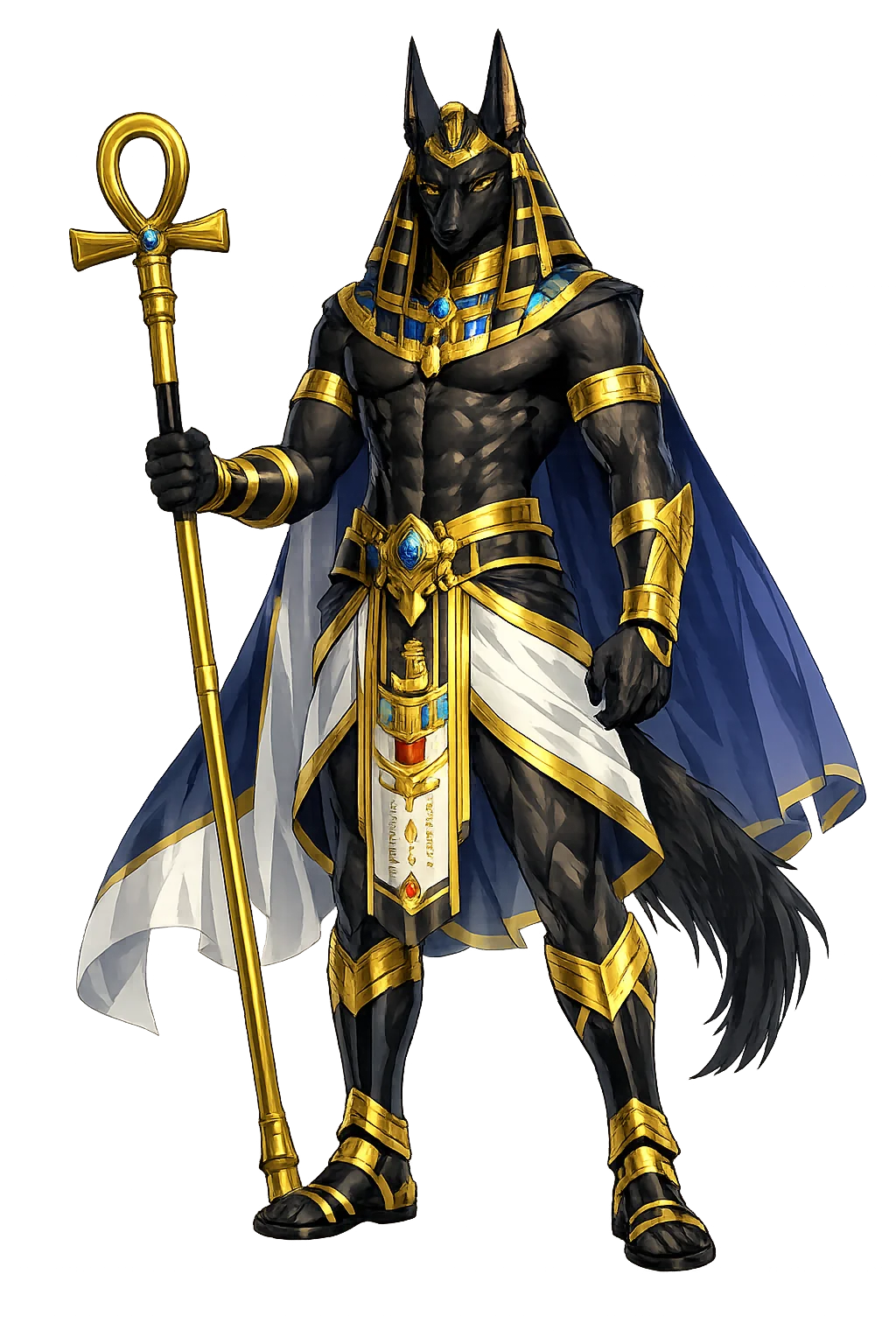
ꜣnpw — the one true spelling, and the forms that fail it
Evidence dossier 040 — ꜣnpw. Every exhibit catalogued, every ruling stated with its grounds.
At a Glance
- Canonical form: ꜣnpw
- Original script: 𓃢
- Pantheon: Egyptian
- Convention: Egyptological transliteration — ꜣ, ꜥ, ḥ, ḏ, ṯ as the grammars record them
- False forms on record: 2
- Contested forms: 1
- Series: The Canonical Register, No. 40 of 546
The Evidence
Exhibit 1 — the attestation. The attested form is 𓃢, from the tradition's own record. The canonical transliteration is ꜣnpw.
Exhibit 2 — the flattened form. The plain form anubis is not false — it is a fallback, and the register is exact about what that means. In systems that cannot carry diacritics (legacy databases, older tooling, parts of the address-bar pipeline) the flattened form is the accepted vehicle, and the rulebook names it explicitly as the final rung of the fallback hierarchy: full restoration first, circumflex where attested, macron-only by the academic standard, an attested variant, and only then plain ASCII.
What the fallback status forbids is promotion: anubis may carry the name where marks are impossible, but it may not represent the name where marks are possible. A fallback is a vehicle, never the primary.
Exhibit 3 — struck from the record: anpw. Origin: the publisher compromise — older books and hurried websites that print the "English equivalent" as if it were the name itself. Grounds: every substitution here (ꜣ→a) is a romanization of convenience, not an attested spelling — it teaches the reader to guess, not to read.
Exhibit 4 — struck from the record: ânpw. Origin: the near-miss — a form that looks right at a glance and circulates on wikis and forums. Grounds: the aleph ꜣ is a consonant (a glottal/vocalic reed), not a long vowel â.
Exhibit 5 — forms with legitimate standing. Anúbis (Acute on upsilon: alternate stress position; support: Faulkner). Recorded with their grounds; none displaces the canonical primary.
Exhibit 6 — the physical record. Tutankhamun's tomb (KV62) yielded the Anubis shrine: a life-size black wooden jackal, gilded ears and collar, guarding the canopic equipment — now in Cairo. The Anubeion at Saqqara, excavated over decades, preserves catacombs of mummified dogs and jackals offered to him — estimates run to millions of animals across Egypt's canine catacombs. Vignettes of spell 125, with his hand on the scales, survive in hundreds of Books of the Dead, from the papyrus of Ani in the British Museum to the papyrus of Hunefer.
Exhibit 7 — the continuing record. He is, for most of the world, the face of ancient Egypt: Tutankhamun's recumbent jackal shrine — black wood, gilded ears, guarding the royal canopic chest — is among the most reproduced objects on earth, and the mummy-genre of cinema, from Karloff's Imhotep to modern franchises, works entirely in his territory. The modern image of justice borrowed his instrument: every balanced beam in courthouse iconography unconsciously quotes his scales.
The Convention's Own History
Egyptological transliteration exists because hieroglyphs write consonants, not vowels. The characters ꜣ (aleph) and ꜥ (ayin) are consonants — a glottal reed and a pharyngeal grip — and rendering them as vowels does not "simplify" the name, it deletes consonants from it. The conventions in use descend from nineteenth-century decipherment and the standardized Manuel de Codage: ḥ, ḫ, ḏ, ṯ each mark a distinct consonant the Egyptian wrote and a modern reader must not merge. When this register defends them, it defends the principle that a writing system older than the alphabet gets to keep its consonants.
The Protocol's Position
Can the canonical form live in the address bar? Almost always, yes. IDNA 2008 admits every mark this register defends — the DNS stores them as `xn--` punycode and modern browsers render them natively. The real frictions are practical, not legal: some registrars stock only part of the IDN space, so a theoretically valid name can be temporarily unbuyable; and stacked combinations (an acute riding a macron) remain awkward to type on mobile keyboards even where the protocol accepts them.
The project's answer is a ranked ladder, not a compromise: the full restoration first, then attested fallbacks in descending order of completeness. The ladder's lowest rung, plain ASCII, is a vehicle for legacy systems — sanctioned, but never presented as the scholarly form.
The Verdict
Case closed on ꜣnpw: canonical, cited, and defended. The keyboard form anubis rides as the sanctioned fallback — and stays in that lane. The register's files remain open: if a source surfaces that changes any line of this entry, the entry changes. Until then, the temple at /anubis/ holds the canonical form.
The docket for this ruling: 2 false forms ruled against, anpw first on the docket; 1 contested form recorded with its support; the attestation rests on 5 cited sources — Pyramid Texts (Old Kingdom funerary corpus; Faulkner, The Ancient Egyptian Pyramid Texts), Book of the Dead, spell 125 (the weighing of the heart, with vignettes), Plutarch, De Iside et Osiride 12–14, 20 (the Osiris myth and Anubis' lineage).
The Register Continues
The register holds 546 entries like this one — each temple with its own ruling. Read the temple's founding dispatch for the story, its Restoration File for the philology, its Resonance File for the industries, or the whole archive end to end.
Continue the register — previous entry: Anû (read it) · next entry: ꜥꜣpp (read it).
The Canonical Register is written from the same canonical record as the lexicon itself. If a false form is missing from this page, it is because the evidence does not support calling it false — or because we have not seen it yet. Show us, with a citation, and the register will answer.