PuniCodex

Extended Lore

𓋹 ꜥnḫ

Etymology · Orthography · Cult · Iconography · Reception · Sources

Tier 1 ꜥnḫ.com
ꜥnḫ — Symbol of Life
01

Quick Facts

Essential information about ꜥnḫ, Symbol of Life

Original Script𓋹
Unicode Restorationꜥnḫ
Reconstructed Pronunciation/ˈʕaːnax/
PantheonEgyptian
DomainSymbol of Life
MeaningLife; Egyptian ankh sign
ClassificationTier 1
Primary Domainꜥnḫ.com
Sacred SymbolsAnkh hieroglyph, Breath / nostril, Shen ring, Was scepter, Sandal strap
02

Etymology & Word Family

From original script to Unicode restoration

Original Script 𓋹 ꜥnḫ — "Life; Egyptian ankh sign"
Unicode Restoration ꜥnḫ Restored stress, length, and script
Modern ASCII ankh Plain-ASCII fallback

The name ꜥnḫ carries the orthographic signature of the egyptian tradition: 𓋹. Unicode restoration recovers what ASCII flattens.

03

Unicode Character Breakdown

Character-by-character philological analysis

CharacterUnicodeNameBlockPhonetic Role
ꜥU+A725Latin Small Letter Egyptological AinLatin Extended-DGlottal stop ꜥ
nU+006ELatin Small Letter NBasic LatinSame
ḫU+1E2BLatin Small Letter H with Breve BelowUnknownVoiceless velar fricative ḫ
—N/ADropped characterEgyptian orthographyDropped: English placeholder

The Tier 1 classification reflects how much of the original phonology this restoration preserves — stress and vowel length for Greek names, distinctive letters and diacritics for every other tradition.

04

Cult & Worship

How the sacred was kept — rites, sanctuaries, remains

The Cult

The ankh was not itself a god and had no temples, but it held a permanent post in every temple in Egypt. Its cult was the daily office: each morning the cult statue was washed, anointed, dressed, and handed the sign of life by the officiating king or priest — the transaction carved thousands of times from Karnak to Edfu, the longest-running maintenance liturgy in religious history. Royal ideology made the rite constitutional: the king ruled because the gods handed him life, breath by breath, and to omit the morning offering was to let the world's charge drain. In the tomb the sign changed clergy: ankh amulets of faience, carnelian, and gold were laid at the throat and chest of the dead, and the Late-Period Book of Breathings promised that its recitation would supply the ba with air. No festival honored the sign and no priesthood served it alone — but for three thousand years someone was always handing life to someone else, and that is cult enough.

In the Earth

The ankh sign appears from the First Dynasty onward on seal impressions, labels, and pottery. It dominates royal stelae such as the Sphinx Stela of Thutmose IV and the Kamutef scenes at Luxor Temple, where Amun offers life to the divine birth of the king. Thousands of ankh amulets survive from New Kingdom tombs, including examples from the Valley of the Kings and the burial of Tutankhamun. The sign is painted on coffins, papyri, and tomb walls from Saqqara to Nubia.

05

Iconography

How ꜥnḫ was imaged across the ages

The Image

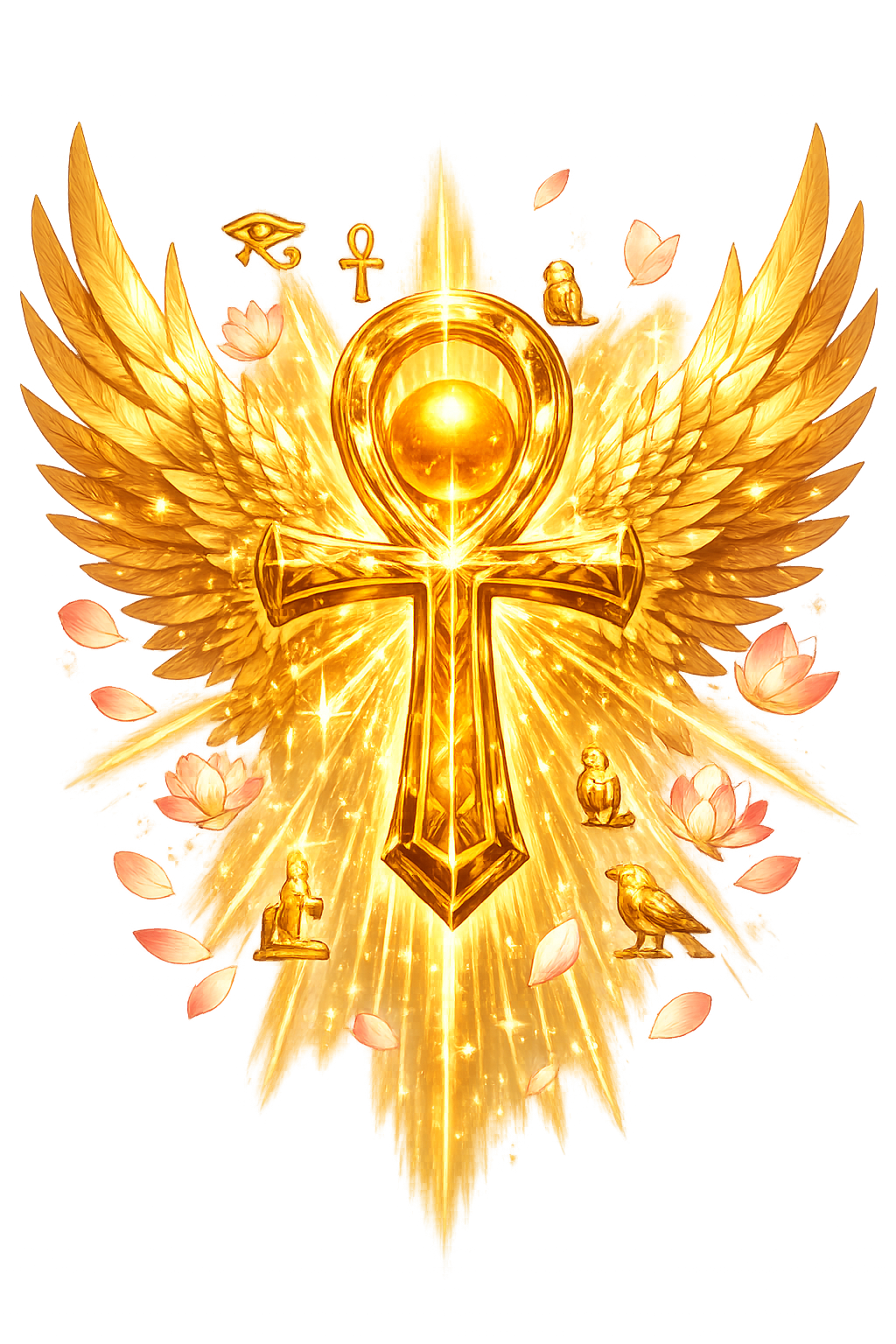
The ankh is instantly recognizable: a looped teardrop set on a crossbar above a vertical stroke, Gardiner sign S34. It appears at the very start of Egyptian history — First Dynasty sealings and labels carry it — and Gardiner's still-standard hypothesis derives it from a sandal-strap knot, the word ꜥnḫ being homonymous with 'sandal strap.' The loop lengthened over the centuries, and the sign learned to combine: wedged between the was-scepter and the djed-pillar it formed the triad 'life, dominion, stability' that bands coffins and temple walls. Its most eloquent career is gestural — the god leaning to press the ankh to the royal nostrils, from the Sphinx Stela of Thutmose IV to the divine-birth rooms at Luxor. At Amarna the sun's rays end in tiny hands offering ankhs to the royal family. Key survivors: the Thutmose IV stela before the Great Sphinx, and Tutankhamun's gilded shrines, where the sign borders every surface — life as wallpaper for eternity.

06

Reception & Transformation

The name after its own age — transmission, translation, survival

Afterlives

The ankh's long journey began with a change of clergy. In the early centuries CE Egypt's Christians folded the sign into their own art as the crux ansata, and Coptic funerary stelae carried it for a millennium — the loop crossing over without loosening its grip on 'life.' Medieval Europe then lost the symbol entirely; it returned with the Napoleonic savants, whose Description de l'Égypte (1809–1829) flooded European workshops with accurate plates of temple reliefs thick with looped crosses. Champollion's decipherment in 1822 named the sign at last: ꜥnḫ, 'life.' Nineteenth-century Egyptomania diffused the form through jewelry, furniture, and architecture, usually as a romantic cipher, while scholarship slowly rebuilt its biography: Erman and Grapow's Wörterbuch fixed its dictionary entry in 1926, and Gardiner's Egyptian Grammar catalogued it as S34 with the sandal-strap etymology that still frames the debate. The journey's latest station is a registry no temple could have imagined — Unicode, where U+2625 gives the ankh a permanent code point. Three thousand years from nostril to keyboard.

Identifications Across Traditions

The ankh outlived pharaonic religion. Coptic Christians adopted it as the crux ansata, the 'handled cross,' seeing in its loop the triumph of eternal life over death. Some early Christian writers interpreted the loop as a halo or the risen Christ. In the twentieth century the ankh became an emblem of Black identity, Afrofuturism, and Kemetic spirituality, often detached from its specific Egyptian context. It also entered fantasy fiction, gothic fashion, and popular occultism as a generic symbol of immortality — a remarkable afterlife for a sign that began on the lips of gods.

Modern Legacy

No Egyptian symbol is more recognizable today. The ankh appears on jewelry, tattoos, album covers, and video-game inventory screens, usually as a token of life or undead persistence. In Coptic Christianity it remains a baptismal and funerary emblem. Scholars of African diaspora religions note its power as a reclaimed icon of Nile Valley civilization. Whether worn as faith, fashion, or fandom, the ankh still asks the same question it asked in the tombs: What does it mean to live beyond the limits of a single body?

07

The Meditation

What ꜥnḫ means — beyond the dictionary

The ankh is a quiet god. It does not speak, fight, or weep; it simply offers. In a culture obsessed with heroic narratives, a symbol whose whole theology is 'here, breathe' can seem too simple. But that simplicity is its depth. The ankh reminds us that life is not a possession we secure through effort; it is a current we receive and pass on.

Every time a deity in a temple relief presses the ankh to a king's nostrils, Egypt is teaching a physics of grace: existence flows from the divine into the human, from the human into the land, from the land into the memory of those who come after. To carry the ankh is to join that circulation. It is the oldest imaginable promise, written in three consonants and one elegant loop: you are alive, you can be alive again.

08

Frequently Asked Questions

Common questions about ꜥnḫ, Symbol of Life, and Unicode restoration

01How do you pronounce ꜥnḫ?

In reconstructed pronunciation, ꜥnḫ is /ˈʕaːnax/ — approximately 'AH-nakh' — say 'ah' from the back of the throat, then 'nakh' with the final consonant like Scottish 'loch' (not a hard English k).

02What does ꜥnḫ mean?

ꜥnḫ means Life; Egyptian ankh sign in the egyptian tradition.

03What are the symbols of ꜥnḫ?

ꜥnḫ is associated with Ankh hieroglyph (The looped cross itself, logogram and phonogram for 'life'), Breath / nostril (The air of life that gods deliver by pressing the ankh to the nose), Shen ring (Eternity; often paired with the ankh on royal cartouches), Was scepter (Dominion and vitality, frequently held alongside the ankh in divine hands), Sandal strap (Gardiner's proposed pictographic origin of the sign — a looped strap; the word ꜥnḫ is homonymous with 'sandal strap', and the object's knot survives in the sign's crossed base.).

04Why restore ꜥnḫ in Unicode?

Plain ASCII ankh strips the stress, length, and script that make the name specific. Unicode restoration returns the name to its original written dignity.

05What is the most important myth about ꜥnḫ?

“The First Giving of Life” — the Cosmogony story that anchors the mythology of ꜥnḫ, told in full on the lore page.

09

Scholarly Sources

The philological foundations of this restoration

Every claim on this page is grounded in established scholarship. The orthographic restorations follow disciplinary convention. The etymological chain follows the best available reference works. This is not invention — it is resurrection through scholarship.

◈

Lexicography & Philology

  • Faulkner, R. O. A Concise Dictionary of Middle Egyptian. Oxford: Griffith Institute, 1962.
  • Gardiner
◎

Primary Texts

◉

Archaeology & Art History

  • Material evidence — iconography, inscriptions, and temple archaeology — for ꜥnḫ and related cults.
✦

Religious Studies

  • Allen, Middle Egyptian (2014), on ꜥ and ḫ
  • Faulkner, A Concise Dictionary of Middle Egyptian, s.v. ꜥnḫ
  • Wörterbuch der ägyptischen Sprache I, s.v. ꜥnḫ
  • Gardiner, Egyptian Grammar, sign-list S34
  • Hornung, The Ancient Egyptian Books of the Afterlife
  • Wilkinson, Reading Egyptian Art, s.v. ankh
Return

The Surface Awaits

You have traced the name from its earliest attestation to its Unicode restoration. Now return to the myth. The story is where the name lives.

Back to Lore
ꜥnḫ mascot