
Pronouncing Andvari: a guide for the curious
Saying Andvari aloud is harder than reading it on a screen, and more rewarding. The restored spelling is a compressed pronunciation guide: every accent and macron is an instruction. This post unpacks those instructions — the reconstructed sound, the phoneme-by-phoneme record, the kindred forms in neighboring languages — and then zooms out to the full record around the name: its Younger Futhark writing, its mythology, its cult, and its modern life as a Unicode domain. Whether you arrive as a linguist, a reader of myth, or a domainer, you will leave able to say the name the way the evidence suggests it was said — and able to type it the way it was written.
At a Glance
- Restored name: Andvari
- ASCII form: andvari
- Meaning: "Careful one"
- Domain of influence: Dwarf, Guardian of Gold
- Pantheon: Norse
- Classification: Tier 2
- Original script: ᛅᚾᛏᚠᛅᚱᛁ (Younger Futhark)
Overview
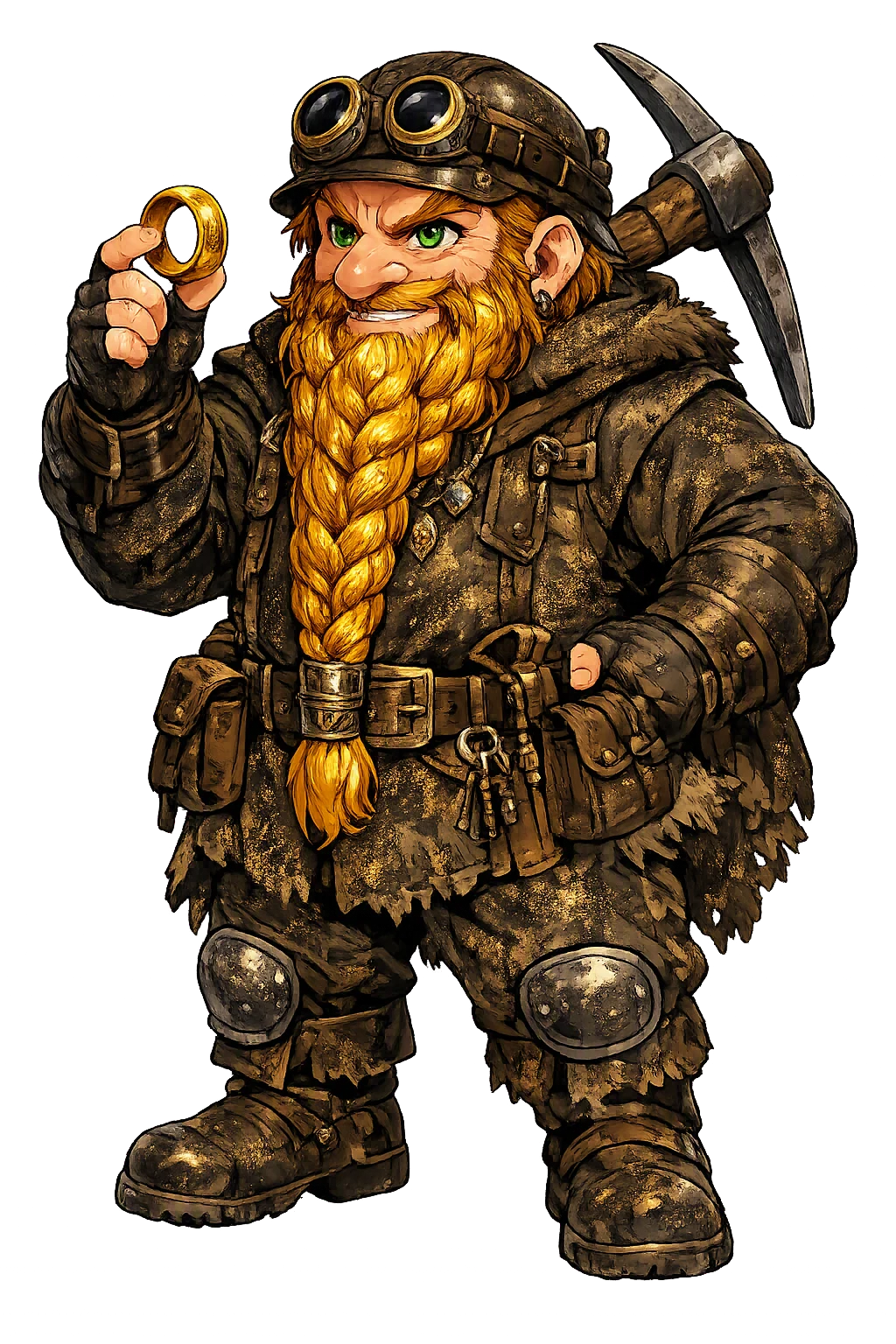
Andvari (andvari) — Dwarf, Guardian of Gold · The Careful One of the Waterfall — is the dwarf of Andvarafors who kept his hoard in a pike's shape, and the first owner of Andvaranaut, the ring whose curse runs through the whole Völsung cycle. When the Æsir owed Hreiðmarr a wergild for his shape-changing son Ótr, Loki borrowed Rán's net, dragged the waterfall, and stripped the dwarf of every coin — and Andvari answered the robbery with a sentence that outlived him by four generations: the gold would be the death of two brothers, strife to eight of the kin-line, and joy to no one.
His dossier is a single episode and its enormous echo. Reginsmál's prose, Snorri's Skáldskaparmál, and Völsunga saga all tell the catching at the waterfall; everything after — Fáfnir brooding into a dragon on Gnitaheiðr, Sigurðr's sword, the hoard sunk in the Rhine by the doomed Gjúkungar — is the curse working itself out, owner by owner.
PuniCodex restores the name as Andvari — identical to the ASCII input, because normalized Old Norse writes no diacritic in this name. The mechanical rule therefore places it in Tier 2: nothing distinctive is lost in transit, a statement about orthography and never about the figure. No domain is claimed: the plain-ASCII andvari.com is held outside the collection and is watched for release.
The Name
The name is attested in Old Norse as Andvari — a weak masculine noun with no added nominative ending, so the name ends in plain -i. Beside the proper name stands the common noun andvari, 'care, solicitude, watchfulness': the dwarf bears a speaking name, 'the careful one', exactly the quality a hoard-keeper requires — and exactly the quality the myth shows failing. Cleasby–Vigfusson record both the noun and the dwarf under the same headword, and the same dictionary derives the ring's name as Andvara-naut, 'Andvari's jewel'.
The ASCII form survives unchanged because the name was always plain ASCII: Old Norse writes no diacritic here, no eth, no thorn, no long vowel. Because the restoration preserves nothing the ASCII alphabet could not carry, the name is classified Tier 2 by the mechanical rule — a report on orthography, never a judgment on the figure.
The letter-by-letter transformation runs:
- a → A — Same, capitalized
- n → n — Same
- d → d — Same
- v → v — Same
- a → a — Same
- r → r — Same
- i → i — Same
The project holds no domain for this name: andvari.com is registered outside the PuniCodex collection and is watched for release. The temple lives at its canonical lexicon address.
The Original Script
The name is preserved in medieval Icelandic manuscripts in the Latin alphabet as Andvari — Old Norse (North Germanic), attested 13th c. CE in the Codex Regius of the Poetic Edda and the codices of the Prose Edda, with Völsunga saga surviving in the paper manuscript NKS 1824 b 4to (c. 1400). The manuscript form is itself plain ASCII: Old Norse writes no diacritic in this name, and the restoration changes nothing but the capital. In the Younger Futhark — the sixteen-rune Viking-Age row — the name would have been carved ᛅᚾᛏᚢᛅᚱᛁ (a-n-t-u-a-r-i); the runic row underspecifies what the manuscripts fix, with ᛏ writing both t and d and ᚢ writing v. No Viking-Age carving of the name is known, so the manuscript spelling remains the primary witness.
The scholarly rendering proceeds step by step:
- The name is a weak masculine noun, andvari, 'care, watchfulness' — the same word as the common noun — ending in plain -i with no added nominative -r.
- Old Norse orthography writes no long vowel and no diacritic anywhere in the name.
- The letter v is the voiced labiodental fricative; in runic carving it falls to ᚢ (úr), as in most v-initial and medial positions.
- The Unicode restoration Andvari keeps the attested spelling exactly; the ASCII form andvari loses only the capital.
Because the name is pure ASCII, its domain was registered in the ordinary way: andvari.com is held outside the PuniCodex collection and is watched for release — no form of the name is currently owned, and this temple claims none.
Pronunciation
The reconstructed pronunciation of the name is /ˈɑnd.vɑ.rɪ/ — Old Norse Reconstruction.
Phoneme by phoneme:
- A- — Short open back unrounded [ɑ], stressed as the first syllable of every Old Norse word; brief, not the long á
- -nd- — Alveolar nasal [n] followed by a fully voiced stop [d]; in runic carving the d would be written with the t-rune, which underspecifies voicing
- -vari — Voiced labiodental [v] as in English very, a second short [ɑ], trilled [r], and a short close [i]; the weak-declension name carries no added nominative -r
For the modern speaker, the closest approximation is: 'AHND-vah-ri' — three even syllables, stress on the first, the v soft, the r trilled, the ending a short 'ih'.
Kindred and historical forms of the name:
- Old Norse — Andvari, the dwarf of Andvarafors; also the common noun andvari, 'care, solicitude'
- Younger Futhark — ᛅᚾᛏᚢᛅᚱᛁ (a-n-t-u-a-r-i), the Viking-Age runic rendering, with ᛏ writing d and ᚢ writing v
- Modern Icelandic — Andvari, revived as the title of the learned journal of the Icelandic Literary Society, founded 1874
Andvari is Tier 2 because the restoration preserves nothing the ASCII form loses — no diacritic, no distinctive letter, no vowel length. The dwarf's fame rides on his ring, not on his orthography.
Mythology
Andvari's mythology is one afternoon's extortion and a four-generation echo. The corpus tells the catching three times — Reginsmál's prose, Snorri's Skáldskaparmál, and Völsunga saga — with unusual agreement, and then spends the rest of the Völsung cycle proving the curse.
The Otter's Ransom (Reginsmál prose · Skáldskaparmál)
Óðinn, Loki, and Hœnir came to a waterfall and saw an otter on the bank eating a salmon, its eyes shut; Loki killed it with a stone and boasted of a double catch. But the otter was Ótr, shape-changing son of the farmer Hreiðmarr. That night Hreiðmarr and his sons Fáfnir and Reginn seized the gods and set the wergild: the otter's skin filled with red gold and covered with gold until not a hair showed. Óðinn sent Loki down to Svartálfaheimr to find the gold where it lay — in the keeping of a dwarf at a waterfall.
The Net of Rán (Völsunga saga 14)
Loki went to Rán, the sea-queen who drowns sailors, and borrowed her net; at Andvarafors he cast it and caught the pike-shaped dwarf. The ransom was everything: all the gold in the waterfall, or Andvari's head. The dwarf paid the hoard over but kept one small ring hidden in his hand — with it, he pleaded, he could breed gold again. Loki took that too: one coin left would be one too many.
The Curse (Reginsmál prose · Völsunga saga 14)
Stripped bare, Andvari spoke the sentence the tradition preserved as its own words: the gold that Gustr — the dwarf's other name in the prose — had owned would be the death of two brothers and bring strife to eight of the kin-line, and no man would have joy of his wealth. The ring took its name from the loss: Andvaranaut, 'Andvari's jewel'. Even the last coin went into the ransom, covering the final hair of the otter-skin.
Fáfnir's Bed (Völsunga saga 14–20 · Fáfnismál)
The curse began at once: Hreiðmarr refused his sons a share, Fáfnir killed his father sleeping, took the hoard to Gnitaheiðr, and brooded on it until he became the worst of serpents. Reginn, cheated, fostered Sigurðr of the Völsungs, reforged the sword Gram, and egged the hero to the heath. Sigurðr stabbed up into the dragon's belly from a pit, killed Reginn on the nuthatches' warning, and loaded the hoard — Andvaranaut and all — on Grani's back. The third owner of the ring was the greatest hero of the North, and the curse did not care.
The Gold in the Rhine (Völsunga saga 24–31 · Atlakviða)
From Sigurðr the treasure passed into the house of the Gjúkungar. When Atli lured Gunnar and Högni to his hall for the hoard, the brothers sank the whole of it in the Rhine before riding to their deaths — Högni's heart cut out, Gunnar harping with his toes in the snake-pit until an adder found his heart. Atlakviða closes the account with the river as the treasure's last keeper: the Rhine shall hold the strife-metal of the Niflungar. Two brothers dead, eight of the line at strife, no man the happier: Reginsmál's prophecy closed like a hand.
Symbols & Iconography
The iconography of Andvari is the iconography of a single robbery — the corpus fixed around his waterfall a set of objects no retelling can omit:
- Andvaranaut — 'Andvari's jewel', the last ring of the hoard, hidden in his hand, taken by force, and answered with the curse: the treasure that kills every hand it passes through
- Rán's net — the sea-queen's drowning-net, borrowed by Loki to drag the waterfall: borrowed catching-power, a fisherman's trick in the service of a blood-debt
- Andvarafors — the waterfall named for its keeper, the flowing hoard-hall where he swam in fish-shape
- The pike-shape — the disguise of the careful: a form made for guarding, useless against a net
- The otter's skin — not his own emblem but the measure of his loss: the wergild that had to fill and cover Ótr's hide, hair by hair, until the last coin of the hoard went on the last hair
Archaeology & Evidence
Andvari himself is a purely literary figure: no runestone, votive deposit, or named image records him. But the cycle his gold sets in motion is the best-attested narrative in Viking-Age art. The Ramsund carving in Södermanland (Sö 101, c. 1030) cuts the whole Fáfnir episode into a rock face — Sigurðr thrusting up through the serpent's body, the slain Reginn with his smith's tools, Grani loaded with the treasure, and the birds whose speech the dragon-heart taught — and the Gök stone (Sö 327) weaves the same scenes through a runic inscription.
The Drävle runestone (U 1163) shows Sigurðr stabbing the serpent, and related scenes appear as far west as the Isle of Man and the Halton cross in Lancashire, tracking the cycle along the Norse sea-roads. The manuscript witnesses are thin in the usual way: Reginsmál and its narrative prose stand in the Codex Regius of the Poetic Edda, Snorri's account in the codices of the Prose Edda, and Völsunga saga in the paper manuscript NKS 1824 b 4to (c. 1400), the saga's only complete medieval copy.
Realm & Domain
Andvari is catalogued under Dwarf, Guardian of Gold — and the sources give each term its full weight: he is one of the dvergar, the smith-people of the dark places, and his keeping of the waterfall's gold is the most complete portrait of hoard-guardianship the Norse corpus preserves.
The Dwarf
Reginsmál's prose introduces him by kind before name: 'Andvari was the name of a dwarf' who lived in the waterfall. The corpus sets him among the dvergar of Svartálfaheimr, the world Loki enters to find the ransom-gold — the smiths and hoarders who stand opposite the Æsir in every treasure-story.
Guardian of Gold
He kept his hoard by swimming it: in a pike's shape he swept through Andvarafors with the gold about him, a guardian whose watchfulness is his very name — andvari, 'care'. The pike-form is camouflage, not nature: a shape made for keeping, not for fighting.
The Waterfall-Keeper
The falls themselves bear his name — Andvarafors, 'Andvari's waterfall' — a hoard-hall that flows and cannot be locked, which is why it took a net rather than a siege to rob him.
Speaker of the Curse
His last domain is speech: stripped of everything, he laid on the ring the sentence that governs the rest of the cycle — death to two brothers, strife to eight of the kin-line, joy to no one. The careful one's final act of care was to make sure the gold would care for no one else either.
Across Cultures
Andvari needs no foreign counterpart: the cursed-hoard complex is native Germanic, and the corpus supplies its own sharpest contrast in another dwarf-ring. Draupnir, forged freely by Brokkr and Sindri for the gods, drips eight new rings every ninth night — the given ring multiplies; the taken ring kills. Between them the two rings map the North's whole ethics of treasure: gold that moves as gift breeds more, gold that moves by force breeds death.
Continental heroic tradition keeps the same stratum: the hoard of the Nibelungenlied, won by Siegfried, sunk in the Rhine, and deadly to its holders, is the southern telling of the Andvaranaut complex, and scholarship treats the Norse and German versions as one inheritance rather than borrowings. The dwarf caught in fish-shape has a family resemblance to the water-spirits of later folklore, but the Eddic Andvari is a smith and hoarder first; his pike-form is camouflage, not nature.
Cultural Legacy
Andvari's afterlife is one of the largest in mythology, worn under another name. Wagner's Alberich in Das Rheingold — the dwarf of the water's depth, robbed of his gold, who lays a curse on the ring and watches it destroy owner after owner through four operas — is built substantially on the Andvari of Reginsmál and Völsunga saga, crossed with the Nibelungenlied's hoard; the curse-motif that drives the entire Ring cycle is the sentence spoken at Andvarafors.
William Morris's Sigurd the Volsung (1876) kept the dwarf's own name before English readers in the Victorian North's most ambitious retelling. In Iceland the name was revived with no curse attached: Andvari is the title of the learned journal of the Icelandic Literary Society, founded in 1874 — the careful one finally keeping something that multiplies without killing. And modern fantasy's treasury of cursed gold runs downhill from his waterfall.
The Scholarly Record
The account of Andvari given in this edition rests on the witnesses and reference works listed below. Reginsmál's prose, Skáldskaparmál, and Völsunga saga supply the narrative; the lexica secure the name's meaning; the handbooks arbitrate the cursed-hoard complex and its reception.
- Reginsmál, prose introduction (the killing of Ótr, Rán's net, the ransom, the curse), trans. Carolyne Larrington, The Poetic Edda, 2nd ed. (Oxford: Oxford University Press, 2014).
- Völsunga saga, chs. 14–31, trans. Jesse L. Byock, The Saga of the Volsungs (London: Penguin, 1999).
- Snorri Sturluson, Edda, Skáldskaparmál (the otter's ransom; kennings for gold), ed. and trans. Anthony Faulkes (London: Everyman, 1987).
- Fáfnismál and Atlakviða (Poetic Edda), trans. Larrington (2014).
- Cleasby, Richard, and Guðbrandur Vigfússon, An Icelandic-English Dictionary, 2nd ed. (Oxford: Clarendon Press, 1957), s.v. andvari, Andvara-naut, otr-gjöld.
- Zoëga, Geir T., A Concise Dictionary of Old Icelandic (Oxford: Clarendon Press, 1910), s.v. andvari.
- Simek, Rudolf, Dictionary of Northern Mythology, trans. Angela Hall (Cambridge: D. S. Brewer, 1993), s.v. Andvari.
- Orchard, Andy, Dictionary of Norse Myth and Legend (London: Cassell, 1997), s.v. Andvari.
- Lindow, John, Norse Mythology: A Guide to the Gods, Heroes, Rituals, and Beliefs (Oxford: Oxford University Press, 2001), s.v. Andvari, Andvaranaut.
- Morris, William, The Story of Sigurd the Volsung and the Fall of the Niblungs (London: Ellis and White, 1876).
A Meditation
His name is care itself — andvari, watchfulness, the quality of mind that checks the locks twice. And the myth is merciless to it: the most careful keeper in the corpus is caught in an afternoon, by a borrowed net, in his own water, and stripped to the last hidden ring. Care could not save him, because care guards against theft, and what came for him was law — a wergild, a skin that had to be covered hair by hair.
What he had left was speech, and he used it like a dwarf: precisely, vindictively, and with perfect aim. The curse is the one thing he made that nobody could take, because it was already given. Everything after is arithmetic — two brothers, eight of the line, no joy — and the myth lets the numbers run for four generations to teach the lesson the North never tired of: gold taken by force does not change owners; it changes victims. The careful one's revenge on the careless world was simply to tell it the truth about what it had just picked up.
The Unicode Restoration
Andvari is classified as Tier 2: the restoration needs no distinctive letters or diacritics its ASCII form would lose. The ASCII fallback andvari still resolves everywhere, but it is the restored form that carries the name's full information. That is the whole thesis of this temple: the marks are the message.
Why This Restoration Matters
Pronunciation turns out to be the heart of the matter. The marks in Andvari are instructions for the voice, and a web that strips them is a web that mispronounces the past at scale. The restoration hands the instructions back: say it as the evidence suggests, type it as the tradition wrote it, and let the punycode machinery do the quiet translation in between. That is all the PuniCodex project asks of the infrastructure — and everything it asks of you, the reader, is to use the whole name.
Explore Further
This post is one doorway into the temple. The home page carries the full character breakdown and the ambient canvas; the lore page tells the myths in long form; the Scholarly Edition preserves the sources, pronunciation data, and revision history; and the patron wall supports the restoration directly. For the wider map, browse the Lexicon, explore the Pantheon, or return to the PuniCodex blog.
Related Names
Sources
The full scholarly apparatus — every citation, revision, and review — lives in the Scholarly Edition. Key references for this post:
- Reginsmál, prose introduction (Poetic Edda), trans. Carolyne Larrington, The Poetic Edda, 2nd ed. (Oxford: Oxford University Press, 2014).
- Völsunga saga, chs. 14–31, trans. Jesse L. Byock, The Saga of the Volsungs (London: Penguin, 1999).
- Cleasby, Richard, and Guðbrandur Vigfússon, An Icelandic-English Dictionary, 2nd ed. (Oxford: Clarendon Press, 1957), s.v. andvari, Andvara-naut.
- Cleasby, Richard, and Guðbrandur Vigfússon, An Icelandic-English Dictionary, 2nd ed. (Oxford: Clarendon Press, 1957), s.v. andvari.
- Lexicon authorities for this entry: Poetic Edda, Cleasby-Vigfusson.