The Living Myth
Goddess of War and the Hunt · The Virgin of the Hunt and War
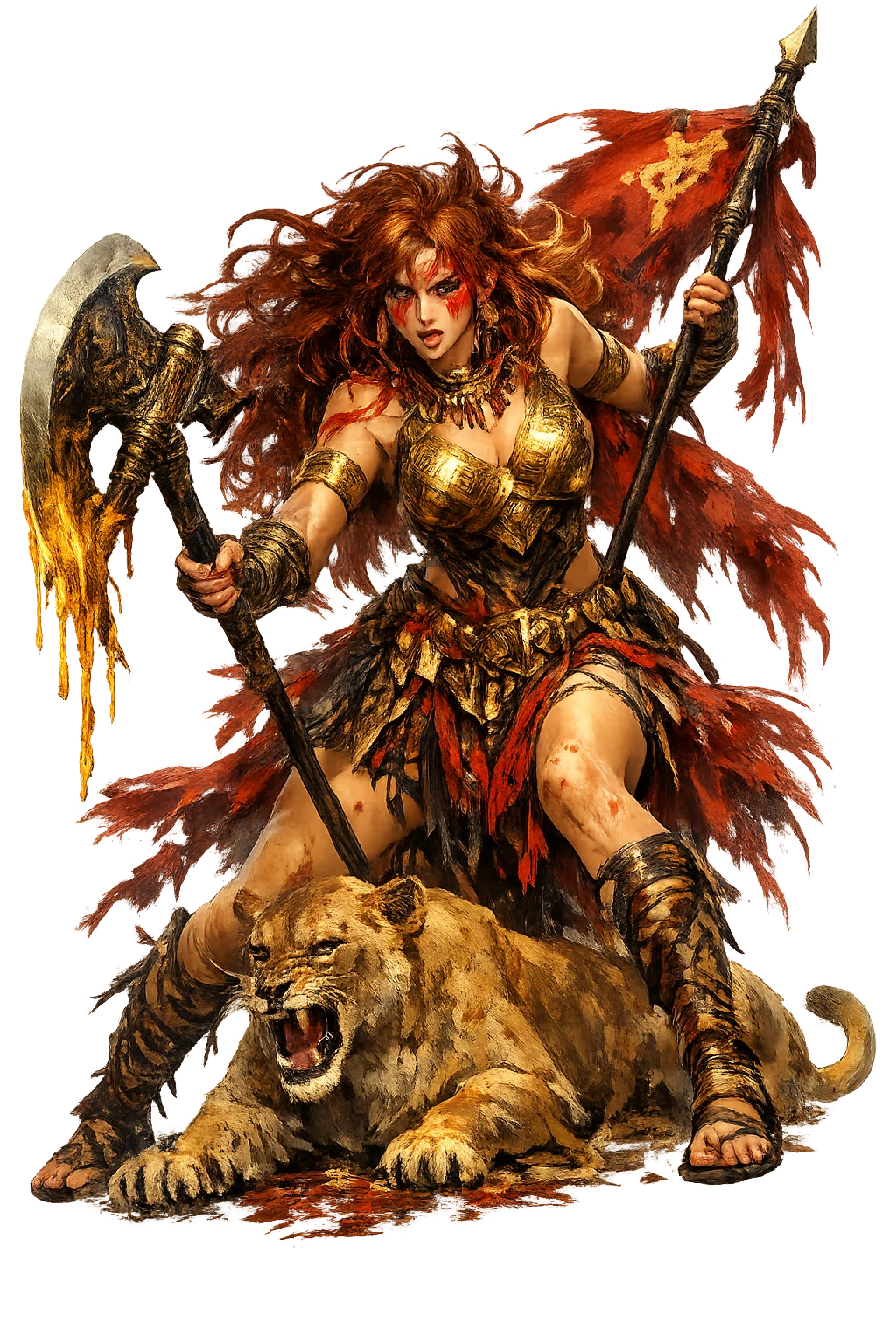
Stories of ꜥAnat
ꜥAnat's mythology is preserved chiefly in the Ugaritic Baꜥal Cycle and the Epic of Aqhat. She is not a fertility goddess in the usual sense; she is force itself, concentrated in a young woman's body, and her stories turn on violence, loyalty, and the refusal to accept limits.
The most famous portrait of ꜥAnat is a battlefield after the killing is done (KTU 1.3 ii). She stands in her house, her garments spattered, and boasts over her work: 'heads rolled beneath her like balls, the hands of warriors flew over her like locusts.' In exultation she fastens the severed heads to her back and hangs the men's hands on her belt, then sits down to her own victory rite — she slaughters her captives 'beneath her like lambs.' When the gore is spent she washes herself, not in water alone but in the dew of heaven that Baꜥal, the Rider on the Clouds, sends down upon her. The scene appalls and fascinates in equal measure: war here is not grim duty but ecstasy, and the dew that cleanses her comes from her brother, binding her violence to the storm's life-giving water. Destruction and fertility are the two hands of one goddess.
When Mōt swallows Baꜥal, ꜥAnat becomes the myth's destroyer of death itself. She ranges the earth searching for her brother; finding him dead, she gives him burial on Zaphon and turns her full ferocity on the god who took him (KTU 1.6 ii). She seizes Mot and works him like a harvest: 'with a sword she splits him, with a sieve she winnows him, with fire she burns him, with millstones she grinds him, in a field she scatters him.' Every verb is a verb of threshing — splitting, winnowing, grinding, scattering — so that the annihilation of death is cast as the harvest it had interrupted. Baꜥal returns, and the rains return with him. The portrait redeems the earlier horror: the ferocity that seemed an excess on the battlefield proves to be the world's repair mechanism. Only an unbounded love, the myth says, is equal to an unbounded appetite — and only a sister could do this work.
The Epic of Aqhat turns on a gift and a refusal. Kothar-wa-Ḫasīs gives the young hero Aqhat a bow without equal, and ꜥAnat covets it. She offers him silver and gold; he refuses. She offers him the one prize gods cannot truly give — 'years like Baꜥal's, life like the sons of El' — and Aqhat answers with a line the tradition never forgave: bows are for men, not for women. Enraged, the goddess flies to the Sutean warrior Yatpan and, in a disguise the poem savors, orders Aqhat's death. The plan miscarries catastrophically: the marvelous bow is shattered, the land is cursed with drought, and Aqhat's sister Pughat — the poem's quiet, formidable heroine — sets out after Yatpan. The text breaks off before her revenge is complete. Even so, the poem's judgment is plain in its ruined harvest: to deny a goddess her due, whether her honor or her weapon, is to let the whole world dry out.
A single fragmentary hymn (KTU 1.13) opens a quieter window on the goddess: the poet sings of Anat the maiden, of the beauty and bounty of the highlands where she roams. Though badly broken, the tablet shows her invoked in blessing — a guardian of her devotees and a power of the open country rather than the city wall, matching her role in the Aqhat epic as a huntress of mountain and steppe. Peggy Day's study of the goddess read her as Ugarit's Mistress of Animals, heir to a Bronze Age tradition of the woman who stands among lions and controls the game, and the fragment coheres with that reading. The hymn matters because almost everything else we have of ꜥAnat is violence; here, at the edge of a broken tablet, is the goddess invoked the way a patron is invoked — for protection, for plenty, for the favor of one who has never learned to be mild.
War, Hunt, and Ferocious Loyalty
ꜥAnat is the maiden who refuses the domestic sphere. In the Ugaritic texts she is neither wife nor mother but a singular force: a warrior who wades knee-deep in the blood of her enemies, a huntress of the open country, and the most faithful ally of Baꜥal. Her title btlt — 'maiden' — marks her as marriageable, yet mythologically she remains unattached, unpredictable, and absolutely devoted to her brother.
She fights both armies and cosmic foes, wielding bow, spear, and sword; KTU 1.3 ii describes her battle fury in graphic detail.
She ranges mountains and heights in search of game or vengeance; her pursuit of Aqhat turns the hunt into tragic myth.
Baꜥal's most passionate advocate; she confronts El, avenges Baꜥal's death, and restores the storm to the world.
A young woman operating in male-coded spheres without condemnation — a figure of autonomous, even terrifying, agency.
From the original script to the living URL
𐎓𐎐𐎚
The name in its original Canaanite form. ꜥAnat (𐎓𐎐𐎚) is attested in the source tradition — “Canaanite warrior goddess, sister and ally of Baꜥal”. Its Egyptological ain and alef letters carry the full phonetic and orthographic weight of the source tradition.
anat
Reduced to plain anat, the name loses everything that made it specific: Egyptological ain and alef letters. What remains is an ASCII string that machines can parse but that no longer speaks with its original voice.
ꜥAnat
The Unicode restoration recovers what ASCII flattened. ꜥAnat restores Egyptological ain and alef letters, returning the name to its original written dignity. The domain encodes to Punycode, but the browser displays the truth.
ꜥAnat.com → xn--anat-pe8o.com
The non-ASCII characters in ꜥAnat are encoded while the ASCII remains visible. To the DNS, it is Punycode. To humanity, it is ꜥAnat.
Owned, ideal, and ASCII forms of ꜥAnat
ꜥAnat
Restores 𐎓𐎐𐎚. The live temple domain — ꜥanat.com.
ʿAnat
Restores 𐎓𐎐𐎚. Ugaritic/Phoenician ʿayin (ʿ) is ideal but not registrable at the DNS root. Not in the PuniCodex collection.
anat
Flattens 𐎓𐎐𐎚. The plain ASCII fallback — what DNS and legacy systems see.
How ꜥAnat was spoken
How ꜥAnat travels from ancient script to the modern URL
Ugaritic ꜥnṯ, cognate with Hebrew ʿĂnāt; a warrior-goddess whose name is probably related to a Semitic root for vigour or strife.
Goddess of War and the Hunt
The Unicode restoration ꜥAnat uses registrable Latin diacritics; the Ugaritic form is not registrable in .com.
The lore you have read is the living myth. Extended Lore opens the scholarly vault beneath it: the cult and its material remains, a history of the image, the name after antiquity, a meditation on what the name still means, and the full scholarly apparatus — etymology, orthography, sources.
Enter Extended Lore