
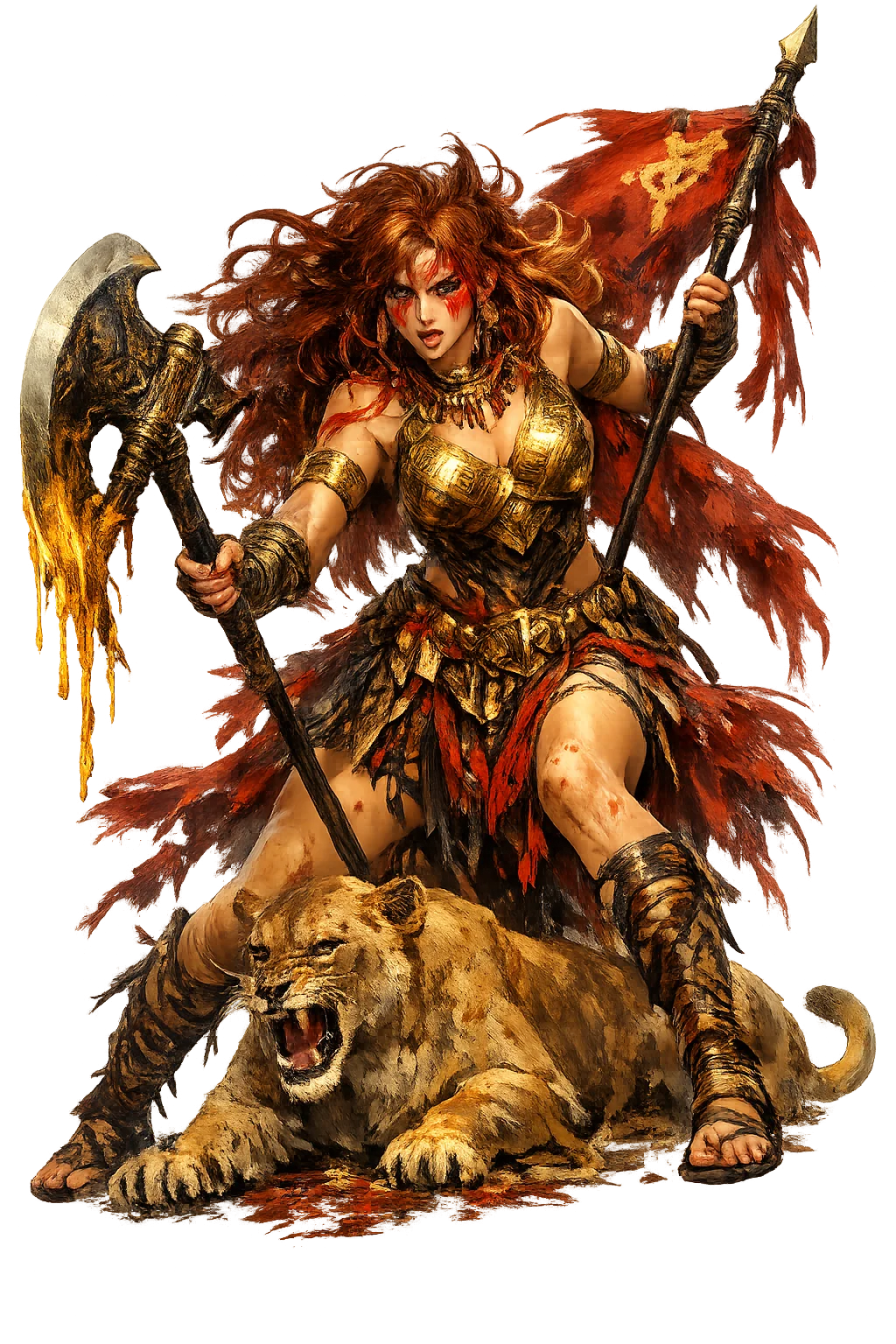
The provenance file on ꜥAnat
The provenance file for ꜥAnat. Nothing here is unsourced; that is what the file is for.
Provenance
1. The attestation. Ἀνάθ — "Canaanite warrior goddess, sister and ally of Baꜥal". On record: KTU (Ugaritic texts), CIS, Coogan, Stories from Ancient Canaan, Smith, The Ugaritic Baal Cycle.
2. The narrative record. Wading Knee-Deep in Blood — The most famous portrait of ꜥAnat is a battlefield after the killing is done (KTU 1. 3 ii). The Sowing of Mot — When Mōt swallows Baꜥal, ꜥAnat becomes the myth's destroyer of death itself. She ranges the earth searching for her brother; finding him dead, she gives him burial on Zaphon and turns her full ferocity on the god who took him (KTU 1.
3. The physical record. The Ugaritic tablets from Ras Shamra (KTU 1.3, 1.6, 1.17–19) preserve her warrior mythology in alphabetic cuneiform. In Egypt, bronze figurines and scarabs from Tanis, Memphis, and the eastern Delta identify her as ꜥnt(t), a Levantine war goddess absorbed into the New Kingdom pantheon. The stela from Beth-Shean and Israelite place names such as Anathoth and the epithet Shamgar ben-Anath attest her cult west of the Jordan.
4. The current holding. The temple at /anat/, a temple of the restored name. preserves distinctive letters
5. The documented resonances. Defense, Military & Security, Forestry, Conservation & Outdoor Industries, Sports, Fitness & Competition — seats argued and weighted in the pattern atlas, read through the myths in this temple's Resonance File.
6. The primary sources. Enūma Eliš — the library this file answers to, open at the Sacred Texts collection.
7. The continuing record. The name ꜥAnat echoes across millennia in unexpected ways. The Israelite town of Anathoth (Jeremiah's birthplace) carries her name.
At a Glance
- Restored name: ꜥAnat
- ASCII form: anat
- Meaning: "Canaanite warrior goddess, sister and ally of Baꜥal"
- Domain of influence: Goddess of War and the Hunt
- Pantheon: Canaanite
- Restoration: Preserves distinctive letters
- Original script: 𐎓𐎐𐎚
- Series: The Restoration Files, No. 33 of 597
The Emblems
The name does not travel alone. Bow — The peerless bow of Aqhat — she would kill for it, and the land paid the price (KTU 1.17–19); Spear and sword — The blade she turned on Mot itself, splitting death like a stalk of grain (KTU 1.6 ii); Lion — Her leonine ferocity; Day reads her as Ugarit's Mistress of Animals (JNES 51, 1992). Each emblem is filed in the temple's record with its own provenance, the same discipline the spelling gets.
For the Voice
'AH-naht' — start with a rough, throaty 'ah' (like Arabic ع), then 'naht' with a crisp final t. The reconstructed line runs `/ʕa.nat/` — the temple's pronunciation atlas carries the phonemes one by one.
The Discipline It Answers To
This restoration belongs to Canaanite, a tradition with its own exact discipline. The rules that govern it are not house style; they are the tradition's own scholarship, applied with the same care here as in any edition — and published, with the sources, so the file can be checked the way an edition can be checked. preserves distinctive letters
The File Continues
Read the founding dispatch for the name's full story, the Resonance File for the archetype at work — or the whole archive in one sitting.
Continue the series — previous file: Anánkē (read it here) · next file: Andromedē (read it here).
The Restoration Files are written from the same canonical record as the temples themselves: the lexicon, the lore catalog, the pattern atlas, and the cited scholarly sources. If a file ever disagrees with its temple, the temple is right — tell us, and the file will be corrected.