PuniCodex

Extended Lore

Ἀνάγκη Anánkē

Etymology · Orthography · Cult · Iconography · Reception · Sources

Tier 1 Anánkē.com
Anánkē — Necessity, Compulsion
01

Quick Facts

Essential information about Anánkē, Necessity, Compulsion

Original ScriptἈνάγκη
Unicode RestorationAnánkē
Reconstructed Pronunciation/a.nán.kɛː/
PantheonGreek
DomainNecessity, Compulsion
MeaningNecessity, constraint
ClassificationTier 1
Primary DomainAnánkē.com
Sacred SymbolsSpindle, Chains or bonds, Snake biting its tail (ouroboros), Bronze adamant, The yoke-strap
02

Etymology & Word Family

From original script to Unicode restoration

Original Script Ἀνάγκη Anánkē — "Necessity, constraint"
Unicode Restoration Anánkē Restored stress, length, and script
Modern ASCII ananke Plain-ASCII fallback

The name Anánkē carries the orthographic signature of the greek tradition: Ἀνάγκη. Unicode restoration recovers what ASCII flattens.

03

Unicode Character Breakdown

Character-by-character philological analysis

CharacterUnicodeNameBlockPhonetic Role
AU+0041Latin Capital Letter ABasic LatinA uppercase
nU+006ELatin Small Letter NBasic Latinn same
áU+00E1Latin Small Letter A with AcuteLatin-1 SupplementAcute on a
nU+006ELatin Small Letter NBasic Latinn same
kU+006BLatin Small Letter KBasic Latink same
ēU+0113Latin Small Letter E with MacronLatin Extended-AMacron: long vowel

The Tier 1 classification reflects how much of the original phonology this restoration preserves — stress and vowel length for Greek names, distinctive letters and diacritics for every other tradition.

04

Cult & Worship

How the sacred was kept — rites, sanctuaries, remains

The Cult

No ancient cult of Anánkē is attested in any city or sanctuary. She had no temples, priesthoods, festivals, or regular votive offerings; her presence in Greek religion was conceptual rather than ceremonial. Plato's Republic placed her spindle at the axis of the cosmos, and later Orphic and Neoplatonic texts invoked her as the binding force of necessity, but these were philosophical speculations, not rites. The absence of cult is the evidence: Anánkē belonged to the history of ideas and cosmology, not to the practical world of sacrifice and pilgrimage.

In the Earth

Anánkē had no widespread cult: no temple, no priesthood, no festival — she exists in the history of ideas rather than in votive stone, and that absence is itself the evidence. Her 'monuments' are texts and diagrams: the closing myth of Plato's Republic with its spindle, Sirens, and whorls; the Orphic cosmogonies whose serpent coils survive in Damascius' quotation; and the rare Roman personification Necessitas, whom the poets arm with a nail that pins fate in place (Horace, Odes 1.35). The goddess of compulsion kept her true temples in grammar — in the anánkē that seals treaties, binds oaths, and closes syllogisms to this day.

05

Iconography

How Anánkē was imaged across the ages

The Image

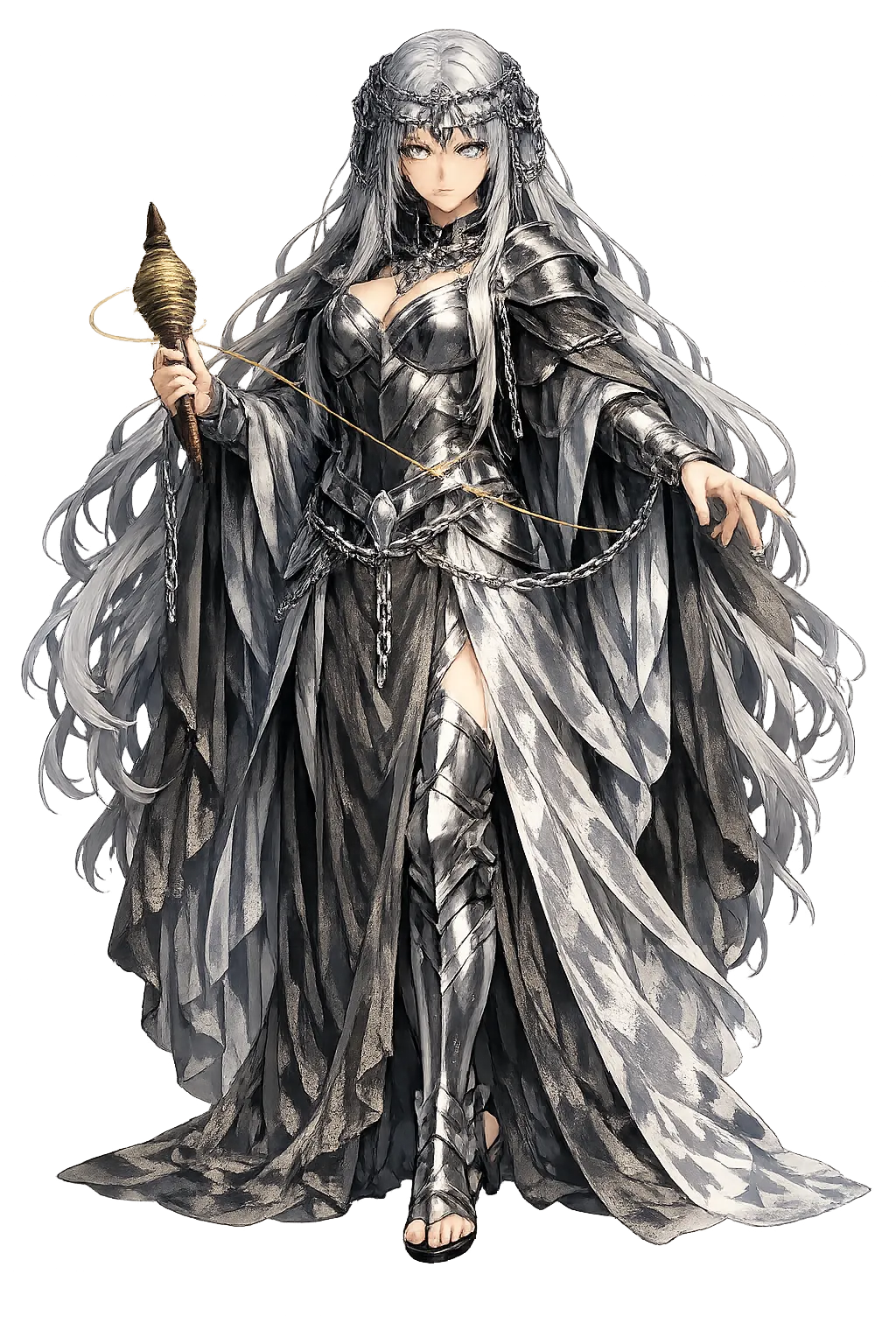
Anánkē was imagined rather than imaged. Plato describes her spindle, the whorls, and the Sirens seated on its rim, and this text became the basis for later manuscript illuminations and Renaissance diagrams of the cosmic order. Personifications of Necessity appear occasionally in Roman and early modern art as a severe, veiled woman holding spindle, chains, or a globe, but no independent ancient statue or vase type can be assigned to her. Her visual afterlife is therefore literary and diagrammatic, an abstraction given provisional form by readers of Plato.

06

Reception & Transformation

The name after its own age — transmission, translation, survival

Afterlives

Anánkē's afterlife is almost entirely philosophical and literary. Plato made her the cosmic spindle-handler of the Myth of Er, and from that moment she became inseparable from debates about fate, free will, and natural law. The Stoics, Orphics, and Neoplatonists transmitted her as the personification of compulsion, while Roman authors translated the idea into necessitas. Medieval and Renaissance readers encountered her mainly through Plato and Cicero; later thinkers from Spinoza to nineteenth-century determinists used her as a symbol of inexorable necessity. In modern literature and popular cosmology her name still signals an absolute, impersonal constraint — the force that even the gods cannot escape.

Identifications Across Traditions

The Romans personified her as Necessitas, and Horace imagines her with a nail that pins fixed fate in place (Odes 1.35.17–20) — compulsion as carpentry. In Stoicism, anánkē merged with heimarménē (fate) and the divine logos, becoming the rational order that even Zeus administers rather than invents. Christian theology then wrestled with her: is God's will constrained by necessity, or does necessity proceed from his nature? Augustine and Boethius argued that divine eternity is necessity rightly understood — freedom and fate reconciled above time. Modern philosophy keeps the concept in its hardest rooms: logical necessity, causal determinism, moral obligation. What began as a goddess whom no one prayed to ended as the skeleton of Western reasoning about what cannot be otherwise.

Modern Legacy

Anánkē is the god of 'must.' Her name stands behind every Western discipline that trades in the unavoidable — 'necessary' in logic and law, the 'necessary and sufficient' of mathematics, determinism's iron chain, the moral 'ought' that brooks no refusal. Cicero gave Rome her as Necessitas; the Stoics married her to fate; medieval theologians wrestled over whether even God's freedom bows to her. In literature she is the terror behind tragedy: not accident, not malice, but what must happen because it must. And in ordinary Greek her word never died — anánkē remains the Modern Greek word for emergency, constraint, and force majeure. A goddess the Greeks rarely worshipped became the load-bearing concept of their civilization's thought.

07

The Meditation

What Anánkē means — beyond the dictionary

Anánkē is the hardest god to love because she does not negotiate. She is the answer to every 'why must this be?' — because it must. Yet there is also dignity in her. To accept necessity is to stop wasting energy on impossibility and to turn toward what can be done.

The Stoics made anánkē their ally. They did not complain about winter or death because these things were necessary. What remained was choice: how to meet the necessary. Anánkē thus becomes not an enemy of freedom but its frame. To restore her name is to remember that wisdom begins with recognizing the limits within which life is lived.

08

Frequently Asked Questions

Common questions about Anánkē, Necessity, Compulsion, and Unicode restoration

01How do you pronounce Anánkē?

In reconstructed pronunciation, Anánkē is /a.nán.kɛː/ — approximately 'ah-NAHN-kay' — stress the middle syllable and draw out the final 'kay'.

02What does Anánkē mean?

Anánkē means Necessity, constraint in the greek tradition.

03What are the symbols of Anánkē?

Anánkē is associated with Spindle (The cosmic axis around which necessity turns the heavens (Plato, Republic 10.616c)), Chains or bonds (The inescapable constraints she lays on gods and mortals), Snake biting its tail (ouroboros) (The cyclical, self-binding nature of necessity), Bronze adamant (The hardest substance, representing what cannot be broken), The yoke-strap (From Aeschylus, Agamemnon 218: the harness of compulsion a man 'puts on' when he walks to what he cannot avoid).

04Why restore Anánkē in Unicode?

Plain ASCII ananke strips the stress, length, and script that make the name specific. Unicode restoration returns the name to its original written dignity.

05What is the most important myth about Anánkē?

“The Spindle of Necessity” — the Plato, Republic story that anchors the mythology of Anánkē, told in full on the lore page.

09

Scholarly Sources

The philological foundations of this restoration

Every claim on this page is grounded in established scholarship. The orthographic restorations follow disciplinary convention. The etymological chain follows the best available reference works. This is not invention — it is resurrection through scholarship.

◈

Lexicography & Philology

  • Liddell, H. G., Scott, R., & Jones, H. S. A Greek-English Lexicon. Oxford: Clarendon Press, 9th ed. 1996.
◎

Primary Texts

  • Plato
  • Plato, Republic 10 (Myth of Er)
  • Aeschylus, Agamemnon and Prometheus Bound
  • Plutarch, On Fate
◉

Archaeology & Art History

  • Material evidence — iconography, inscriptions, and temple archaeology — for Anánkē and related cults.
✦

Religious Studies

  • Beekes, Etymological Dictionary of Greek
  • Orphic Rhapsodies (frs. 54, 75, 83 Bernabé; Damascius)
Return

The Surface Awaits

You have traced the name from its earliest attestation to its Unicode restoration. Now return to the myth. The story is where the name lives.

Back to Lore
Anánkē mascot