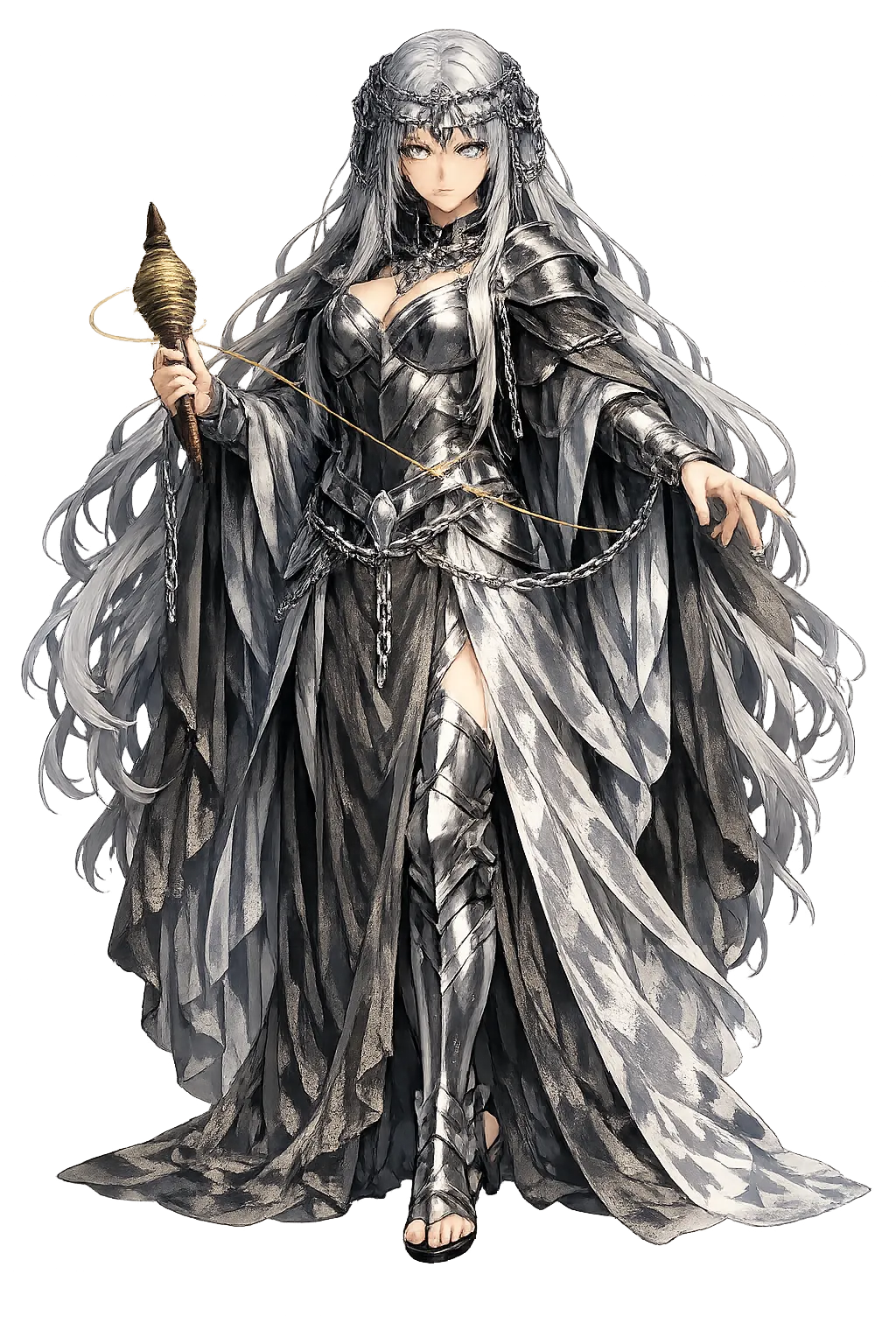
Stories of Anánkē
Anánkē is not a narrative goddess but a cosmic principle. Her 'myths' are the great philosophical and tragic accounts of how the universe is ordered by what cannot be otherwise — Plato's spindle, Orphism's serpent coils, and the yoke of Aeschylus.
In the closing myth of Plato's Republic (10.616c–617d), the soul of Er beholds the cosmos from outside: a spindle of light turning on the knees of Anánkē, Necessity herself, while her three daughters — the Moirai, 'daughters of Anánkē, lightly clad' — stand on its whorls. Lachesis sings what was, Clotho what is, Atropos what will be; around each ring a Siren voices a single note, and the eight together make the harmony of the spheres. Below the spindle the souls of the dead file past to choose their next lives, 'not without Anánkē.' Every other Greek god can be flattered, bribed, or outwitted; the spindle turns anyway. The image gave Western imagination its deepest picture of the ordered universe — not a tyrant's command but a mechanism of necessity, grinding out harmony, indifferent to prayer.
The Orphic theologians pushed Anánkē back to the very beginning. In the Rhapsodies (frs. 54, 75, 83 Bernabé; the account survives in Damascius), Hydros (Water) and Gē (Earth) bring forth Chronos (Time) — unaging, serpent-formed — and with him Anánkē, called Adrasteia, 'she whom none can escape'. The two coil around the egg of the cosmos and split it, and from it the ordered world hatches: heaven, ocean, and the gods who follow. Necessity is therefore not a late imposition on the world but its eldest wrapper — the coils within which time itself moves. The Orphic claim is radical even by Greek standards: before Zeus, before the Titans, before the marriage of Sky and Earth, there is the serpent pair, time bound in necessity. Order was not chosen; it was bound into being, and every later freedom — even a god's — moves inside coils set before the first dawn.
Greek tragedy is Anánkē's theatre. When Aeschylus' Agamemnon walks to his death at Clytemnestra's hands, the chorus says he 'put on the yoke-strap of necessity' (Agamemnon 218) — the same yoke with which his father Atreus bound the house. Sophocles' Oedipus runs from a prophecy and runs straight into it, discovering at Colonus that the 'dread watchcraft of the gods' cannot be dodged, only endured. In the Prometheus Bound, the chained titan knows the secret that threatens Zeus himself, yet even he cannot break 'the decrees of Necessity' — 'not even Zeus' is the boast that rings through the play. Euripides' heroines invoke anánkē as the last court of appeal. The tragedians never ask whether necessity is just; they show what it costs to be inside it. Their lesson is not resignation but clear sight: the free thing left to a mortal is to see the yoke — and bear it knowingly, which is the only dignity necessity cannot confiscate.
Plato's myth quietly makes Anánkē the mother of the Fates (Republic 617c): the Moirai are 'daughters of Anánkē', stationed at the spindle she turns. The genealogy is philosophically exact — if fate distributes what necessity determines, the distributors must be necessity's children, bound by her law even as they apply it. The allotment works by lot and by choice joined: each soul draws its lot in the order of approach, then chooses a life from the spread laid out — tyrant, athlete, swan, anything — and 'the blame is his who chooses; god is blameless.' Lachesis sends each soul onward with its daimon, the genius of its chosen lot; Clotho ratifies; Atropos makes irrevocable. It is the most sophisticated fate-doctrine of antiquity: necessity frames the menu, character picks the dish. Anánkē rules the cosmos absolutely — and lets mortals, fatally, pick which necessity will rule them.
Fate, Compulsion, Cosmic Order
Anánkē is necessity personified, the force that binds gods and mortals to what must be. She is not cruel but implacable: the cosmic law that even Zeus cannot overturn, though he directs its fulfillment.
Even Zeus is subject to Anánkē; she is the limit of divine freedom.
In Plato's myth of Er, she turns the spindle of the universe with the Fates.
In the Orphic Rhapsodies Chronos is born of Hydros and Gē, and Anánkē entwines him — she is of the same nature as Adrasteia.
The principle that what is necessary cannot be avoided by prayer or power.
From the original script to the living URL
Ἀνάγκη
The name in its original Greek form. Anánkē (Ἀνάγκη) is attested in the source tradition — “Necessity, constraint”. Its long vowels and acute accents carry the full phonetic and orthographic weight of the source tradition.
ananke
Reduced to plain ananke, the name loses everything that made it specific: long vowels and acute accents. What remains is an ASCII string that machines can parse but that no longer speaks with its original voice.
Anánkē
The Unicode restoration recovers what ASCII flattened. Anánkē restores long vowels and acute accents, returning the name to its original written dignity. The domain encodes to Punycode, but the browser displays the truth.
Anánkē.com → xn--annk-6na61a.com
The non-ASCII characters in Anánkē are encoded while the ASCII remains visible. To the DNS, it is Punycode. To humanity, it is Anánkē.
Owned, ideal, and ASCII forms of Anánkē
Anánkē
Restores Ἀνάγκη. The live temple domain — anánkē.com.
ananke
Flattens Ἀνάγκη. The plain ASCII fallback — what DNS and legacy systems see.
How Anánkē was spoken
How Anánkē is preserved in writing
A bespoke provenance study for Anánkē is being prepared by the PUNICODEX scholarly team.
Contribute scholarly provenance →The lore you have read is the living myth. Extended Lore opens the scholarly vault beneath it: the cult and its material remains, a history of the image, the name after antiquity, a meditation on what the name still means, and the full scholarly apparatus — etymology, orthography, sources.
Enter Extended Lore