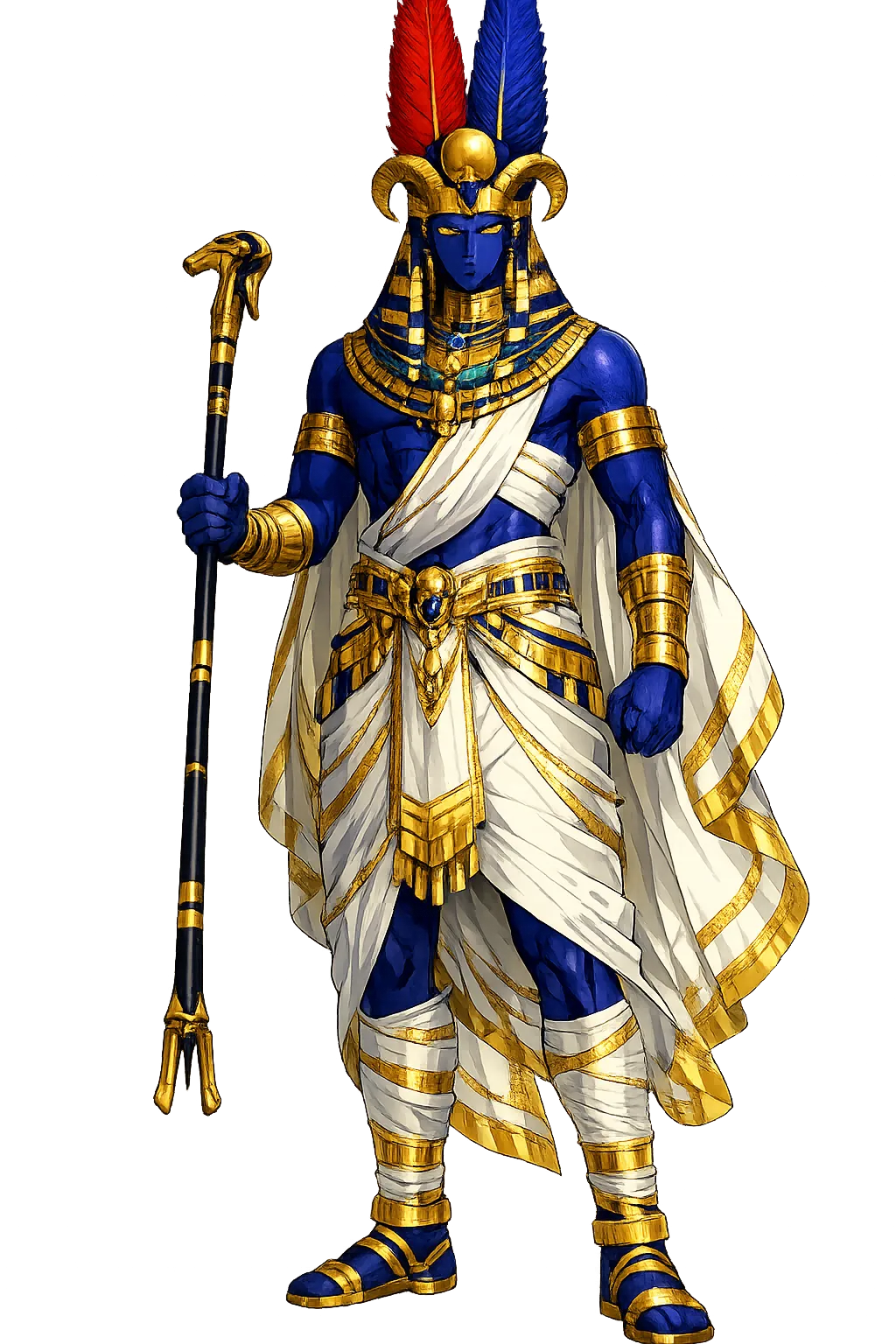
Stories of Ꜣmun
Amun's rise from provincial wind god to universal king is one of the great success stories of Egyptian religion. By the Middle Kingdom he is national; by the New Kingdom he is Amun-Ra, hidden lord of the cosmos; by the Late Period his oracles and priesthoods rival pharaonic power. His myths revolve around concealment, revelation, and the transmission of authority.
Amun's beginnings are almost comically modest. His first attestations are Old Kingdom: in the Pyramid Texts he stands quietly beside his consort Amaunet among the eight 'Elder Gods' — the Hermopolitan Ogdoad, frog- and snake-headed powers of the primordial waters. He is a god of air and invisibility, one of eight, local to Thebes, a provincial town. Then history intervened. When the Theban dynasty of Mentuhotep II reunified Egypt (c. 2055 BCE), Amun rode the rise; when the New Kingdom pharaohs of the Eighteenth Dynasty built an empire, his theologians proclaimed him 'King of the Gods', his hiddenness the mark of a supreme being too vast to be fully known. The myth of Amun is thus a success story about invisibility: the god you cannot see became the god you cannot avoid, and the ancient world learned that the unseen is often the most powerful thing in the room.
The Theban temples inscribed their own version of Egypt's most beloved story, the 'Distant Goddess' cycle (preserved in first-millennium temple inscriptions of the Eye of Ra, e.g. at Edfu). The sun-god's eye — his daughter, the fierce lioness — grows angry and flees south toward Nubia, and Egypt withers without her: crops fail, the Nile slackens, the gods' laughter stops. A messenger goes to bring her back; in the Theban reading the returning eye is identified with Mut, and she is appeased and united to the waiting god — Amun of Karnak — so that rage becomes alliance and the land blooms again. The myth was not merely read: it was staged, in the great processions when Amun's bark sailed from Karnak to Luxor at the Opet festival, the god visiting his consort Mut across the river. The royal theology fused the wandering eye with the king's own vital force: the empire's order was the marriage of returning rage to the patient hidden god.
In 331 BCE the god received his most famous petitioner. Alexander the Great, having taken Egypt without a battle, crossed the Libyan desert to the oasis of Siwa, where Amun's oracle had spoken to Greeks for two centuries — Herodotus already knew Zeus Ammon of the oasis (Histories 2.42). What exactly the priest hailed him — 'son of Ammon' or simply a beloved of the god — the sources dispute; Arrian (Anabasis 3.3–4) and Plutarch (Alexander 26–27) each preserve the tradition differently, and the romantic details multiply with distance from the event. But the political meaning is not in doubt: the oracle legitimated Alexander as pharaoh and god, and the conqueror thereafter wore Ammon's horns on his coins and in his official portraits. For Amun it was the last great act of the hidden god: having climbed from provincial air-spirit to king of the Egyptian pantheon, he now adopted a Macedonian warlord — and made the god of Thebes a father of the Hellenistic world.
The fullest statement of Amun's theology is a poem. Papyrus Leiden I 350 — the Great Amun Hymn of the late 13th century BCE — praises a god of terrifying intimacy: 'Amun, lend an ear to the lonely in court, to the poor and wretched — the vizier of the humble; it is the weak he champions... he makes the least into the greatest.' The hymn also coins the formula later religions would echo: Amun is 'the sole one without a second' — among the earliest universalizing claims for a god in the ancient world, centuries before similar language was heard elsewhere. Hidden by name, universal in power, partial to the powerless: the hymn's Amun is a theology of the unseen champion, the god who works precisely where no statue stands. It is the strangest profile a state god ever wrote for himself, and Egypt's priests carved its verses high on temple walls: the empire's god confessing that he sides with the people the empire forgets.
Wind, Kingship, and the Invisible Power
Ꜣmun begins as a local Theban wind god and ends as the king of the Egyptian pantheon, fused with Ra as Amun-Ra. His very name means 'Hidden One': he is the power that cannot be seen, the breath behind the storm, the unseen source of royal and cosmic authority. Where solar gods blaze in the sky, Amun moves in the air, the temple shadows, and the oracle's whisper.
Amun's wind aspect links him to invisible force, royal fortune, and the breath that animates the cosmos.
The great temple complex at Karnak was his principal seat; each pharaoh added to its forest of pylons and obelisks.
Fused with the sun god, Amun becomes the hidden power within the visible disk, worshipped across Egypt.
His desert oracle at Siwa was consulted by Greek colonists and famously by Alexander the Great.
From the original script to the living URL
𓇋𓏠𓈖
The name in its original Egyptian form. Ꜣmun (𓇋𓏠𓈖) is attested in the source tradition — “Hidden One (Egyptian jmn; vocalized Ꜣmun)”. Its original diacritics and script distinctions carry the full phonetic and orthographic weight of the source tradition.
amun
Reduced to plain amun, the name loses everything that made it specific: original diacritics and script distinctions. What remains is an ASCII string that machines can parse but that no longer speaks with its original voice.
Ꜣmun
The Unicode restoration recovers what ASCII flattened. Ꜣmun restores original diacritics and script distinctions, returning the name to its original written dignity. The domain encodes to Punycode, but the browser displays the truth.
Ꜣmun.com → xn--mun-lk3l.com
The non-ASCII characters in Ꜣmun are encoded while the ASCII remains visible. To the DNS, it is Punycode. To humanity, it is Ꜣmun.
Owned, ideal, and ASCII forms of Ꜣmun
Ꜣmun
Restores 𓇋𓏠𓈖. The live temple domain — ꜣmun.com.
amun
Flattens 𓇋𓏠𓈖. The plain ASCII fallback — what DNS and legacy systems see.
How Ꜣmun was spoken
How Ꜣmun travels from ancient script to the modern URL
Egyptian jmn; the original vocalisation is unknown. The name means “the hidden one", reflecting Amun’s character as an invisible, transcendent deity.
The lore you have read is the living myth. Extended Lore opens the scholarly vault beneath it: the cult and its material remains, a history of the image, the name after antiquity, a meditation on what the name still means, and the full scholarly apparatus — etymology, orthography, sources.
Enter Extended Lore