
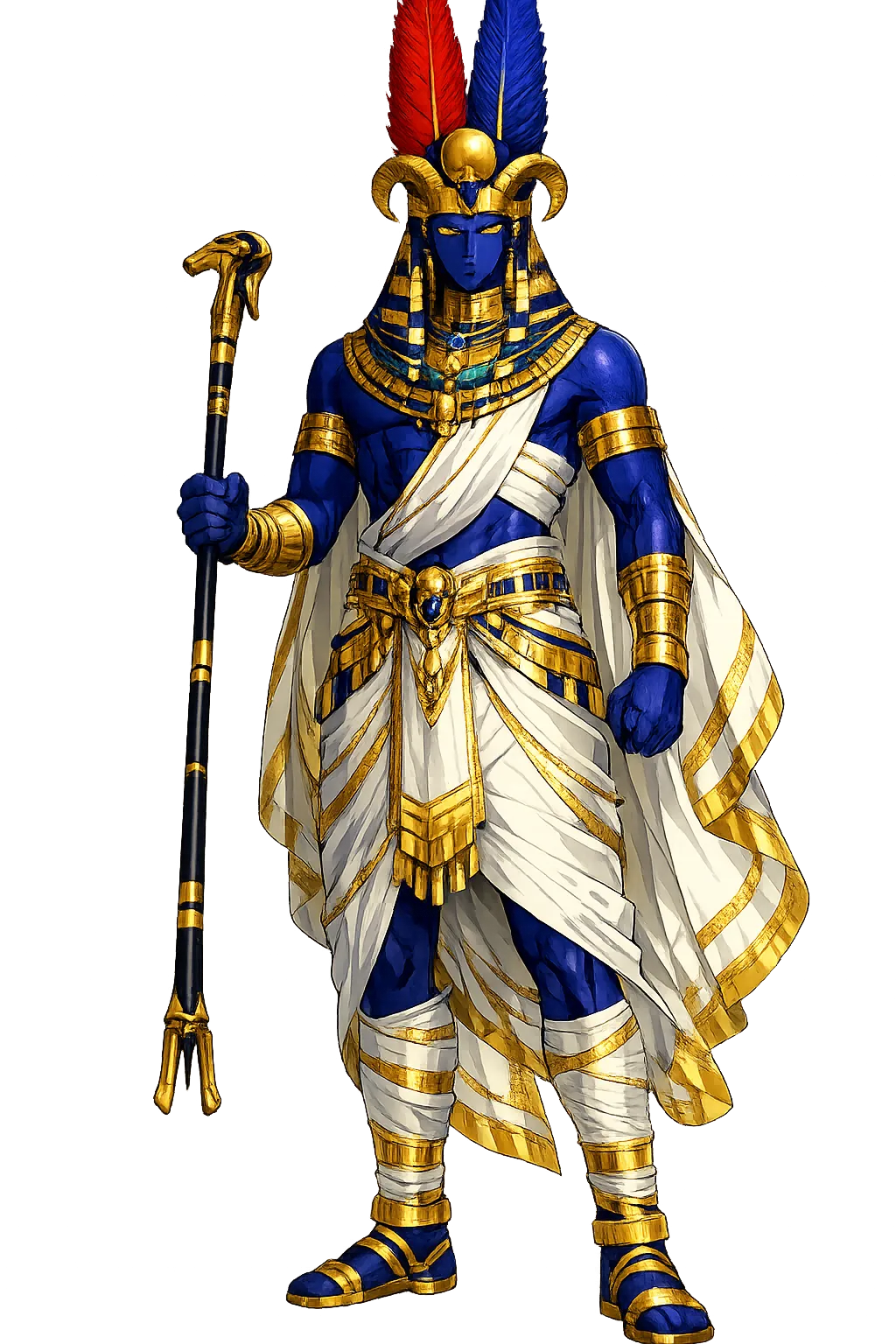
Why Ꜣmun is spelled that way — and what it costs to get it right
There is a version of this name the early internet had to settle for: amun. This is the file on how Ꜣmun replaced it.
Amun's rise from provincial wind god to universal king is one of the great success stories of Egyptian religion. By the Middle Kingdom he is national; by the New Kingdom he is Amun-Ra, hidden lord of the cosmos; by the Late Period his oracles and priesthoods rival pharaonic power. His myths revolve around concealment, revelation, and the transmission of authority.
At a Glance
- Restored name: Ꜣmun
- ASCII form: amun
- Meaning: "Hidden One (Egyptian jmn; vocalized Ꜣmun)"
- Domain of influence: Wind, Kingship, Thebes
- Pantheon: Egyptian
- Classification: Tier 1
- Original script: 𓇋𓏠𓈖
- Series: The Restoration Files, No. 28 of 546
The Name Before the Marks
Spoken, the name runs `/ʔaˈmuːn/` — ah-MOON — begin with a soft glottal catch, then a long 'moon' without the final glide.
The Temple That Stands Now
The restored name is not a plaque; it is an address. The temple of Ꜣmun lives at /amun/, with its mythology in the lore halls, its peer-reviewed record in the Scholarly Edition, and its place in the pattern atlas on the patterns floor.
Tier-1 is not a compliment; it is a measurement. This restoration keeps something the ASCII form provably loses, and the measurement is repeatable.
Where the Name Stood First
Amun's principal sanctuary was Karnak in Thebes, a vast complex of temples, pylons, obelisks, and sacred lakes developed over more than a millennium. The temple of Luxor, the Khonsu temple, and the Mut precinct formed the southern counterpart. His oracular temple at Siwa in the Libyan desert attracted Greek and later Roman visitors. Ram statues line the processional way at Karnak, and temple inscriptions record Amun's oracular responses and royal legitimation. In Nubia, temples at Jebel Barkal and Meroë continued his cult into the first millennium CE. The temple on the web is the newest of these addresses — the first one that fits in a pocket.
The Archetype at Work
The pattern atlas seats this temple in 5 industries, each match argued and weighted: Leadership, Governance & Public Administration (king of gods in Thebes; the hidden hand of empire.); AI, Data & Predictive Intelligence (his oracle at Siwa answered Alexander the Great; hidden knowledge delivered as a prediction service.); Astrology, Tarot & Esoteric Services (the Hidden One; modern esotericism's patron of unseen forces and concealed power.). The Resonance File reads those seats through the myths themselves.
In the Sacred Texts
The Egyptian tradition is not a vibe; it is a library. The Sacred Texts collection holds The Book of the Dead — the primary sources the temple's scholarship is built on. The temple is the argument; the texts are the evidence.
The File Continues
The temple's founding dispatch tells the name's story; its Resonance File reads the myths into the industries; the blog index holds the whole archive.
Continue the series — previous file: Aṃśa (read it here) · next file: Anāhitā (read it here).
The Restoration Files are written from the same canonical record as the temples themselves: the lexicon, the lore catalog, the pattern atlas, and the cited scholarly sources. If a file ever disagrees with its temple, the temple is right — tell us, and the file will be corrected.