The Living Myth
Infinite Light, Pure Land · The Light Without Measure
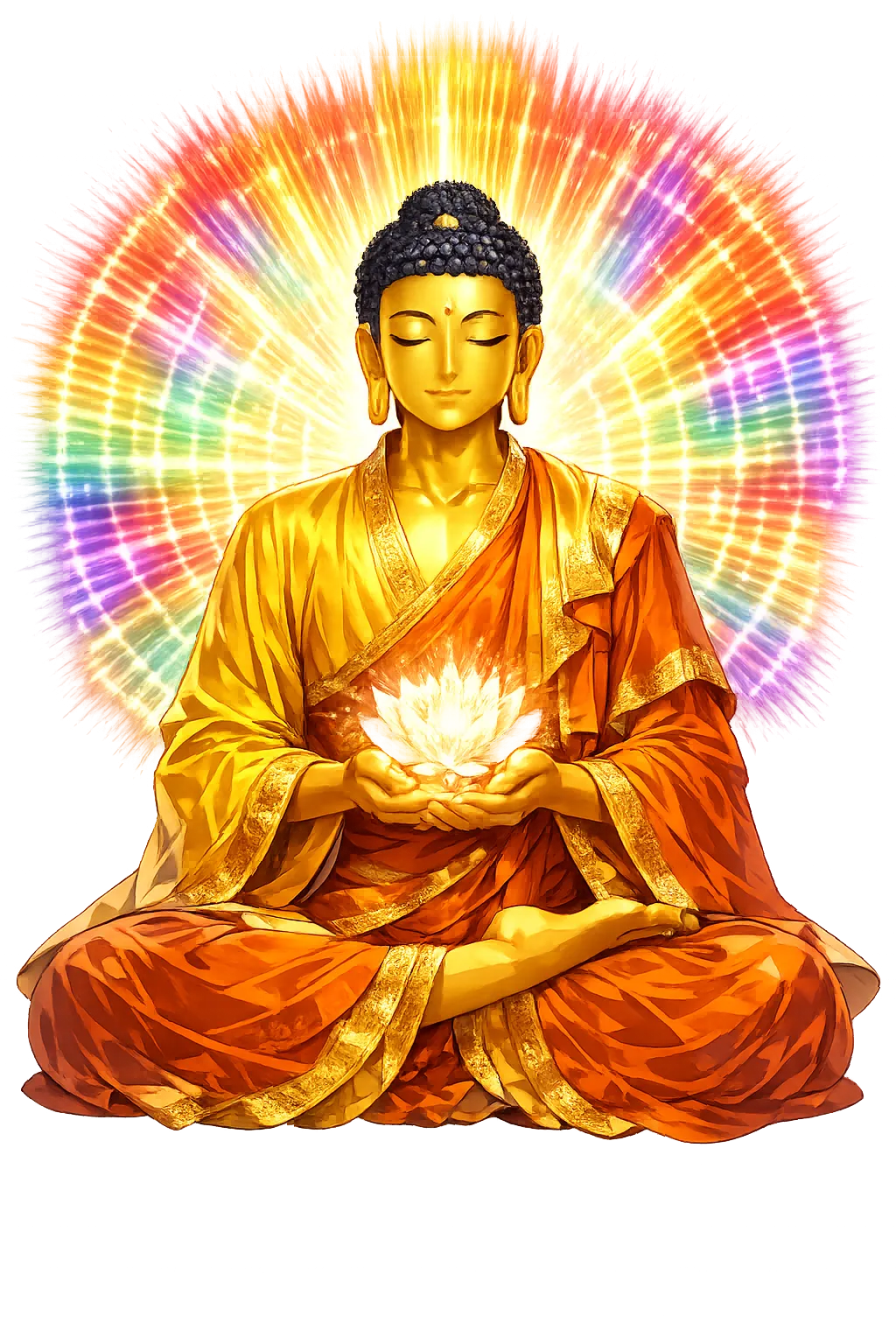
Stories of Amitābha
Amitābha's mythology is the story of a vow. Long ago, as the monk Dharmākara, he stood before the Buddha Lokeśvararāja and promised to build a Buddha-field so perfect that any being who trusted in him would be reborn there and swiftly attain enlightenment — and then he practiced until the promise became the cosmos.
The Larger Sukhāvatīvyūha Sūtra — the longer of the three Pure Land sūtras, carried into Chinese more than once between the second and fifth centuries — describes how the monk Dharmākara, after five aeons of contemplation, surveyed every Buddha-field in the ten directions and distilled from their best qualities forty-six vows: forty-eight in the Chinese recensions, forty-six in the surviving Sanskrit. The eighteenth vow became the foundation of Pure Land practice: any being, however burdened by karma, who entrusted themselves to him and called his name even ten times would be reborn in Sukhāvatī. Having made the vows, Dharmākara labored through countless ages until every one stood fulfilled, and he became Amitābha, the Buddha of Infinite Light, his Pure Land lying to the west of every world that needs it. The sūtra's claim is quiet and enormous: salvation is not a prize for the strong but a gift finished long ago, waiting only to be received.
The Amitāyurdhyāna Sūtra is addressed to Queen Vaidehī, imprisoned by her own son, the patricide Ajātaśatru, in the palace where the Buddha's great disciple had already been starved nearly to death. In her despair she begged the Buddha for a land without sorrow, and the Buddha, appearing in her cell, taught sixteen graded contemplations — from the setting sun to the jeweled trees, waters, and throne of Sukhāvatī — culminating in a vision of Amitābha himself. The sūtra then makes its most radical move: even one who has committed the five gravest sins, if at the moment of death they sincerely call Amitābha's name, will be received. Composed later than the other Pure Land sūtras, it is the devotional manual that carried the cult to the laity: vision first, ethics after, and mercy down to the final breath.
The Saddharma-puṇḍarīka Sūtra (Lotus Sūtra) places Amitābha within a cosmos crowded with Buddhas rather than a universe with one savior. In its eleventh chapter the assembly beholds an immense jeweled stūpa rising from the earth, and within it the Buddha Prabhūtaratna — Many Treasures — who confirms every Buddha's teaching; to open that stūpa, the Buddha summons manifestations of himself from every direction, including the Amitābha of the western Sukhāvatī. The sūtra's twenty-fifth chapter then locates Avalokiteśvara — the bodhisattva who answers every cry — in Amitābha's Pure Land, sent from that western paradise to the worlds of the east, so that Amitābha's compassion travels in person. The pairing became permanent in art and liturgy: the Buddha who promises the land, and the bodhisattva who comes back from it to fetch the promise's beneficiaries. The Lotus thus makes Sukhāvatī not an escape hatch from the Buddhist cosmos but one of its busiest stations.
The devotional movement that would conquer East Asia began as a club on a mountain. In 402 CE the monk Huiyuan — the great exegete, recently settled at Donglin monastery on Mount Lushan — gathered one hundred and twenty-three lay and monastic companions before an image of Amitābha and led them in a joint vow to be reborn together in Sukhāvatī; their names were inscribed in stone as a contract with the Buddha. His biography in Hui Jiao's Gaoseng zhuan records the society as the model of lay Pure Land devotion, and later tradition crowned Huiyuan the movement's first patriarch. The gesture proved prophetic: what was done once on Lushan as an elite experiment among scholars would, eight centuries later, be repeated in every Japanese village — the Buddha's name as a shared vow, recited together by people who would never meet again except, they trusted, in the Pure Land.
Pure Land, Compassion, and Other-Power Salvation
Amitābha is the Buddha whose light has no limit and whose compassion refuses no one. In Mahāyāna Buddhism he presides over Sukhāvatī, the Blissful Land, a western paradise where rebirth guarantees progress toward Buddhahood — and his cult transformed Buddhism from a monastic path of self-cultivation into a devotional religion open to laypeople, sinners, and the spiritually exhausted.
The Pure Land of Bliss: gold trees, jeweled ponds, and ceaseless Dharma teaching — a Buddha-field built as a gift.
As the monk Dharmākara he vowed that even those with heavy karma could be reborn in Sukhāvatī through faith and name-recitation.
The invocation of his name — Namo Amitābhāya, Namo Amituofo — becomes the central practice of Pure Land devotion.
At death he descends with Avalokiteśvara and Mahāsthāmaprāpta to escort the faithful — the raigō painted and meditated upon across East Asia.
From the original script to the living URL
अमिताभ
The name in its original Buddhist form. Amitābha (अमिताभ) is attested in the source tradition — “Of unmeasured splendour; infinite light; the Buddha of the Pure Land Sukhāvatī.”. Its macron-length vowels carry the full phonetic and orthographic weight of the source tradition.
amitabha
Reduced to plain amitabha, the name loses everything that made it specific: macron-length vowels. What remains is an ASCII string that machines can parse but that no longer speaks with its original voice.
Amitābha
The Unicode restoration recovers what ASCII flattened. Amitābha restores macron-length vowels, returning the name to its original written dignity. The domain encodes to Punycode, but the browser displays the truth.
Amitābha.com → xn--amitbha-v3a.com
The non-ASCII characters in Amitābha are encoded while the ASCII remains visible. To the DNS, it is Punycode. To humanity, it is Amitābha.
Owned, ideal, and ASCII forms of Amitābha
Amitābha
Restores अमिताभ. The live temple domain — amitābha.com.
amitabha
Flattens अमिताभ. The plain ASCII fallback — what DNS and legacy systems see.
How Amitābha was spoken
How Amitābha travels from ancient script to the modern URL
Sanskrit bahuvrīhi compound a-mita ('unmeasured') + ābha ('light, splendor'); the name describes a Buddha whose light is boundless.
Infinite light; the Buddha of the Pure Land Sukhāvatī.
The IAST form Amitābha preserves the long ā and aspirated bh; the Devanagari form is not registrable in .com.
The lore you have read is the living myth. Extended Lore opens the scholarly vault beneath it: the cult and its material remains, a history of the image, the name after antiquity, a meditation on what the name still means, and the full scholarly apparatus — etymology, orthography, sources.
Enter Extended Lore