The Living Myth
Divine Mother, Power, Protection · Mother; epithet of Pārvatī/Durgā, the multi-armed goddess with lion
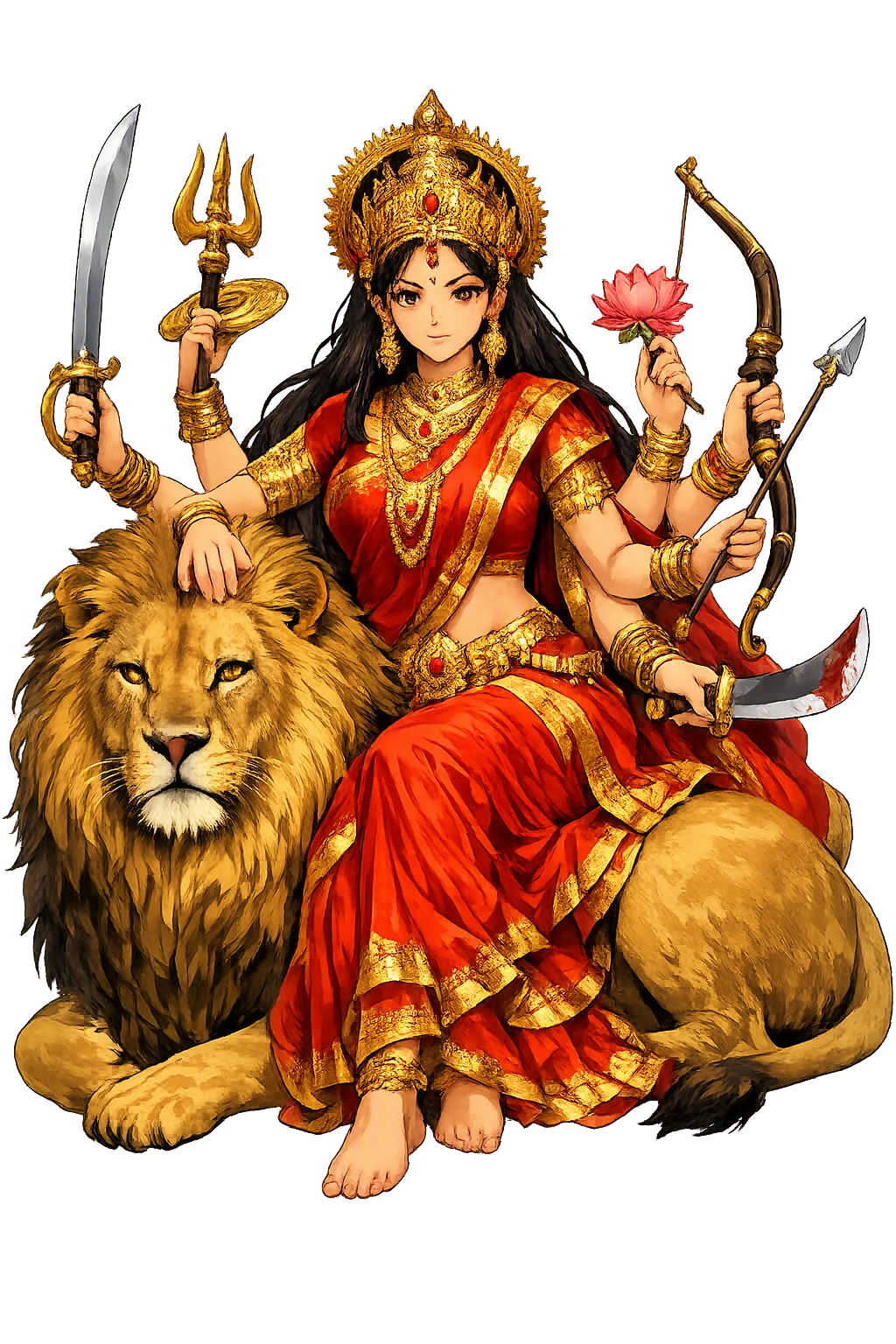
Stories of Ambikā
Ambikā's mythology is not separate from that of Pārvatī and Durgā; it is one mask of the Great Goddess, the one who becomes a mother to the cosmos and a warrior to its enemies. The name means 'little mother'; the texts show what a little mother does when the cosmos itself is attacked.
In the Śiva Purāṇa, when Śiva addresses Pārvatī in her aspect of the devoted consort and cosmic mother, he calls her Ambikā — 'little mother', the diminutive of ambā, 'mother'. The grammar is the theology: the awe-inspiring goddess of the mountains, daughter of Himavat and Menā, is also everyone's mother, and the scriptures keep both truths in a single name. The same Purāṇa that praises her maternal gentleness does not hesitate to show her as the source of Durgā and Kālī when demons threaten the three worlds, so the epithet never means softness. Monier-Williams's dictionary records the word as an epithet of several mother-goddesses, but in practice the name fastens to Pārvatī, the Great Goddess in her domestic-cosmic double life. The myth's point is that in the Hindu imagination the highest power does not outgrow being a mother; it wears motherhood as a title of the absolute.
When the buffalo-demon Mahiṣāsura usurped the throne of heaven, the gods' defeat was so complete that only their own radiance remained to fight with. The Devī Māhātmya (chapters 2–3) describes how a tejas — a blaze of combined energy — streamed from the bodies of Brahmā, Śiva, Viṣṇu, Indra, and the rest, and from that blaze a woman stepped forth, bearing the face of each god who had given himself to her. Each deity armed her: Śiva gave his trident, Viṣṇu his discus, Indra his thunderbolt, Agni his spear, Yama his staff, and Himavat, the mountain-god Pārvatī's father, gave the lion she rides. Then, in the form later tradition calls Durgā and Ambikā, she laughed at Mahiṣāsura's advances; when the demon shifted from buffalo to lion to man to elephant, she cut him down at last with a sword through his buffalo neck, restoring the gods to their thrones. The account is the theological core of the Durgā-Ambikā identity: the mother of the world is not one goddess among others but the concentrated power of all of them. Her victory means that divine motherhood, when roused, is the sum total of every weapon the gods possess.
The Devī Māhātmya continues her story in stranger forms. After Mahiṣāsura fell, the demons Caṇḍa and Muṇḍa closed in, and from Ambikā's frowning brow sprang a black goddess, emaciated, girded with a garland of skulls — the first emergence of Kālī, who slaughtered the demon armies and brought Caṇḍa's head to Ambikā on a platter. For this deed Ambikā named her Cāmuṇḍā. Elsewhere in the same text the goddess goes to bathe in the Gaṅgā, and from the body she sheds emerges a golden form, Kauśikī, radiant and terrible, while the dark remainder becomes Kālī again — so that one goddess multiplies into mother, black one, and golden one as the battle requires. The Mārkaṇḍeya Purāṇa, which preserves the Devī Māhātmya, thus refuses to let Ambikā be a single fixed portrait. The myth means that the divine mother contains more selves than any icon can hold — tenderness, terror, and brilliance — and deploys each in its season.
Beyond the Sanskrit canon, Ambikā lives at village thresholds across Gujarat, Rajasthan, and Maharashtra, worshipped as a guardian and healer of children. Her shrines stand at town edges and crossroads; women bring infants to be blessed under her gaze, and Sunday is kept as her day. The celebrated Ambikā Mātā temple at Jagat near Udaipur (10th–11th century) shows the medieval state of this cult in carved stone: processions of goddesses, apsarases, and the lion-riding Devī herself. Jain communities keep their own Ambikā — the yakṣiṇī of the 22nd Tīrthaṅkara Neminātha — in marble temples such as those of Kumbhāria, where she sits as a four-armed mother with her children, petitioned for the same protections as her Hindu namesake. The sources do not always separate the two, and scholarship (Coburn; Kinsley) treats Ambikā as a title that pooled its meanings wherever a mother-goddess was needed. The cult's lesson is that theology without a doorway is incomplete: Ambikā matters most where mothers stand with children in their arms.
Motherhood, Power, and the Protection of the Cosmos
Ambikā is the Mother who takes up arms. As an epithet of Pārvatī and Durgā, she is the gentle parent become warrioress: multi-armed, riding or attended by a lion, and invoked against the demons who threaten cosmic order. Her name means 'mother', but in cult it means 'mother who fights for her children'.
The maternal face of the Goddess, compassionate and inexhaustible — the ambā behind Ambikā.
She wields the gods' own weapons against demons to defend devotees and restore dharma.
Her vehicle, the gift of Himavat, and the emblem of sovereign, ferocious maternal power.
Each arm carries a divine weapon gifted by the gods for the destruction of evil.
From the original script to the living URL
अम्बिका
The name in its original Sanskrit form. Ambikā (अम्बिका) is attested in the source tradition — “Mother; epithet of Pārvatī/Durgā, the multi-armed goddess with lion”. Its macron-length vowels carry the full phonetic and orthographic weight of the source tradition.
ambika
Reduced to plain ambika, the name loses everything that made it specific: macron-length vowels. What remains is an ASCII string that machines can parse but that no longer speaks with its original voice.
Ambikā
The Unicode restoration recovers what ASCII flattened. Ambikā restores macron-length vowels, returning the name to its original written dignity. The domain encodes to Punycode, but the browser displays the truth.
Ambikā.com → xn--ambik-jwa.com
The non-ASCII characters in Ambikā are encoded while the ASCII remains visible. To the DNS, it is Punycode. To humanity, it is Ambikā.
Owned, ideal, and ASCII forms of Ambikā
Ambikā
Restores अम्बिका. The live temple domain — ambikā.com.
ambika
Flattens अम्बिका. The plain ASCII fallback — what DNS and legacy systems see.
How Ambikā was spoken
How Ambikā travels from ancient script to the modern URL
The lore you have read is the living myth. Extended Lore opens the scholarly vault beneath it: the cult and its material remains, a history of the image, the name after antiquity, a meditation on what the name still means, and the full scholarly apparatus — etymology, orthography, sources.
Enter Extended Lore