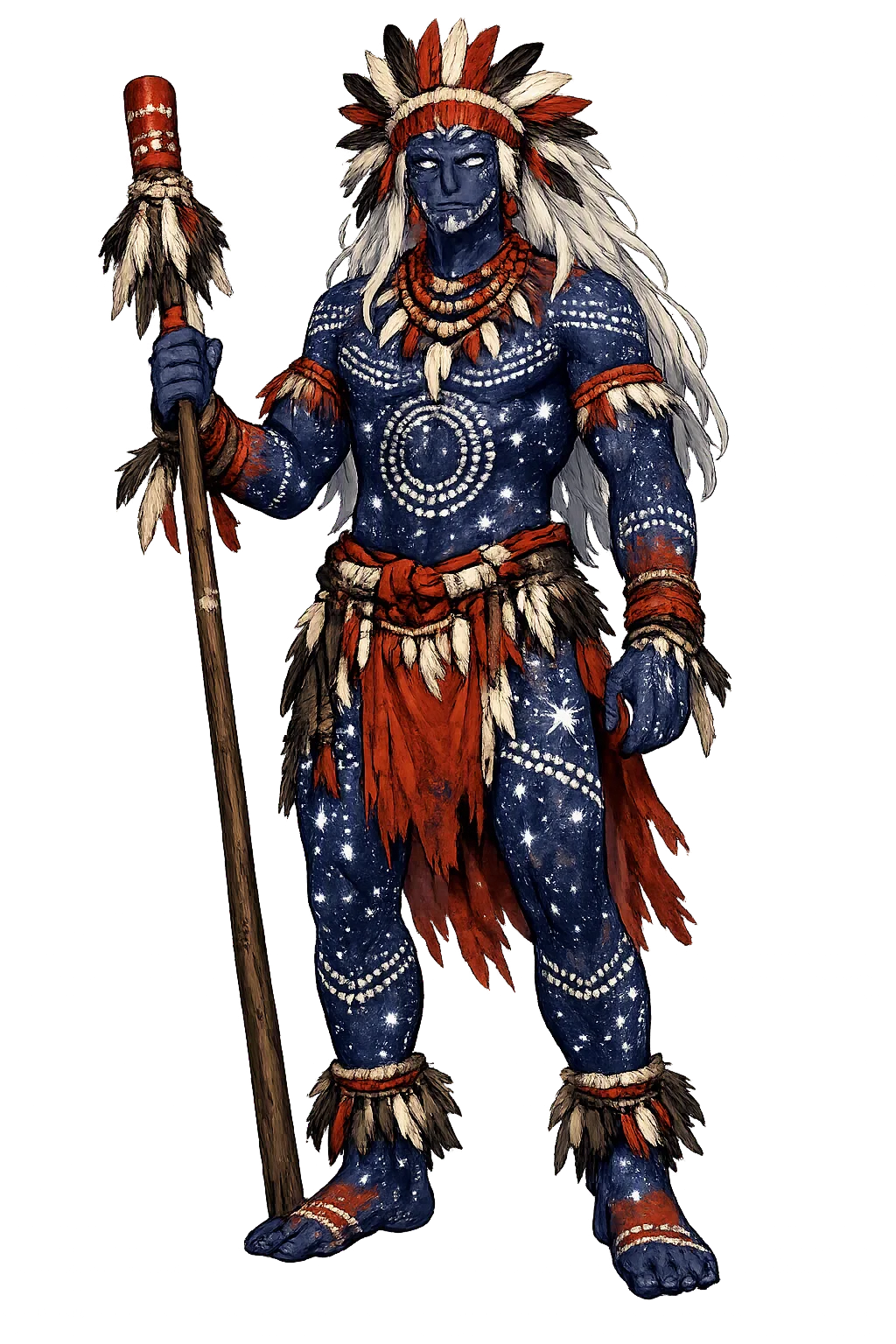
Stories of Altjira
The mythology of Altjira comes to us through Arrernte oral tradition and the early ethnographies of Spencer and Gillen, Carl Strehlow, and later scholars. The stories are not entertainment; they are title deeds to country, instructions for ceremony, and maps of moral responsibility. Some details are held by initiated custodians and are not shared in public space.
In the account recorded by Spencer and Gillen, Altjira is eternal: he was not born and will not die. In the beginning he made the earth and all that it contains — its hills, waterholes, plants, and animals — and then he rose into the sky, where he remains with his two sons. The earth was left for the ancestors who followed and for the human beings who would inherit their law (Spencer & Gillen, The Arunta, 1927; Carl Strehlow, Die Aranda- und Loritja-Stämme). Later Arrernte teaching, above all T. G. H. Strehlow's, corrected the early picture: altjira is less a person than the eternal order itself. The word thus carries its own commentary — creator and creation-principle named alike, as if the language insisted that the maker cannot be separated from what making means.
Altjira lives in the sky, high above the camps of men and women. His feet are like the feet of the emu, and he never bends them, because the sky is wide and there is no obstacle in his path. The stars and the Milky Way are the camps and tracks of ancestral beings, so that the night sky is read as a mirror of the country below (Spencer & Gillen; Berndt & Berndt, The World of the First Australians). The detail is characteristically Australian: a creator imagined not enthroned but walking — a sky roomy enough that the eternal being in it never has to stoop. Here creation is not a pyramid with a god on top but a landscape with a footpath, and the footpath belongs to something older than the walker's arrival.
The term alcheringa — rendered from Arrernte altjira — names the Dreaming: the time when the ancestors moved across the land, creating its forms and leaving behind the songs, designs, and ceremonies that maintain it. Altjira is both the name of the eternal sky being and the name of the epoch in which the world received its present shape. Later Arrernte scholarship, especially T. G. H. Strehlow's Aranda Traditions (1947), stressed that altjira primarily means 'to dream' and refers to the eternal creative order rather than to a single personal deity comparable to the biblical God. The ambiguity is the doctrine: in Arrernte thought the dream and the order it discloses are one word, and a vocabulary that separates god from epoch is translating something that was never divided.
The public, scholarly record of Altjira is only one layer of knowledge. Arrernte custodians hold song-cycles, designs, and ceremonial responsibilities that are not published and are transmitted under strict traditional protocols. PuniCodex presents only the documented, open scholarly account and acknowledges that deeper knowledge belongs to the communities who keep it. The restraint is itself part of the mythology: a tradition whose deepest layer is protected teaches, by its silence, what sacredness is — that some knowledge is not secret because it is threatened, but powerful because it is withheld, and that the shoreline of the public record is not the edge of the sea.
The Dreaming, Creation, and the Sky Above
Altjira is the eternal sky being of the Arrernte peoples of Central Australia. In the early ethnographic record he is described as the uncreated creator: he made the earth, shaped its first features, and then withdrew to dwell forever in the sky. His feet are said to be like those of an emu, and he never needs to bend, because the sky is high and he is eternal. Behind the figure lies the deeper Arrernte concept of altjira — the Dreaming — the timeless ground of law, country, and ancestral identity.
Altjira dwells in the sky above, unborn and undying, the source from which the visible world was shaped.
Altjira names the timeless epoch in which ancestral beings travelled, made country, and left law for the living.
He formed the land, its waterholes and ranges, and then ascended to the sky, leaving the world for his children.
The stories and ceremonies that bind people to country are carried as sacred trust by Arrernte custodians.
From the original script to the living URL
Altjira
The name survives in scholarly transliteration. Altjira is the standard Aboriginal romanisation, documented in academic sources — “The dreamtime”. Because the spelling uses only Latin letters, the form is the same in both ASCII and Unicode.
No indigenous writing system is securely attested for individual aboriginal names. The form shown is a modern scholarly transliteration.
altjira
The plain altjira form is identical to the Unicode restoration. Because this name is already written in Latin letters, no diacritics, stress, or script information were lost — only capitalization differs.
Altjira
The Unicode restoration does not need to recover lost marks for Altjira. Its value is canonical spelling and consistent cataloguing, not the reconstruction of erased orthography. The domain is readable as-is to both DNS and humanity.
Altjira.com
This restoration is written entirely in ASCII letters — no Punycode encoding stands between Altjira and the DNS. The domain reads identically to machines and to human eyes.
Owned, ideal, and ASCII forms of Altjira
Altjira
The full Unicode restoration. altjira.com is not in the PuniCodex collection — it is watched for release; if it drops, this temple upgrades to an owned flagship.
How Altjira was spoken
How Altjira is preserved in writing
No indigenous writing system is securely attested for individual aboriginal names. The form shown is a modern scholarly transliteration.
Contribute scholarly provenance →The lore you have read is the living myth. Extended Lore opens the scholarly vault beneath it: the cult and its material remains, a history of the image, the name after antiquity, a meditation on what the name still means, and the full scholarly apparatus — etymology, orthography, sources.
Enter Extended Lore