
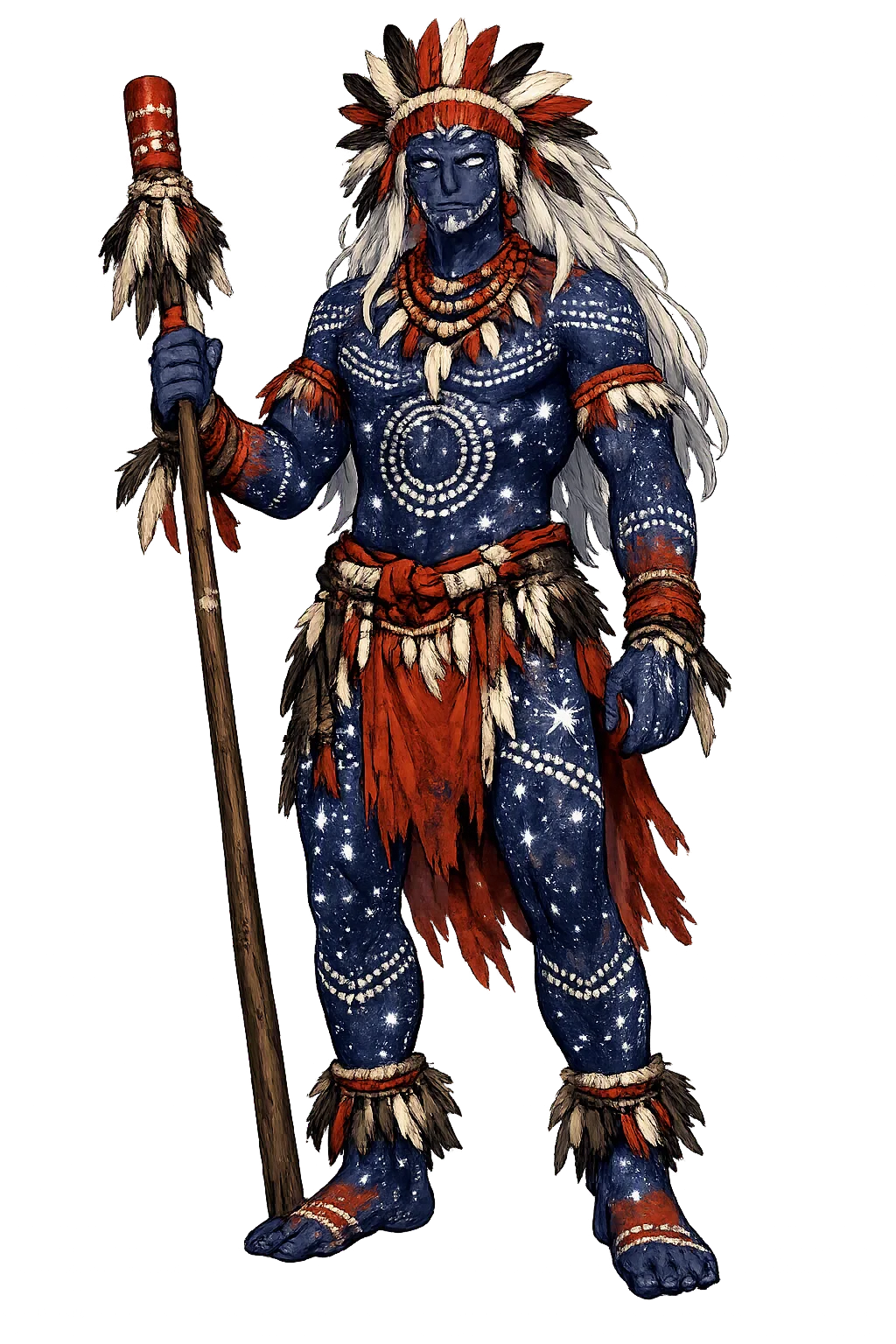
Altjira and the Dreaming: restoring an Arrernte name
The ASCII form altjira looks like any other lowercase string, but Altjira is not an ordinary name. It carries the Arrernte concept of the Dreaming — the eternal creative order that shaped the land, its people, and their law. This post explains what the restoration preserves, why the capital matters, and how the scholarly record around Altjira has changed over the last century.
At a Glance
- Restored name: Altjira
- ASCII form: altjira
- Meaning: "The dreamtime"
- Domain of influence: The Dreaming, Eternal
- Pantheon: Aboriginal
- Classification: Tier 2
- Original script: scholarly transliteration (Arrernte has no indigenous alphabetic script)
- Live domain: none — this is a domainless flagship
Overview
Altjira is the eternal sky being of the Arrernte peoples of Central Australia. In the early ethnographies of Spencer and Gillen, and later in Carl Strehlow's Arrernte studies, Altjira is described as the uncreated creator: he made the earth, shaped its first features, and then withdrew to dwell forever in the sky. His feet are said to be like those of an emu, and he never bends, because the sky is high and he is eternal.
Behind the personal name lies the deeper Arrernte concept of altjira — the Dreaming. The Dreaming is not a long-ago golden age; it is the continuing ground of law, country, and identity. The ancestors did their work, but the work is renewed every time a song is sung, a design is painted, or a custodian walks country.
The Name
The name comes from Arrernte altjira, meaning "to dream" or "the Dreaming." In early missionary and ethnographic literature it was rendered as Alchera or Alcheringa, and it was sometimes personified as a supreme sky being. Later Arrernte scholarship, especially T. G. H. Strehlow, argued that altjira primarily means the Dreaming itself — the eternal creative order — rather than the name of a single personal deity.
PuniCodex restores the name as Altjira. Because Arrernte has no indigenous alphabetic script, the form is a scholarly transliteration, not an "original script." The plain ASCII form altjira is a technological compromise imposed by the early domain-name system; the capitalised restoration is the conventional citation form used in scholarly and respectful public discourse.
The Dreaming
The term Alcheringa — derived from Arrernte altjira — names the epoch in which ancestral beings moved across the land, creating its waterholes, ranges, plants, and animals, and leaving behind the songs, designs, and ceremonies that maintain it. These stories are not entertainment; they are title deeds to country, instructions for ceremony, and maps of moral responsibility.
Some knowledge about Altjira and the associated song-cycles is held by initiated Arrernte custodians and is not shared in public space. The account presented here is drawn from the published scholarly record and is offered with respect for the communities who keep the fuller tradition.
The Scholarly Record
The earliest detailed accounts come from Spencer and Gillen's fieldwork in Central Australia in the 1890s and from Carl Strehlow's missionary ethnography in the early twentieth century. They recorded Altjira as an eternal creator who made the earth and retired to the sky. T. G. H. Strehlow, writing later from within the Arrernte community, offered an important correction: altjira is better understood as the Dreaming, not as an anthropomorphic high god comparable to the deity of biblical monotheism.
Later scholars such as Ronald and Catherine Berndt and A. P. Elkin placed Altjira within the wider context of Aboriginal cosmology, stressing the connection between myth, law, land, and social organisation.
Why Tier 2?
Altjira is Tier 2 because the ASCII form altjira already represents the same phonemic sequence as the restoration. No stress mark, length mark, or distinctive letter is required to recover the spoken name. The restoration adds only the conventional capital of a proper name. In the PuniCodex system, that makes the entry Tier 2 — a scholarly citation form rather than a diacritic-first restoration.
Name Variations
- Altjira — Standard Arrernte spelling used in scholarly and community sources.
- Alchera — Early English rendering used by Spencer and Gillen.
- Alcheringa — English term for the Dreaming epoch, derived from Arrernte altjira.
- Altjira (sky god) — The personified eternal being described in Carl Strehlow's Arrernte ethnography.
A Domainless Flagship
This temple is a domainless flagship: no Unicode domain is currently owned for Altjira. The project still treats the restored form as the canonical reference, and the ASCII form as a practical fallback. The goal is to keep the name accurate, accessible, and ready for the day a community or sponsor chooses to register its proper domain.
Conclusion
Restoring Altjira is a small act with a large meaning. The capital letter does not change the pronunciation, but it signals that the name is a proper noun, a scholarly citation, and a link to a living cosmology. In a web built on ASCII, even that small mark is worth defending.
The Meaning Behind the Name
The name Altjira encodes more than a simple label. In the Aboriginal tradition that holds it, the name carries the history of the country, the authority of ancestral law, and the obligations of the living custodians. The plain ASCII form altjira is a modern technological convenience: it allows the name to travel through the domain-name system and other digital infrastructure, but it cannot represent the full cultural weight that the name carries in ceremony and song.
PuniCodex restores the name as Altjira because the capitalized scholarly form is the standard way to cite a proper noun from an oral tradition. This restoration is not a cosmetic change. It marks the name as belonging to a living culture and asserts that digital infrastructure should be able to honor such names rather than flatten them into lowercase ASCII strings.
Mythology and Worldview
The stories of Altjira are not entertainment or simple explanations of natural phenomena. They are title deeds to country, instructions for ceremony, and maps of moral responsibility. In the accounts recorded by anthropologists and preserved by custodians, Altjira appears as a figure whose actions shaped the land and established the patterns that human beings must follow.
These stories are held under traditional protocols. Some details are appropriate for public discussion, while others are restricted to initiated members of the community or to specific kin groups. The public scholarly record therefore gives only the outer layer of a much deeper body of knowledge. Even so, it is enough to show that Altjira is not a static mythological curiosity but a living presence in Aboriginal law and identity.
Cultural Significance Today
In contemporary Australia, Altjira continues to appear in Aboriginal art, dance, environmental management, and public ceremony. Indigenous artists depict the figure in bark paintings, rock-art renewals, and digital media, always in ways that respect the custodial protocols of the communities that hold the name. Welcome-to-country ceremonies, language-revival programs, and land-care initiatives all draw on the authority of ancestral figures such as Altjira.
At the same time, the name reminds us that the digital world was built on assumptions that privilege ASCII text. Domain names, file systems, search engines, and social-media handles all tend to treat lowercase English letters as the default. Restoring Altjira as a flagship temple is a small but concrete step toward challenging that default and making space for Indigenous names in the digital realm.
Why This Restoration Matters
PuniCodex classifies Altjira as a Tier 2 restoration. This means that the ASCII form altjira already represents the same phonemic and orthographic sequence as the restored form; no diacritic or special letter is required to recover the scholarly spelling. The restoration therefore focuses on the proper-noun convention: the capitalized form Altjira is the respectful citation form, while altjira remains a practical compromise for digital systems that cannot yet honor Indigenous typographic conventions.
Even without a registered Unicode domain, Altjira deserves a flagship temple. The domain-name market may make the exact string unavailable, but the name itself remains a vital part of human heritage. By building a temple around it, PuniCodex preserves the scholarly form, explains its significance, and keeps watch for the day when the digital infrastructure of names can fully include the world's oral traditions.
A Note on Sources and Respect
The scholarly record on Altjira draws on nineteenth- and twentieth-century ethnography, more recent anthropological fieldwork, and the guidance of Aboriginal custodians and institutions such as AIATSIS. Early colonial accounts must be read critically: they often imposed European religious categories on Aboriginal beliefs and ignored the protocols that govern the transmission of sacred knowledge. Contemporary presentations of Altjira therefore prioritize Indigenous authorship and custodial authority.
Readers who wish to learn more should seek out resources produced by the Aboriginal nations that hold the name, as well as scholarly works that cite Indigenous collaborators. The PuniCodex temple is offered as a starting point for that journey, not as the final word on a living tradition.
Related Names
The Aboriginal traditions of Australia hold many figures whose stories overlap or contrast with Altjira. Sky beings, ancestral creators, and totemic ancestors appear in different regional forms, and the same figure may be known by more than one name or spelling across language groups. Altjira belongs to a network of names that includes Baiame, the Kamilaroi sky father; Bunjil, the Kulin eaglehawk creator; Ngalyod, the rainbow serpent of the north; and Yurlungur, the great copper python of Yolŋu country. Each name encodes a specific relationship to country, law, and custodial responsibility, and none is interchangeable with another.
For researchers and readers, the important distinction is between the capitalized scholarly citation form Altjira and the lowercase ASCII form altjira. The capitalized form marks the name as a proper noun and situates it within the scholarly and custodial discourse of Aboriginal studies. The lowercase form is a technological artifact, useful for domain names and search queries but carrying none of the cultural weight of the citation form.
Sources
The account of Altjira given here rests on ethnographic and anthropological sources spanning more than a century, together with the guidance of Aboriginal custodians and institutions such as AIATSIS. Early colonial accounts must be read critically, because they often imposed European religious categories on Aboriginal beliefs and ignored the protocols that govern sacred knowledge. Contemporary presentations of Altjira therefore prioritize Indigenous authorship and custodial authority.
Readers who wish to learn more should seek out resources produced by the Aboriginal nations that hold the name, as well as scholarly works that cite Indigenous collaborators. The PuniCodex temple is offered as a starting point for that journey, not as the final word on a living tradition. It preserves the scholarly form Altjira, explains its significance, and keeps watch for the day when digital infrastructure can fully include the worlds oral traditions.
Altjira also invites reflection on the broader project of digital decolonization. The internet was built on protocols that assumed ASCII text as the universal default, and that assumption continues to shape who can be represented online and on what terms. Restoring Altjira as a flagship temple is one small step toward challenging that default and making space for Indigenous names, languages, and forms of knowledge in the digital realm. The name is not a relic; it is a living part of Aboriginal law and identity, and its presence in a scholarly catalog of Unicode restorations is a reminder that digital infrastructure can and should evolve to honor the full diversity of human naming.
Altjira also invites reflection on the broader project of digital decolonization. The internet was built on protocols that assumed ASCII text as the universal default, and that assumption continues to shape who can be represented online and on what terms. Restoring Altjira as a flagship temple is one small step toward challenging that default and making space for Indigenous names, languages, and forms of knowledge in the digital realm. The name is not a relic; it is a living part of Aboriginal law and identity, and its presence in a scholarly catalog of Unicode restorations is a reminder that digital infrastructure can and should evolve to honor the full diversity of human naming.
Altjira also invites reflection on the broader project of digital decolonization. The internet was built on protocols that assumed ASCII text as the universal default, and that assumption continues to shape who can be represented online and on what terms. Restoring Altjira as a flagship temple is one small step toward challenging that default and making space for Indigenous names, languages, and forms of knowledge in the digital realm. The name is not a relic; it is a living part of Aboriginal law and identity, and its presence in a scholarly catalog of Unicode restorations is a reminder that digital infrastructure can and should evolve to honor the full diversity of human naming.
Altjira also invites reflection on the broader project of digital decolonization. The internet was built on protocols that assumed ASCII text as the universal default, and that assumption continues to shape who can be represented online and on what terms. Restoring Altjira as a flagship temple is one small step toward challenging that default and making space for Indigenous names, languages, and forms of knowledge in the digital realm. The name is not a relic; it is a living part of Aboriginal law and identity, and its presence in a scholarly catalog of Unicode restorations is a reminder that digital infrastructure can and should evolve to honor the full diversity of human naming.
Altjira also invites reflection on the broader project of digital decolonization. The internet was built on protocols that assumed ASCII text as the universal default, and that assumption continues to shape who can be represented online and on what terms. Restoring Altjira as a flagship temple is one small step toward challenging that default and making space for Indigenous names, languages, and forms of knowledge in the digital realm. The name is not a relic; it is a living part of Aboriginal law and identity, and its presence in a scholarly catalog of Unicode restorations is a reminder that digital infrastructure can and should evolve to honor the full diversity of human naming.
Altjira also invites reflection on the broader project of digital decolonization. The internet was built on protocols that assumed ASCII text as the universal default, and that assumption continues to shape who can be represented online and on what terms. Restoring Altjira as a flagship temple is one small step toward challenging that default and making space for Indigenous names, languages, and forms of knowledge in the digital realm. The name is not a relic; it is a living part of Aboriginal law and identity, and its presence in a scholarly catalog of Unicode restorations is a reminder that digital infrastructure can and should evolve to honor the full diversity of human naming.