The Living Myth
Realm of the Light Elves · The Realm of Living Light
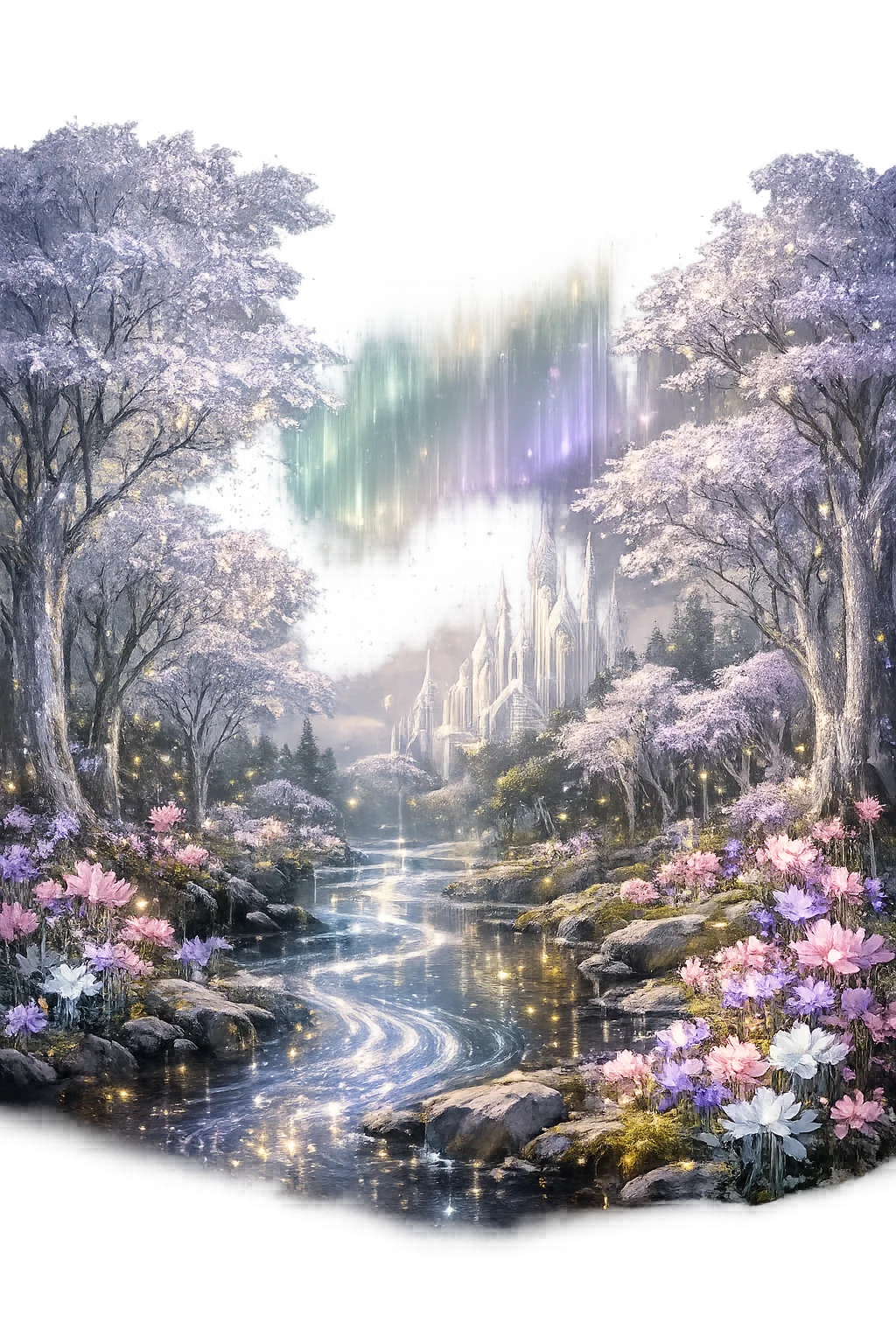
Stories of Álfheimr
Álfheimr enters the record as a gift, a place-name, and a people. The eddic poems and Snorri's prose agree that the light elves hold a realm of their own, ruled by Freyr; beyond that the sources grow deliberately blurry, and scholars still argue whether the 'dark elves' are dwarfs, death-folk, or a tidying invention of Snorri's Christian-era system. The realm's mythology is mostly threshold lore: what stands at the bright edge of the human world, and what it asks of us.
The fullest account of the gift is a single half-stanza. Grímnismál 5 runs: 'Álfheim the gods gave to Freyr in days of old, as a tooth-gift (tannfé)' — the customary present to an infant when the first tooth appears — and Snorri repeats the line in his enumeration of the heavenly regions (Gylfaginning, ch. 8, Faulkes trans.). The infant gift becomes a sovereign realm: Freyr, the Vanir hostage-guest among the Aesir, is made lord of a distinct cosmic territory with a people of its own. The detail marks Álfheimr within the Vanir sphere — the same god who dispenses sun and rain over the fields also governs the elven homeland — and it hints at an older stratum of belief in which elves were not minor spirits but a nation among the nations of the cosmos, with standing enough to be granted by divine assembly.
Alvíssmál, 'The Sayings of All-Wise,' is structured around a journey from under the earth to the world above. The dwarf Alvíss seeks to marry Þórr's daughter, and the thunder-god delays him through the night by asking what things are called among the different peoples. Alvíss names the same objects — earth, heaven, moon, sun, cloud, wind, sea, fire, forest, night, and seed — according to the speech of gods, men, giants, and elves (Alvíssmál sts. 9–35). The elves' vocabulary is one of the catalogues: testimony to the Norse sense that Álfheimr possessed its own idiom and its own way of naming the world. When dawn breaks and turns the dwarf to stone, the poem also confirms the old idea that sunlight is fatal to creatures of the dark — while the light elves dwell in its radiance. The catalogue is the myth: a world is real to the Norse imagination when it has its own words for common things.
Listing the regions of heaven for King Gylfi, Snorri's informant Hár says: 'That which is called Álfheim is one, where the people live that are called light-elves; but dark-elves live down in the earth, and they are unlike them in appearance, and much more unlike them in nature. Light elves are fairer than the sun to look upon, but dark elves are blacker than pitch' (Gylfaginning, ch. 8, Faulkes trans.). It is the closest thing the tradition gives us to a description of Álfheimr, and it is framed as a comparison — the realm defined by its inhabitants' beauty, set against a shadowed twin below. Scholars have long debated what Snorri meant by the pairing: a genuine old duality, an echo of the dökkálfar of later saga conflated with dwarfs, or the systematizing hand of a Christian antiquary arranging his cosmos like a catechism (see Gunnell, 'How Elvish Were the Álfar?'). The disagreement itself is the point: Álfheimr glows most brightly precisely at the edge of definition.
The firmest witness to the cult of the elves is not an eddic poem but a traveler's inconvenience. Around 1018, Sigvatr Þórðarson journeyed through Sweden on King Óláfr's business and was turned away from a farmhouse where the household was keeping the álfablót — the sacrifice to the elves. The housewife at the door refused him entry, saying that she feared Óðinn's wrath, for they were holding the elven sacrifice (Sigvatr Þórðarson, Austrfararvísur sts. 4–6, ed. Whaley). The poet complains of the rebuff in mocking verses, but the incidental detail is gold: a century after Iceland's nominal conversion, elves were still receiving blood-offerings behind closed doors, and the rite was serious enough to bar a king's man. Álfheimr, in other words, was not only poetic geography — it was worshipped territory, with a festival the neighbours respected and a boundary the uninvited could not cross.
The domain of Álfheimr
In the Norse cosmology recorded by Snorri Sturluson, Álfheimr is the bright home of the ljósálfar, the light elves — 'fairer than the sun to look upon' — one of the worlds layered into the structure of the universe. The gods gave the realm to Freyr as a tooth-gift, binding the Vanir god of fertility to an elven people, and its fair folk glide along the border between the divine order and the luminous Otherworld that later Scandinavian folklore knew as the land of the huldufólk.
The álfar of Álfheimr are said to be fairer than the sun to look upon, associated with fertility and subtle natural power.
The gods gave Álfheimr to Freyr when he cut his first tooth, binding the Vanir god to the elven realm.
The dwarf Alvíss records the elves' own names for sun, moon, and earth, testifying to Álfheimr's distinct voice.
Later folklore merged the light elves with landvættir and huldufólk, a radiant realm bordering every farm.
From the original script to the living URL
ᛅᛚᚠᚼᛁᛘᚱ
The name in its original Norse form. Álfheimr (ᛅᛚᚠᚼᛁᛘᚱ) is attested in the source tradition — “Elf-home (from álfr + heimr)”. Its original diacritics and script distinctions carry the full phonetic and orthographic weight of the source tradition.
alfheimr
Reduced to plain alfheimr, the name loses everything that made it specific: original diacritics and script distinctions. What remains is an ASCII string that machines can parse but that no longer speaks with its original voice.
Álfheimr
The Unicode restoration recovers what ASCII flattened. Álfheimr restores original diacritics and script distinctions, returning the name to its original written dignity. The domain encodes to Punycode, but the browser displays the truth.
Álfheimr.com → xn--lfheimr-gwa.com
The non-ASCII characters in Álfheimr are encoded while the ASCII remains visible. To the DNS, it is Punycode. To humanity, it is Álfheimr.
Owned, ideal, and ASCII forms of Álfheimr
Álfheimr
Restores ᛅᛚᚠᚼᛁᛘᚱ. The live temple domain — álfheimr.com.
alfheimr
Flattens ᛅᛚᚠᚼᛁᛘᚱ. The plain ASCII fallback — what DNS and legacy systems see.
How Álfheimr was spoken
How Álfheimr travels from ancient script to the modern URL
Old Norse Álfheimr; from álfr “elf" + heimr “home"; the luminous world of the elves.
Realm of the Light Elves
The Unicode restoration Álfheimr uses registrable Thorn and vowel accents; the runic form is not used because runic TLD support is impractical.
The lore you have read is the living myth. Extended Lore opens the scholarly vault beneath it: the cult and its material remains, a history of the image, the name after antiquity, a meditation on what the name still means, and the full scholarly apparatus — etymology, orthography, sources.
Enter Extended Lore