The Living Myth
Primordial King, Heaven · The first king of the Hittite gods
Stories of Alalu
Alalu's mythology is almost entirely contained in the 'Kingship in Heaven' narrative, but that single text is enough to make him one of the most important figures in Hittite and comparative mythology. He is the beginning of the dynasty of heaven.
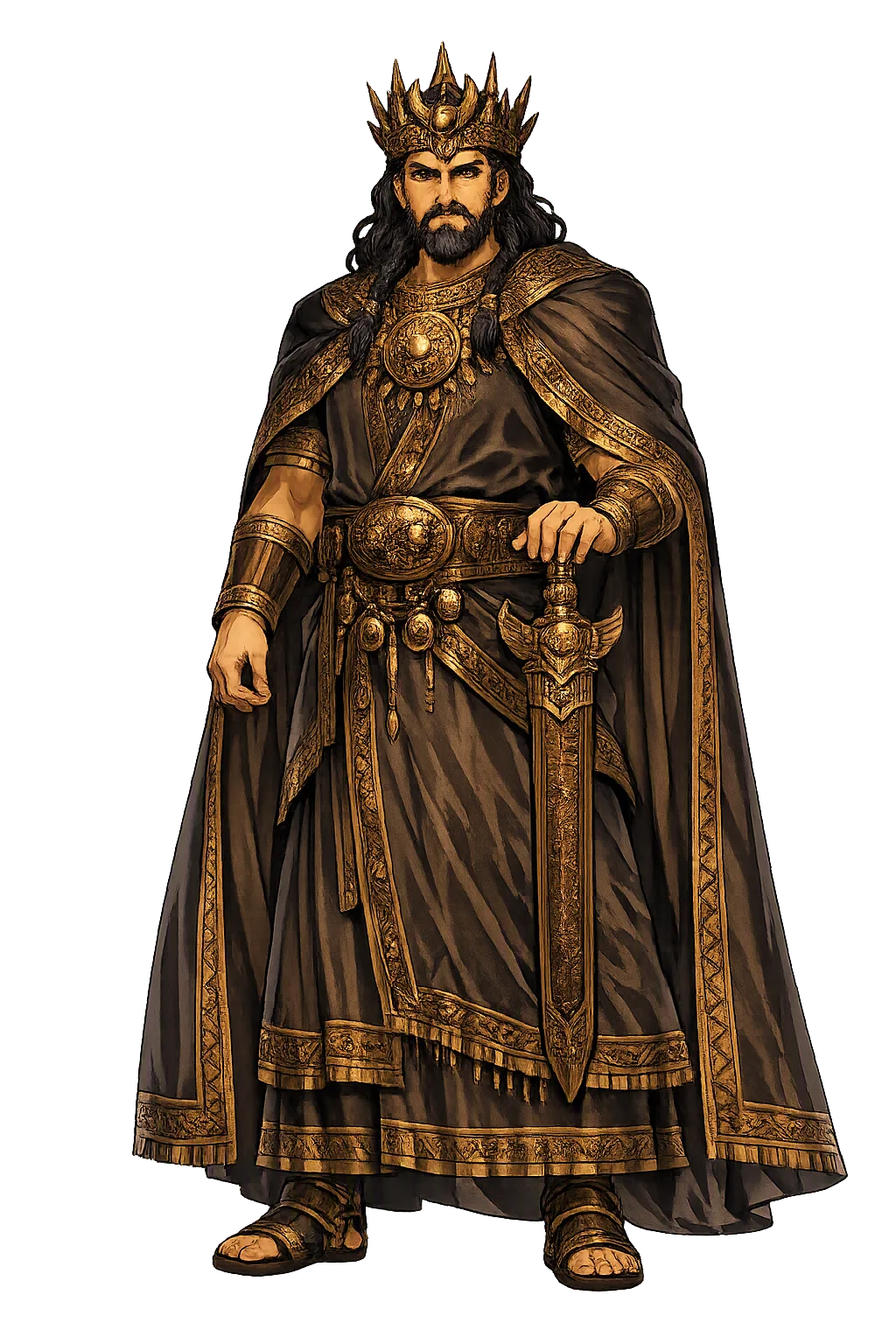
The Hittite 'Kingship in Heaven' myth (CTH 344) opens with Alalu seated on the throne in heaven. He is the first to hold kingship among the gods, and for nine years his word is law while mighty Anu, first among the gods, stands before him and passes him the cup — the ritual posture of a courtier before his king. The text, translated from a Hurrian original, presents kingship not as eternal but as a rotating office: even the highest god may be replaced when his term is fulfilled. Alalu's reign is therefore the prototype of legitimate rule, not its negation.
The fixed term is the text's most remarkable idea: kingship among the gods is an office with a lease. Where Greek theogony leaves succession to violence alone, the Hurrian scribes framed it as lawful rotation — Alalu's fall is the constitution working, not the constitution breaking.
After nine years, Alalu's servant Anu confronts him and defeats him. Alalu flees 'down to the dark earth' — a descent that removes him from active rule but does not annihilate him. Anu then takes the kingship and rules in turn for nine years, until the pattern repeats: his own servant Kumarbi rises, and Anu flees heaven with Kumarbi clinging to him, biting off his genitals and becoming thereby pregnant with the storm-god Teššub (Kingship in Heaven; Song of Kumarbi, CTH 345).
The myth thereby makes revolution structural rather than exceptional: every servant stands in the relation to his master that Anu stood in to Alalu, and the text presents that fact as an order of the cosmos, not a scandal. The dynasty of heaven is a relay of coups, each one legal the moment it succeeds.
Alalu's withdrawal to the dark earth is the Hittite equivalent of the deposed primordial father in other Indo-European and Near Eastern mythologies. Unlike Kronos, who is imprisoned in Tartaros, or Tiamat, who is killed and divided, Alalu simply departs, and the later god-lists and ritual invocations of the Hurro-Hittite tradition keep his name among the primeval powers of the depths, the first of the ancient ones to be named. His continued existence below the ordered world gives him the quality of an ancestor rather than a destroyed enemy: he is past power, not present chaos.
The withdrawal is his immortality. Only a retired god can be a founder — and Alalu's retirement below the earth is what turns a deposed king into the patriarch of the entire pantheon that overthrew him.
The full succession runs Alalu → Anu → Kumarbi → Teššub. Kumarbi, who overthrows Anu and becomes pregnant with the storm-god, is the line through which the defeated first king becomes ancestor of the reigning lord of heaven; every thunderbolt Teššub hurls carries, in the distant background, the memory of Alalu's first throne. The Song of Kumarbi and its sequel, the Song of the Storm-God's struggle against Kumarbi's monstrous brood, are preserved in the same Hittite archive, KUB 33 and KUB 36, from the royal citadel at Boğazköy-Hattusa.
Comparative mythology has read this chain as the Near Eastern sibling of the Greek Ouranos–Kronos–Zeus succession, and the structural match — deposed primordial, ambitious successor, storm-god victor — is close enough that contact, not coincidence, is the working hypothesis. The Hittite tablet thus became a key witness in the oldest argument of the field: how stories travel between languages.
Primordial Kingship · Heavenly Sovereignty · Dynastic Succession
Alalu is the first king of the gods in Hittite and Hurrian mythology, the original occupant of the celestial throne before Anu the sky-god and long before the storm-god Teššub. His reign is narrated in the 'Kingship in Heaven' myth, a Near Eastern succession story that parallels the Greek sequence of Ouranos, Kronos, and Zeus. For nine years Alalu rules in heaven; then his servant Anu rises against him, and Alalu flees to the dark earth below. The kingship he loses becomes the inheritance that shapes the entire Hittite pantheon.
This temple treats Alalu as the archetype of primordial sovereignty: the ruler whose authority is ancient, legitimate, and yet destined to be overthrown. He is not a storm-god or a creator; he is the first holder of the mandate of heaven, the figure against whom every later king defines himself.
Alalu sits on the throne of heaven for a fixed term of nine years before Anu succeeds him — a precise motif of cyclic kingship.
Anu is Alalu's servant; his rise reverses the social order and begins the succession that leads to Kumarbi and Teššub.
Defeated, Alalu descends to the dark earth — not a punishment but the place from which older powers watch newer gods reign.
Through Kumarbi, Alalu becomes the grandfather of Teššub, so the defeated first king fathers the line that rules the storm.
From the original script to the living URL
𒀭𒀀𒆷𒇻
The name in its original Hittite form. Alalu (𒀭𒀀𒆷𒇻) is attested in the source tradition — “Unknown”. Its original diacritics and script distinctions carry the full phonetic and orthographic weight of the source tradition.
alalu
The plain alalu form is identical to the Unicode restoration. Because this name is already written in Latin letters, no diacritics, stress, or script information were lost — only capitalization differs.
Alalu
The Unicode restoration does not need to recover lost marks for Alalu. Its value is canonical spelling and consistent cataloguing, not the reconstruction of erased orthography. The domain is readable as-is to both DNS and humanity.
Alalu.com
This restoration is written entirely in ASCII letters — no Punycode encoding stands between Alalu and the DNS. The domain reads identically to machines and to human eyes.
Owned, ideal, and ASCII forms of Alalu
Alalu
Restores 𒀭𒀀𒆷𒇻. The full Unicode restoration. alalu.com is not in the PuniCodex collection — it is watched for release; if it drops, this temple upgrades to an owned flagship.
How Alalu was spoken
How Alalu travels from ancient script to the modern URL
The lore you have read is the living myth. Extended Lore opens the scholarly vault beneath it: the cult and its material remains, a history of the image, the name after antiquity, a meditation on what the name still means, and the full scholarly apparatus — etymology, orthography, sources.
Enter Extended Lore