The Living Myth
Fire, Sacrifice, Messenger · Fire, the Sacrifice, the Messenger · the god of fire, the fire of the stomach, digestive faculty, gastric fluid
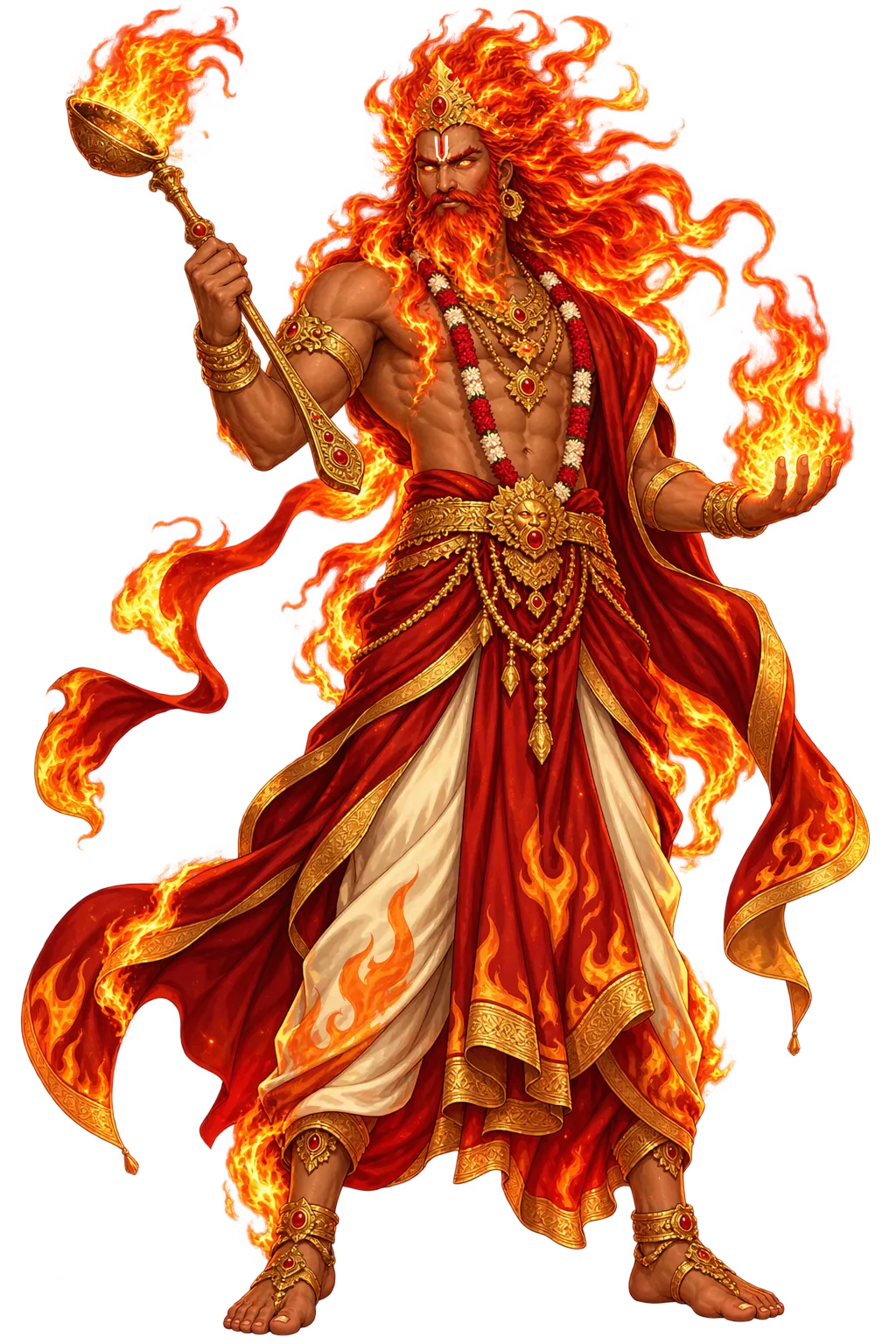
Stories of Agni
Agni’s mythology is less narrative than elemental: he is born daily from the friction-sticks, devours his parents (the sticks that bore him) at birth, and carries the sacrifice skyward. Yet the Vedic poets gave him a full biography — hidden at birth, stolen by the gods, established among men — and the epics gave him a genealogy and a role in every hero’s fire-drill.
The birth-hymns tell that Agni was concealed in the waters and the wood, secret like a son hidden by his mother, until the ten sisters — the fingers of the kindling-priest — rubbed him forth. ‘The new-born infant licks the earth’: the first flame tasting the world it will consume and consecrate.
In the great dialogue hymn, Agni hides from the burden of the office — the god who must eat the offering shrinks from being eaten by his own hunger. The gods find him in the waters, the fig-tree, the plants; each offers to hide him; he returns to the ritual because prayer without fire goes nowhere. It is the most psychologically modern of Vedic hymns.
The Brāhmaṇas narrate how the gods kept Agni from men until Mātariśvan, the Vedic Prometheus, brought him down hidden in the stalk of a plant — the mythic warrant for the fire-drill itself, and for the conviction that fire is heaven’s property on loan to the hearth.
In the epic, Agni, weakened by a surfeit of ghee, begs Krishna and Arjuna to let him burn the Khandava forest; fed by the conflagration, he blazes up again as of old. The episode fixes the epic’s theology of fire: indiscriminate when ravenous, a god still, and the friend of heroes who understand his hunger.
The Priest of the Gods and the Guest of Men
Agni is fire worshipped as a god: the flame that carries every offering upward, the guest in every home’s hearth, the priest of the gods and the god of priests. Second only to Indra in Vedic hymns, he is the most frequently invoked deity at the ritual itself — for without Agni, no prayer reaches heaven.
Every offering is carried to the gods through his flame — Agni is the one channel of prayer.
He has three births — in the heavens as sun, in the waters as lightning, on earth as the hearth-flame.
Hotṛ of the gods, he conducts the rite he is offered at — god and officiant in one flame.
He eats the oblation and burns away sin; the dead pass through his mouth to the fathers.
From the original script to the living URL
अग्नि
The name in its original Sanskrit form. Agni (अग्नि) is attested in the source tradition — “the god of fire, the fire of the stomach, digestive faculty, gastric fluid”. Its original diacritics and script distinctions carry the full phonetic and orthographic weight of the source tradition.
agni
The plain agni form is identical to the Unicode restoration. Because this name is already written in Latin letters, no diacritics, stress, or script information were lost — only capitalization differs.
Agni
The Unicode restoration does not need to recover lost marks for Agni. Its value is canonical spelling and consistent cataloguing, not the reconstruction of erased orthography. The domain is readable as-is to both DNS and humanity.
Agni.com
This restoration is written entirely in ASCII letters — no Punycode encoding stands between Agni and the DNS. The domain reads identically to machines and to human eyes.
The attested spelling family of Agni
Agni
Restores अग्नि. The full Unicode restoration. agni.com is not in the PuniCodex collection — it is watched for release; if it drops, this temple upgrades to an owned flagship. Attested by MW, KEWA.
How Agni was spoken
How Agni travels from ancient script to the modern URL
The lore you have read is the living myth. Extended Lore opens the scholarly vault beneath it: the cult and its material remains, a history of the image, the name after antiquity, a meditation on what the name still means, and the full scholarly apparatus — etymology, orthography, sources.
Enter Extended Lore