PuniCodex

Extended Lore

अग्नि Agni

Etymology · Orthography · Cult · Iconography · Reception · Sources

ASCII-equivalent form Agni
Agni — Fire, Sacrifice, Messenger
01

Quick Facts

Essential information about Agni, Fire, Sacrifice, Messenger

Original Scriptअग्नि
Unicode RestorationAgni
Reconstructed Pronunciation/ˈɑːɡni/
PantheonSanskrit
DomainFire, Sacrifice, Messenger
Meaningthe god of fire, the fire of the stomach, digestive faculty, gastric fluid
ClassificationASCII-equivalent form
Primary DomainAgni
Sacred SymbolsThe Messenger, Threefold Fire, The Divine Priest, Consumer and Purifier
02

Etymology & Word Family

From original script to Unicode restoration

Original Script अग्नि Agni — "the god of fire, the fire of the stomach, digestive faculty, gastric fluid"
Unicode Restoration Agni Canonical scholarly spelling — ASCII-identical
Modern ASCII agni Plain-ASCII fallback

The name Agni reaches the modern world through scholarly transliteration of the sanskrit tradition. Because the conventional spelling uses only Latin letters, its Unicode and ASCII forms coincide — the tradition it carries is in the name itself, not in diacritics.

03

Unicode Character Breakdown

Character-by-character philological analysis

CharacterUnicodeNameBlockPhonetic Role
AU+0041Latin Capital Letter ABasic LatinSame
gU+0067Latin Small Letter GBasic LatinSame
nU+006ELatin Small Letter NBasic LatinSame
iU+0069Latin Small Letter IBasic LatinShort /i/

This restoration reflects fidelity to the attested tradition, not recovered diacritics: every character of Agni already survives in ASCII. What the restoration preserves is the canonical spelling itself — the form scholarship standardised.

04

Cult & Worship

How the sacred was kept — rites, sanctuaries, remains

The Cult

The domestic āhavanīya and gārhapatya fires accompany every rite of passage; the great Śrauta agniṣṭoma lasts a year and raises the fire to the sky on a falcon-shaped brick altar. The Agnihotra prayer at dawn and dusk is his daily liturgy — three millennia without interruption.

In the Earth

The fire-altar itself is his monument: the brick agnicayana altars of the Śrauta ritual, rebuilt in every performance to the geometry the Śulbasūtras prescribe. Harappan fire-pits may be his prehistoric ancestry; Southeast Asian fire-shrines and the homa-cults of esoteric Buddhism carried his cult across Asia.

05

Iconography

How Agni was imaged across the ages

The Image

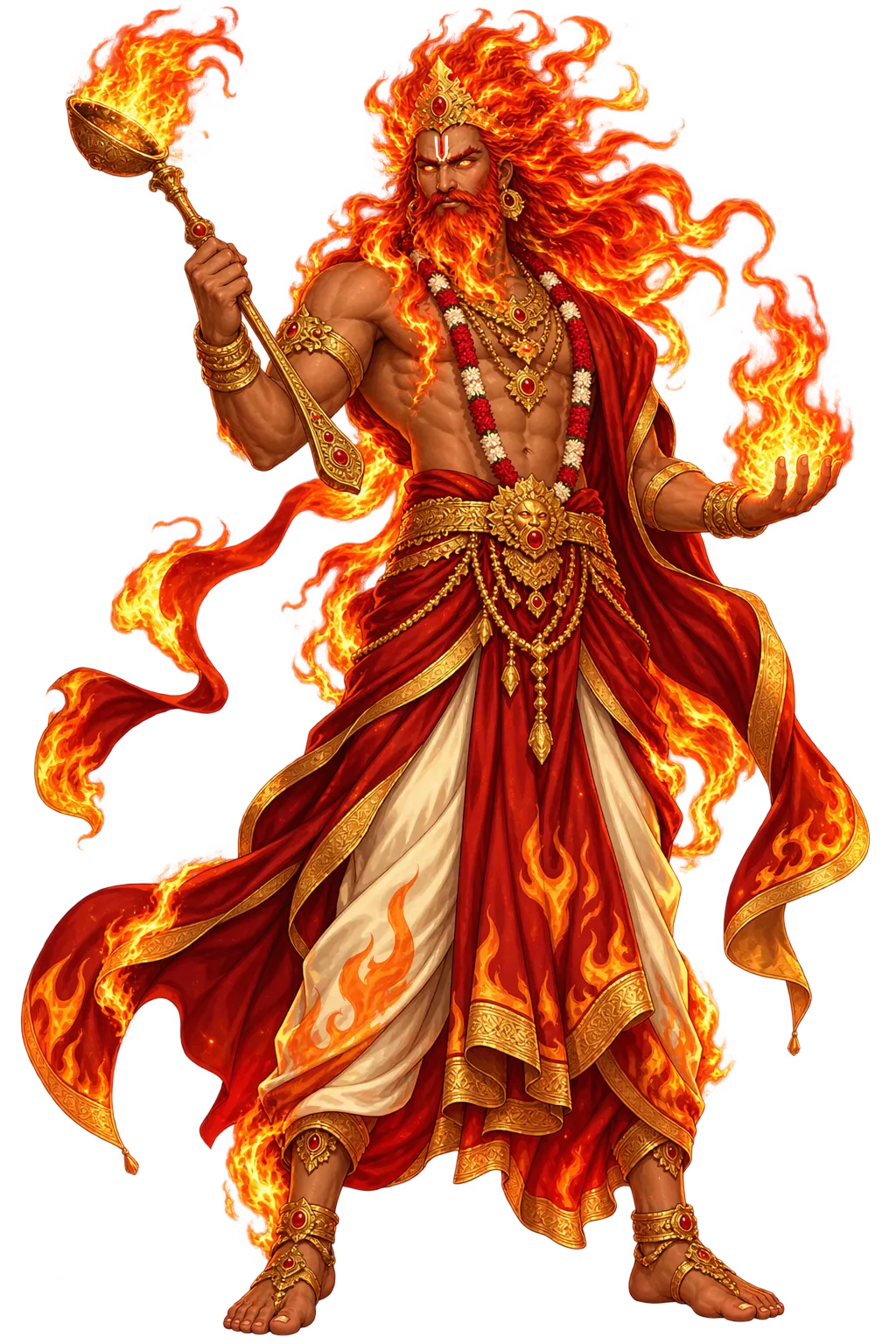
A red two-faced god — the consuming and auspicious faces — riding the ram or the goat, with seven tongues of flame and the ladle and butter in his hands. His body is flame itself; his hair the smoke; his seven tongues named in the hymns as the Kālīs, the carriers of the oblation.

06

Reception & Transformation

The name after its own age — transmission, translation, survival

Afterlives

Comparative religion uses Agni as the case where god and element are one — the purest survivorship of Indo-European fire-worship. The Roman flamen’s flame, the Zoroastrian ātaxš, and the Vedic agni form a triad scholars still trace; and the English word ‘ignite’ speaks his name in every chemistry classroom.

Identifications Across Traditions

Agni is the Vedic counterpart of the Avestan Atar, and the fire-cult is the one element Zoroastrianism kept most fully from the old Indo-Iranian religion. Greek writers compared him to Hephaestus and the altar-flame; modern linguistics binds him to Latin ignis and English ignite. In Hindu ritual he remains unpolluted by sect — every saṃskāra from birth to cremation passes through him.

Modern Legacy

The Agnihotra — the twice-daily milk-offering to fire — has been performed continuously for three thousand years and is still performed today, the oldest uninterrupted ritual on earth. His name, through Latin ignis, kindled the English language’s whole fire-vocabulary; and the ritual fire’s three forms shaped the theology of light in every Indian tradition.

07

The Meditation

What Agni means — beyond the dictionary

Agni: the god whose name is a common noun across four language families. Restoring him in ASCII requires no scholarship at all — every reader has already said his name a thousand times, in ‘ignite’, in ‘ignition’, in the strike of a match. He is the most restored god in the lexicon because his restoration is involuntary.

08

Frequently Asked Questions

Common questions about Agni, Fire, Sacrifice, Messenger, and Unicode restoration

01How do you pronounce Agni?

In reconstructed pronunciation, Agni is /ˈɑːɡni/ — approximately “AHG-nee”.

02What does Agni mean?

Agni means the god of fire, the fire of the stomach, digestive faculty, gastric fluid in the sanskrit tradition.

03What are the symbols of Agni?

Agni is associated with The Messenger (Every offering is carried to the gods through his flame — Agni is the one channel of prayer.), Threefold Fire (He has three births — in the heavens as sun, in the waters as lightning, on earth as the hearth-flame.), The Divine Priest (Hotṛ of the gods, he conducts the rite he is offered at — god and officiant in one flame.), Consumer and Purifier (He eats the oblation and burns away sin; the dead pass through his mouth to the fathers.).

04Why restore Agni in Unicode?

Agni is written entirely in ASCII letters, so its restoration is about canonical fidelity rather than recovered diacritics: the temple fixes the name in its scholarly standard spelling, attested in the source tradition, instead of leaving it to drift.

05What is the most important myth about Agni?

“The Hidden Birth” — the Rigveda 10.129 story that anchors the mythology of Agni, told in full on the lore page.

09

Scholarly Sources

The philological foundations of this restoration

Every claim on this page is grounded in established scholarship. The orthographic restorations follow disciplinary convention. The etymological chain follows the best available reference works. This is not invention — it is resurrection through scholarship.

◈

Lexicography & Philology

  • MW
  • KEWA
◎

Primary Texts

  • Rigveda 1.1 (the first hymn — to Agni)
  • Rigveda 10.51 (Agni’s flight)
  • Śatapatha Brāhmaṇa 1.1.4 (the stolen fire)
◉

Archaeology & Art History

  • Material evidence — iconography, inscriptions, and temple archaeology — for Agni and related cults.
✦

Religious Studies

  • Mahābhārata, Ādi Parvan (the Khandava burn)
Return

The Surface Awaits

You have traced the name from its earliest attestation to its Unicode restoration. Now return to the myth. The story is where the name lives.

Back to Lore
Agni mascot