The Living Myth
Wilderness, Earth, Diaspora Volcano · The Wilderness of the Orisha
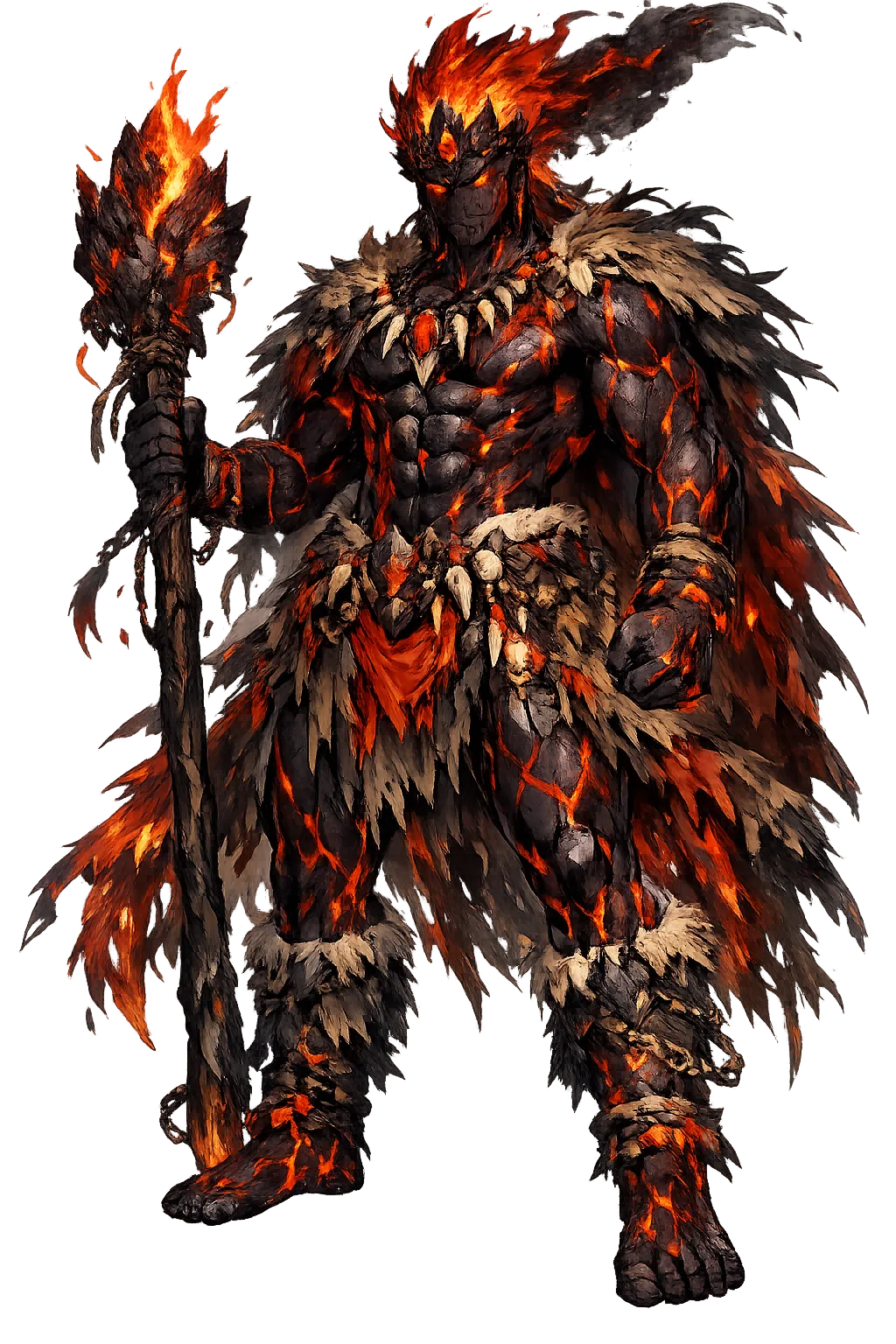
Stories of Aganjú
Aganjú's myths are less numerous than those of Ọṣun or Ṣàngó, but they centre on a single theme: the earth as a living, burning body that carries human life without belonging to it. Where other orishas crowd the town and its markets, Aganjú's dossier is written at the boundary — volcano, desert, quarry — and in the diaspora's discovery that the wilderness god was carrying the world all along.
Aganjú's birth is a statement of his character: he arrives from the union of the two powers that divide the Yoruba cosmos. In many lineages he is counted a son of Odùduwà, the royal ancestor who founded the earth's cities, and of Ọbatalá, the white-clothed sculptor of human bodies; the genealogies vary — oral tradition keeps several versions, and no single Ifá corpus settles the question. What the variants agree on is the outcome. This child of kingship and craft refuses both inheritances and chooses the uncultivated bush, the lava field, the place no farm can claim. Where Ọbatalá shapes and Odùduwà rules, Aganjú simply burns and bears. Divination verses recorded by Bascom and others keep him at the world's edge, immense and mostly silent, invoked when the earth itself must be addressed — droughts, eruptions, the cracking of foundations. The myth means that every order rests on an unowned force it cannot command: the volcano is the family member the palace never invited home.
A second tradition makes Aganjú not a god from birth but a king who became one. Samuel Johnson's History of the Yorubas (1921), the great early record of Oyo tradition, preserves the memory of an Aláàfin — a king of the old Ọ̀yọ́ empire — remembered as Aganjú, whose rule ended in apotheosis: his name passed to the orisha of the wilderness, and the royal cult and the wilderness cult folded into one figure. Johnson is a single, late, colonial-era source, and modern scholarship treats the deified-king account cautiously — it may be a rationalization, or a genuinely remembered apotheosis of the kind Yoruba kingship often produced. But the tradition matters even if it is embroidery, because it explains why Aganjú carries both a king's gravity and a volcano's indifference to law. The myth means that the wilderness god may once have worn a crown — and that a king too fierce for the palace could still find a temple.
In Cuban Santería, Aganjú crosses the Atlantic and grows. As Aggayú Solá — the name already swelling with the sea-voyage — he is imagined as a giant so tall that rivers reach his ankles and palm trees are grass under his feet; he walks through lava as others walk through sand, and the earth rides on his shoulders like a load. When he possesses a devotee in ceremony, the person's whole gait changes: the step becomes heavy, swaying, patient, as if the ground under the dancer has remembered it is alive. Verger, who documented the orisha cults on both sides of the Atlantic, records that the diaspora re-centered Aganjú from the edge of settlement into the very center of the ritual house, pairing him with Ṣàngó as earth-fire to sky-fire. The transformation is the myth's meaning: a god of the uninhabited place became, in exile, the god who carries the inhabited one. The wilderness orisha ends up holding the whole world.
Aganjú's cult geography is a map of the human boundary. His offerings — palm wine, smoked fish, red palm oil — are carried to the edge of towns, to road-cuts and quarries, to the last wall before the bush begins; in Candomblé houses his assentamento of iron-rich and volcanic stones sits low and grounded, as close to the floor as a god can get. Unlike Ọṣun, whose rivers run through the marketplace, Aganjú keeps the places where people stop and wilderness resumes. Mason's studies of New World Yoruba ritual describe the deliberate slowness of his rites: nothing about him is quick, because nothing about volcanoes is quick. The theology is stated by the offering site itself — civilization rests on older, hotter forces and owes them a share. The myth means that the wall around the city is a courtesy the wilderness extends, not a victory it has conceded.
Wilderness, Desert, and Terrestrial Fire
Aganjú is the orixá of the uninhabited places: volcanic earth, desert scrub, and the molten core beneath the mountain. Unlike Ṣàngó, whose fire crackles in the sky, Aganjú's fire moves slowly through stone. He is the son of Odùduwà and Ọbatalá in many accounts, the giant whose strides once shook the earth and whose breath still steams from fissures in the ground.
In Afro-Atlantic ritual he appears as Aggayú Solá, the bearer of the world, a deity so tall that rivers reach only his ankles. To invoke him is to acknowledge that civilization rests on forces older and more patient than human law.
Magma, lava fields, and earthquakes are his body; he is the planet's slow, burning voice.
The uninhabited plain where no farm can take root; the place beyond the town's edge.
In the diaspora he becomes the giant who supports the earth on his shoulders.
Force without malice; the power that does not negotiate because it does not need to.
From the original script to the living URL
Aganjú
The name survives only in scholarly transliteration. Aganjú is the standard Yoruba romanisation, documented in academic sources — “The uninhabited place”. Its acute stress marks preserve distinctions lost in plain ASCII.
No indigenous writing system is securely attested for individual yoruba names. The form shown is a modern scholarly transliteration.
aganju
Reduced to plain aganju, the name loses everything that made it specific: acute stress marks. What remains is an ASCII string that machines can parse but that no longer speaks with its original voice.
Aganjú
The Unicode restoration recovers what ASCII flattened. Aganjú restores acute stress marks, returning the name to its original written dignity. The domain encodes to Punycode, but the browser displays the truth.
Aganjú.com → xn--aganj-cva.com
The non-ASCII characters in Aganjú are encoded while the ASCII remains visible. To the DNS, it is Punycode. To humanity, it is Aganjú.
Owned, ideal, and ASCII forms of Aganjú
Aganjú
The live temple domain — aganjú.com.
aganju
The plain ASCII fallback — what DNS and legacy systems see.
How Aganjú was spoken
How Aganjú is preserved in writing
No indigenous writing system is securely attested for individual yoruba names. The form shown is a modern scholarly transliteration.
Contribute scholarly provenance →The lore you have read is the living myth. Extended Lore opens the scholarly vault beneath it: the cult and its material remains, a history of the image, the name after antiquity, a meditation on what the name still means, and the full scholarly apparatus — etymology, orthography, sources.
Enter Extended Lore