
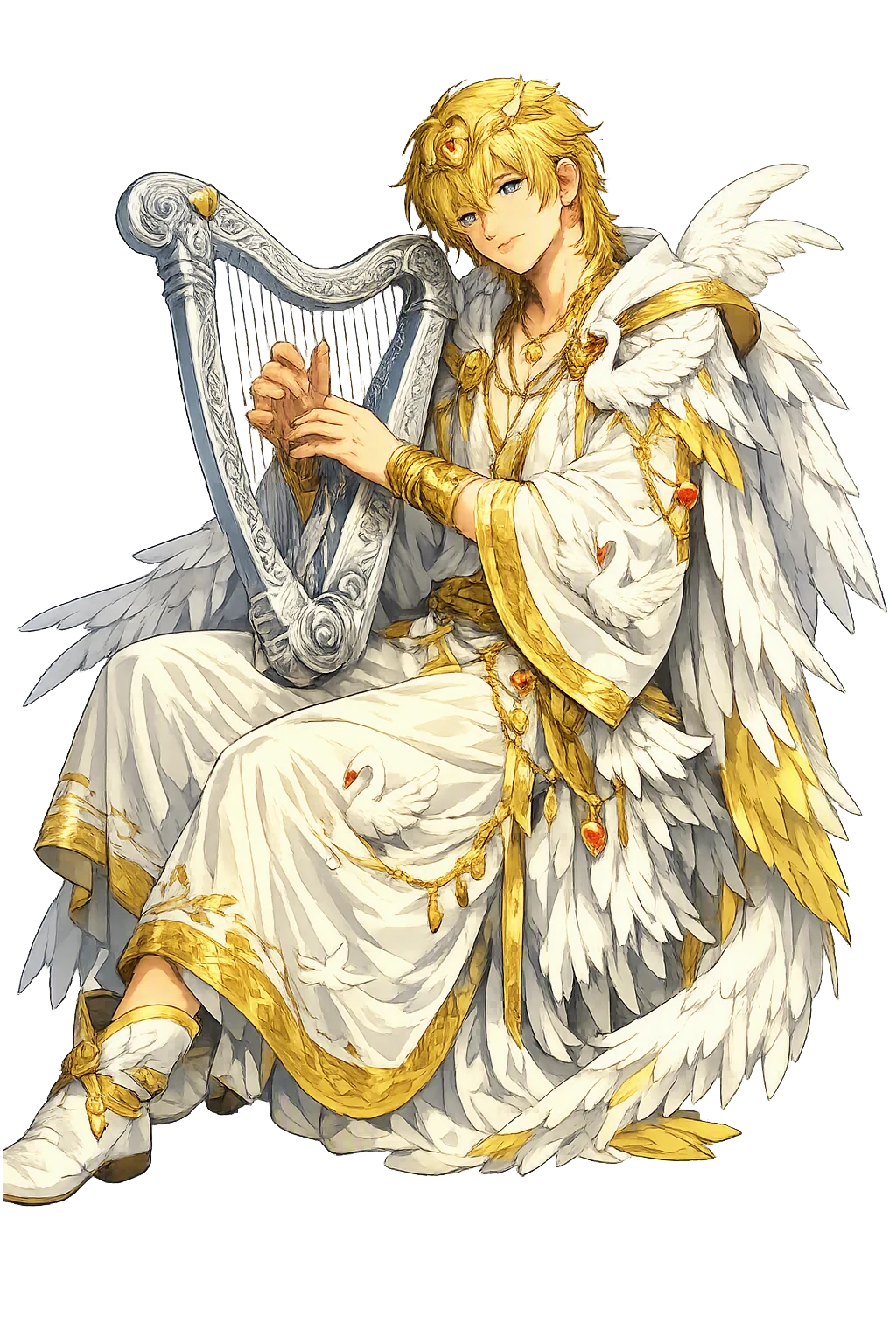
Aengus — the one true spelling, and the forms that fail it
The internet spells Aengus more ways than one, and only one of them is the spelling the scholarly record supports. This is the register's ruling — canonical, fallback, contested, and false, each in its proper place.
At a Glance
- Canonical form: Aengus
- Scholarly Transliteration: no original script securely attested — the romanized form is the primary record
- Pantheon: Celtic
- Convention: the tradition's scholarly romanization, kept exactly as recorded
- False forms on record: 0
- Contested forms: none attested
- Series: The Canonical Register, No. 9 of 597
The Canonical Form
The tradition's record preserves this name in its romanized scholarly form: Aengus — no older script survives to transcribe, so the canonical content is the exactness of the spelling itself.
No diacritics exist to require: the canonical form is the exactness of the spelling itself — plain Latin letters kept exactly as the scholarly convention records them.
Where the Flattened Form Stands
The plain form aengus differs from the canonical Aengus only by convention of display — case, not content. It is acceptable everywhere: in legacy systems, in plain-text citation, in the DNS itself. What is not acceptable is what follows in the register: respellings that change the letters, not just their case.
The Register of False Forms
No circulating form of this name currently qualifies as false under the register's standard — a rare standing. The spelling is short, sturdy, and rarely mangled.
The Contested Forms
No alternate form of this name carries documented scholarly support in the lexicon's record. The scholarly record here produces exactly one defensible reference spelling: Aengus. Forms that differ from it are not contested; they are simply wrong.
The Convention's Own History
The canonical spelling of Aengus rests on the tradition's own scholarly record, not on a marks convention: the name's forms are documented, compared, and one reference spelling is fixed so that citations agree across the temple, the lexicon, and this register. The principle that unifies every entry is the one the whole project stands on: a name is evidence, and evidence is not negotiable — not for keyboards, not for convenience, not for anyone.
The Address, Without an Encoding Detour
The canonical form Aengus already uses ordinary Latin letters, so the address bar needs no special encoding narrative. The digital temple can preserve the spelling exactly as the scholarly record presents it. That is the practical point here: consistency between the source, the citation, and the public address.
This does not make every romanization equally valid. A wrong letter remains wrong even when it is easy to type. Canonical status still depends on the attested convention, never on convenience or registrar inventory.
Where the Name Stood First
Aengus is a textual god — no ogham stone names him and no votive inscription invokes him — but his mythic address is the single most famous piece of prehistoric architecture in Ireland. Brú na Bóinne, the palace of the Boyne, is a UNESCO World Heritage landscape, and the passage tomb of Newgrange (c. 3200 BCE), older than Stonehenge and the pyramids, has been identified with the tales' síd in Broga, Óengus's Brug, since the medieval topographical tradition. The mound's roof-box, which admits the rising sun into the chamber on the mornings around the winter solstice, was excavated and documented by Michael J. O'Kelly (1962–1975), who observed the phenomenon in 1967 — a real alignment behind the mythology of a god born of a stopped sun. The witnesses to the texts are exact: Tochmarc Étaíne is preserved in the twelfth-century Lebor na hUidre and later manuscripts; Aislinge Óenguso survives in the fifteenth-century British Library MS Egerton 1782, the basis of Shaw's edition. For the comparative figure, the material record is Romano-British: altars dedicated to Apollo Maponus from the military north, including the Corbridge series, with the Ravenna Cosmography's locus Maponi completing the map of the Divine Son's cult — comparative evidence, never identification. The temple on the web is the newest of these addresses — the first one that fits in a pocket.
The Verdict
The register rules for Aengus, and the ruling is checkable: every letter traced, every violation stated, every borderline form given its honest standing. aengus carries the name freely — it differs only in display, and the register says so without reservation. Anything else in circulation has its origin and its failure recorded above. That is the whole of the law on this name — and the temple at /aengus/ enforces it.
The docket for this ruling: no false forms on the docket; no contested forms attested; the attestation rests on 10 cited sources — Tochmarc Étaíne (The Wooing of Étaín), ed. and trans. Bergin and Best, Ériu 12 (1938) — the birth of Óengus; the day the sun stood still; the bower of the purple fly, Aislinge Óenguso (The Dream of Óengus), ed. Francis Shaw (1934) — the dream-maiden; the search of the three; Caer Ibormeith and the swans of Loch Bél Dracon, De Gabáil in t-Sída (The Taking of the Síd), ed. Hull, ZCP 19 (1933) — the division of the mounds; the day-and-night winning of Brú na Bóinne.
The Register Continues
Entry 9 of 597 in the Canonical Register. Around it: the temple's founding dispatch, the Restoration File on the marks themselves, the Resonance File on the archetype at work, and the Rulebook behind all of it.
Continue the register — previous entry: Ádōnis (read it) · next entry: Aḗr (read it).
The Canonical Register is written from the same canonical record as the lexicon itself. If a false form is missing from this page, it is because the evidence does not support calling it false — or because we have not seen it yet. Show us, with a citation, and the register will answer.