The Living Myth
Heart, Conscience, Emotion · Heart. Central to the weighing of the heart ritual. Represents conscience, emotion, moral worth
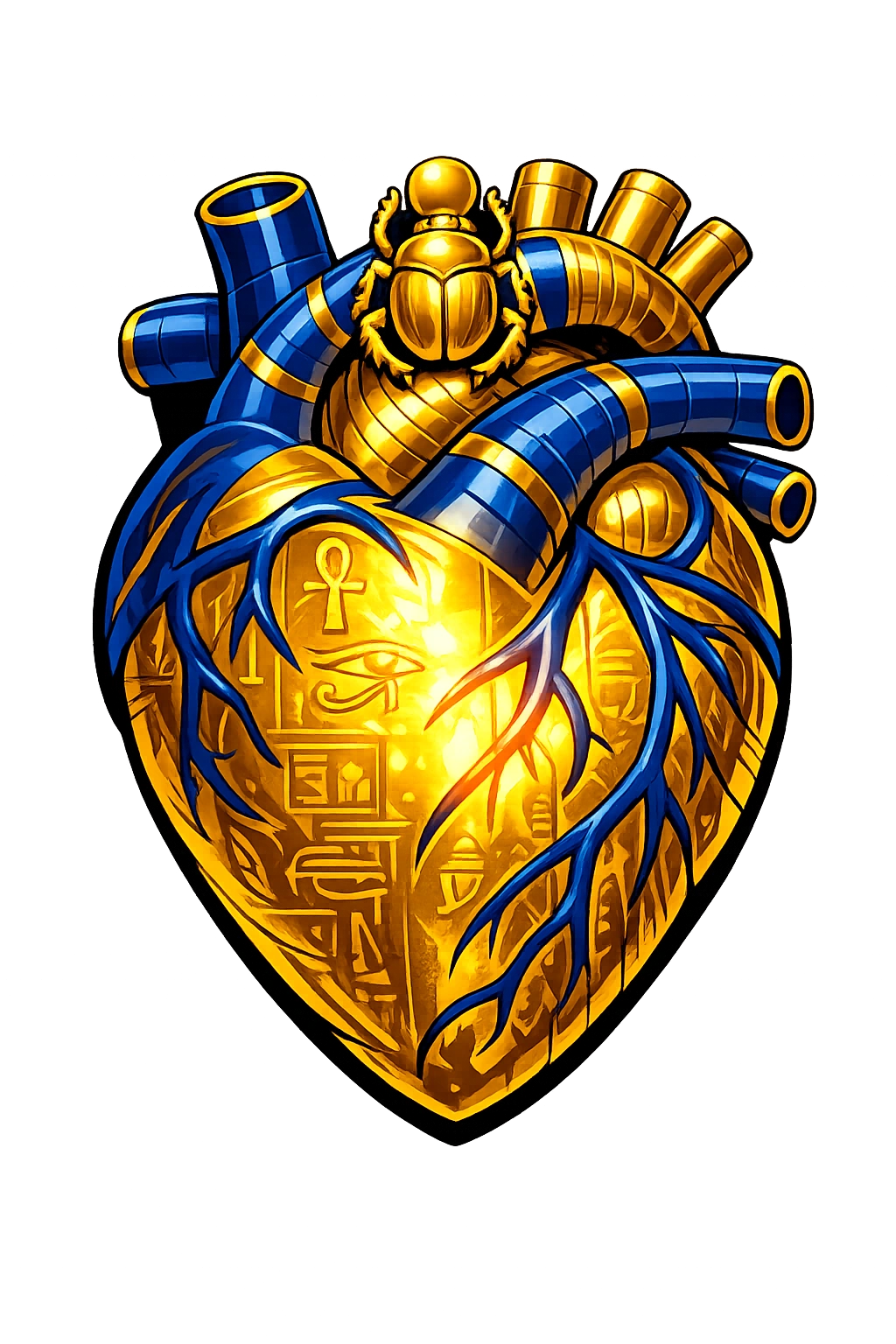
Stories of Ꜣb
The Egyptian ab — usually translated as 'heart' — is far more than a physical organ. It is the seat of intelligence, memory, emotion, and moral character. The ab is the only organ left inside the mummy at embalming, because it must speak for the deceased when the soul stands before the divine tribunal.
For the Egyptians, thought, feeling, and will all occurred in the heart. The great medical compilation known as the Ebers Papyrus teaches that the heart “speaks out of the vessels of every limb” — a network of channels running from the chest to every part of the body, carrying the messages of life. To think was therefore literally a cardiac event: the ib recorded every deed, word, and intention of a lifetime, and no other witness could be so well informed or so incorruptible. This physiology gave Egyptian ethics its distinctive shape. Moral worth was not a matter of rule-keeping alone but of a heart that had genuinely become “true of voice” — maat-kheru — through a lifetime aligned with Maat. A heart heavy with wrongdoing could not deceive the gods, because it could not deceive itself.
In the Hall of the Two Truths, depicted in the most famous vignette of the Book of the Dead — the papyrus of Ani in the British Museum — the heart of the deceased is placed in one pan of the scales against the single ostrich feather of Maat: truth, justice, cosmic order. Anubis supervises the weighing, his jackal’s attention fixed on the beam; Thoth, ibis-headed, stands ready with his palette to record the verdict; Osiris, green-skinned and mummiform, waits enthroned to receive the justified. Around the scene runs the “negative confession,” the dead person’s declaration of innocence before forty-two assessor gods. If the heart balances, the soul is declared maat-kheru and passes into the Field of Reeds; if it sinks heavy with sin, Ammit — the “Devourer,” part crocodile, part lion, part hippopotamus — consumes it, and the soul ceases to exist forever. Judgment in Egypt was thus neither fire nor salvation but measurement: the soul weighed against the weight of a single feather.
Because the heart knew the whole truth, the dead prepared for its possible testimony against them. The Book of the Dead supplies the counter-measures: Spell 27 prevents the heart from being carried off, Spell 29B consecrates the heart-amulet of carnelian set in electrum, and Spell 30B — the most famous of all — is a direct address: “O my heart of my mother, O my heart of my forms, do not stand up against me as a witness, do not oppose me in the tribunal, do not incline against me before the keeper of the balance.” The most splendid survivor of the genre is the green-jasper heart scarab of the Seventeenth-Dynasty king Sobekemsaf II, its underside inscribed in gold. The prayer reveals both terror and trust: the heart cannot be silenced, but the gods, who also hear the body’s silent history, may yet be merciful to the properly prepared.
In Egyptian wisdom literature the heart is the instrument on which character is played. The Instruction of Amenemope, a New Kingdom teaching text, devotes long sections to guarding it: do not make a man’s heart suffer, the teacher warns, for the god of a man is his heart — a phrase that comes remarkably close to a doctrine of conscience. The heart must be silenced at the right moments, trusted at others, and always steered toward maat. Scribal students copied such maxims for centuries, and the weighing scene of the Book of the Dead reads like these teachings rendered as law: a lifetime of guarded speech and honest dealing is the only preparation that lightens the pan. The ab thus binds ethics, medicine, and eschatology into a single image — the self, carried in the chest, is its own record, and the record is read aloud at the end.
Conscience · Memory · Moral Witness
The Egyptian Ꜣb is far more than a physical organ. It is the seat of intelligence, memory, emotion, and moral character — the only organ left inside the mummy at embalming, because it must speak for the deceased in the Hall of the Two Truths.
Thought, feeling, and will all arise in the heart; the ib records every deed, word, and intention.
In judgment the heart is weighed against the feather of Maat; it cannot lie about a life.
Spell 30B amulets, often of green stone, prevent the heart from testifying against its owner.
The heart is presented to Horus and Thoth as the core of the justified self.
From the original script to the living URL
𓍋𓃀𓂻
The name in its original Egyptian form. Ꜣb (𓍋𓃀𓂻) is attested in the source tradition — “Heart. Central to the weighing of the heart ritual. Represents conscience, emotion, moral worth”. Its original diacritics and script distinctions carry the full phonetic and orthographic weight of the source tradition.
ab
Reduced to plain ab, the name loses everything that made it specific: original diacritics and script distinctions. What remains is an ASCII string that machines can parse but that no longer speaks with its original voice.
Ꜣb
The Unicode restoration recovers what ASCII flattened. Ꜣb restores original diacritics and script distinctions, returning the name to its original written dignity. The domain encodes to Punycode, but the browser displays the truth.
Ꜣb.com → xn--b-xw3e.com
The non-ASCII characters in Ꜣb are encoded while the ASCII remains visible. To the DNS, it is Punycode. To humanity, it is Ꜣb.
Owned, ideal, and ASCII forms of Ꜣb
Ꜣb
Restores 𓍋𓃀𓂻. The live temple domain — ꜣb.com.
ab
Flattens 𓍋𓃀𓂻. The plain ASCII fallback — what DNS and legacy systems see.
How Ꜣb was spoken
How Ꜣb travels from ancient script to the modern URL
Egyptian Ꜣb “heart"; the seat of conscience, emotion, and moral judgement, weighed against the feather of Maat.
Heart, Conscience, Emotion
The Unicode restoration Ꜣb uses Egyptological characters registrable in .com; hieroglyphs are outside the .com IDN table.
The lore you have read is the living myth. Extended Lore opens the scholarly vault beneath it: the cult and its material remains, a history of the image, the name after antiquity, a meditation on what the name still means, and the full scholarly apparatus — etymology, orthography, sources.
Enter Extended Lore