PuniCodex

Extended Lore

玉皇 Yùhuáng

Etymology · Orthography · Cult · Iconography · Reception · Sources

Tier 1 Yùhuáng.com
Yùhuáng — Jade Emperor, Heaven, Sovereignty
01

Quick Facts

Essential information about Yùhuáng, Jade Emperor, Heaven, Sovereignty

Original Script玉皇
Unicode RestorationYùhuáng
Reconstructed Pronunciation/ɥy˥˩ xwaŋ˧˥/
PantheonChinese
DomainJade Emperor, Heaven, Sovereignty
MeaningJade Emperor
ClassificationTier 1
Primary DomainYùhuáng.com
Sacred SymbolsThe jade seal, The beaded imperial crown (mianguan), The dragon throne, The peach of immortality, The memorial and the register
02

Etymology & Word Family

From original script to Unicode restoration

Original Script 玉皇 Yùhuáng — "Jade Emperor"
Unicode Restoration Yùhuáng Restored stress, length, and script
Modern ASCII yuhuang Plain-ASCII fallback

Yù (玉) 'jade'; Huáng (皇) 'emperor, sovereign' — the supreme deity of Chinese folk religion and Taoist cosmology.

03

Unicode Character Breakdown

Character-by-character philological analysis

CharacterUnicodeNameBlockPhonetic Role
YU+0059Latin Capital Letter YBasic LatinSame, capitalized
ùU+00F9Latin Small Letter U with GraveLatin-1 SupplementGrave tone mark
hU+0068Latin Small Letter HBasic LatinSame
uU+0075Latin Small Letter UBasic LatinSame
áU+00E1Latin Small Letter A with AcuteLatin-1 SupplementAcute tone mark
nU+006ELatin Small Letter NBasic LatinSame
gU+0067Latin Small Letter GBasic LatinSame

The Tier 1 classification reflects how much of the original phonology this restoration preserves — stress and vowel length for Greek names, distinctive letters and diacritics for every other tradition.

04

Cult & Worship

How the sacred was kept — rites, sanctuaries, remains

The Cult

The Jade Emperor was served by professionals. Daoist priests were his standing clergy: they recited his scripture — the Yuhuang benxing jijing — as an act of merit, and in the great jiao offerings they reported the community's renewal of its covenant with Heaven, written memorials burned so that smoke carried them upward. Temples gave him a throne room: the main hall, conventionally named the Hall of the Numinous Firmament (Língxiāo diàn), where he sat in full imperial regalia to receive the temple's petitions. The state built his grandest sanctuary: under Zhenzong, Song state Daoism raised the Yuqing Zhaoying Palace at Kaifeng — completed in 1014, for decades the ceremonial headquarters of the imperial cult until fire took it in 1043. Households kept his tablet on their own altars, late-imperial spirit-writing circles took him as sovereign patron of their revelations, and fulfilled vows were repaid with opera performed before his image — the gods, like magistrates, were thought to enjoy a good play.

In the Earth

The god's material record begins with texts: the title Yùhuáng is attested in Tao Hongjing's Zhen'gao (5th century), and the imperial turn came under the Song — in 1012 Emperor Zhenzong announced a revelation from the 'Jade Emperor' and heaped honorific titles upon him, beginning the god's absorption of state Heaven worship. Daoist temple art gives him his body: the Yuan-dynasty murals of Yongle Palace (Ruicheng, Shanxi, 13th–14th century) paint his celestial court procession with the graded regalia of an earthly audience hall, and Ming and Qing temple walls repeat the program across China. His birthday altars, heaven-facing offering tables, and the ubiquitous 'tablet of Heaven' in village shrines are the folk archaeology of a cult that left few excavated monuments because it lived above ground, in the open sky.

05

Iconography

How Yùhuáng was imaged across the ages

The Image

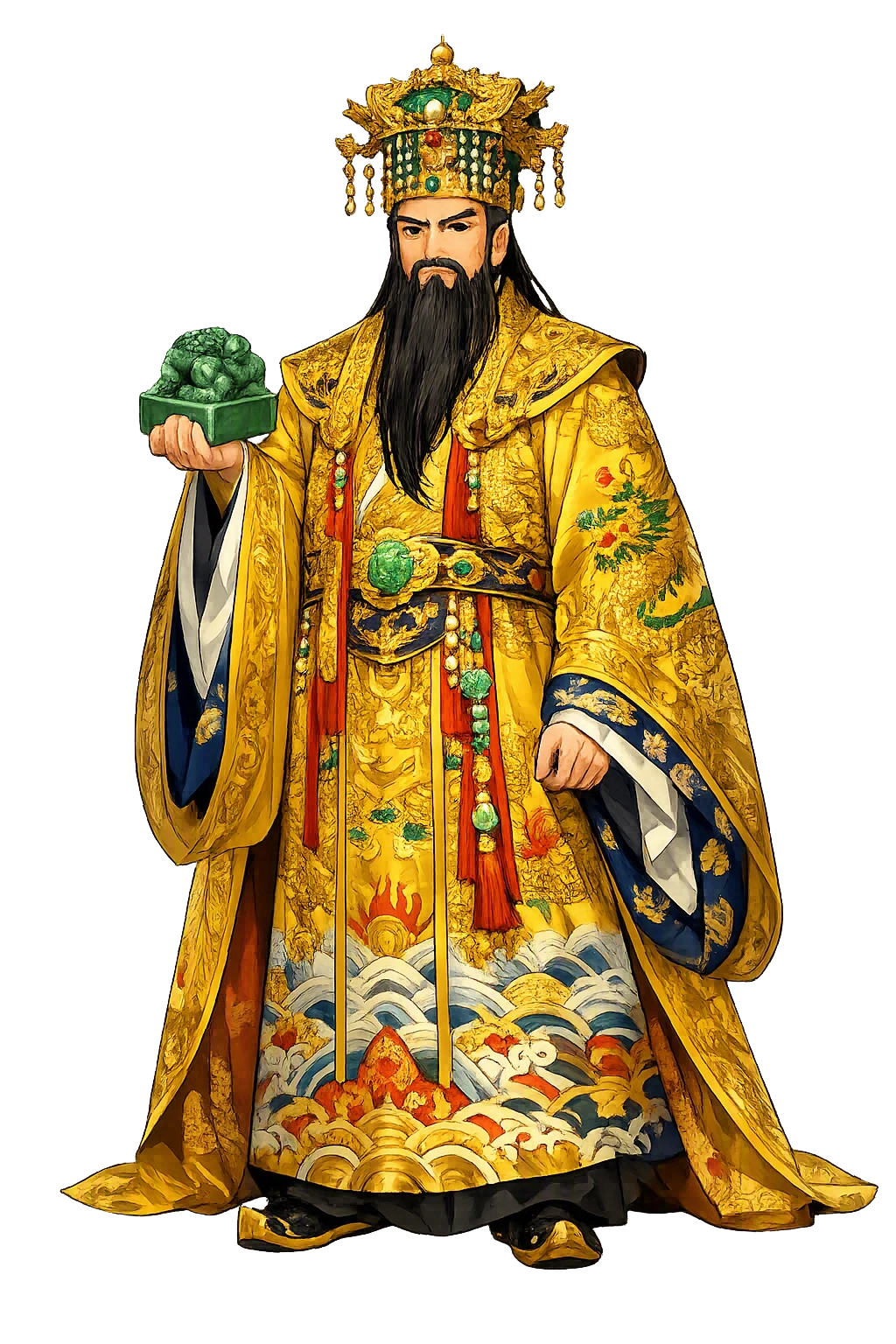
He is imaged as the empire was run: one man enthroned, ranks arrayed. The canonical figure sits frontal and full-length on a throne, wearing the dragon robe and twelve-tasselled beaded crown of the highest imperial rank, a jade seal or tablet in hand, civil and martial officers massed at his back — the audience hall translated into pigment and clay. The formula descends from Song court art: the Northern Song procession handscrolls of the Chaoyuan, or homage-to-the-primordial type, associated with the painter Wu Zongyuan, first arranged heaven as a ranked file of hundreds of officials, and the Yuan muralists of Yongle Palace's Sanqing Hall (Ruicheng, Shanxi, c. 1325) carried the scheme to monumental scale — the key surviving ensemble. No securely dated pre-Song image exists. In the folk register, woodblock paper-horse deity prints and New Year pictures multiplied his portrait for ritual burning, and Ming and Qing temple sculpture froze the type where it remains today: the composed, bearded sovereign of heaven, unchanging as a magistrate's portrait.

06

Reception & Transformation

The name after its own age — transmission, translation, survival

Afterlives

Yùhuáng's transmission runs from revelation text to world literature. The title traveled quietly for six centuries after Tao Hongjing's Zhen'gao — then the Song enthroned it: imperial patronage commissioned the scripture of his former deeds, assembled under the dynasty and later printed in the Ming Daoist Canon (Zhengtong Daozang, 1445), which fixed his biography for all later centuries. The Yuan muralists gave his court a monumental body; the Ming novelists gave it a plot. Journey to the West and the Investiture of the Gods made his bureaucracy the default Chinese picture of Heaven, and through translation — Arthur Waley's Monkey (1942), Anthony Yu's complete version (1977–1983) — the celestial sovereign became a character the whole reading world knows. Western scholarship met the cult earlier than the novels: J. J. M. de Groot's The Religious System of China (1892–1910) described his birthday rites in minute ethnographic detail, and the twentieth century's Daoist studies — Schipper, Robinet, and the Daozang companions — restored the scripture to its place in Chinese religious history. Few gods keep so complete an archive: a canon, a corpus of murals, two novels, a colonial ethnography, and a modern scholarship.

Identifications Across Traditions

The Jade Emperor is a late synthesis wearing an ancient title. The name Yùhuáng appears as early as Tao Hongjing's Zhen'gao (5th century), but the fully enthroned emperor is a product of the Tang and Song, when Daoism absorbed the older Lord on High (Shangdi) and the impersonal Heaven (Tiān) of state religion into a single personal sovereign. Canonically he remains, modestly, below the Three Pure Ones — the Dao itself in triplicate — while in practice he is Heaven's chief executive; the hierarchy lets theology and government mirror each other exactly. Popular religion went further: in Fujian and Taiwan he is Tiāngōng, 'Heaven's Duke,' whose birthday outranks every local god's, and Vietnamese communities worship the same figure as Ngọc Hoàng. Buddhist hells, thunder agencies, and star ministries all file their reports to his court.

Modern Legacy

His birthday, the ninth day of the first lunar month, is the feast of Tiāngōng — 天公誕 — kept with especial splendor by Hokkien- and Teochew-speaking communities in Taiwan, Fujian, and the diaspora of Southeast Asia, where families set a table of offerings facing the open sky at midnight. Daoist temples everywhere raise his image at the summit of the pantheon wall, beneath only the Three Pure Ones; the Yuan-dynasty murals of Yongle Palace in Shanxi preserve the grandest painted vision of his court. Through Journey to the West and its endless adaptations he is known worldwide as heaven's mild, beleaguered manager. In the full title 玉皇大帝 he remains the household name for the highest authority there is.

07

The Meditation

What Yùhuáng means — beyond the dictionary

What the Jade Emperor means is bureaucracy — and that is meant as praise. Chinese religion faced a question most traditions answer with mystery: if the gods are just, who administers the justice? Its answer was to imagine heaven as an empire perfected: a court with ministries, registers, promotions, and memorials, presided over by a sovereign whose paperwork is infallible even when his ministers are not. Prayer in this world is a petition; an omen, an official dispatch. The Jade Emperor is the guarantee that the cosmos is legible — that somewhere the ledger balances and the appeal will be heard. In restoring Yùhuáng with its tones, we restore a small part of that legibility: the falling tone of 玉, the rising tone of 皇 — two beats of the decree by which, for a thousand years, Chinese families ordered their heaven.

08

Frequently Asked Questions

Common questions about Yùhuáng, Jade Emperor, Heaven, Sovereignty, and Unicode restoration

01How do you pronounce Yùhuáng?

In reconstructed pronunciation, Yùhuáng is /ɥy˥˩ xwaŋ˧˥/ — approximately 'YUE-hwong' — say 'ee' with rounded lips and let the pitch drop sharply; then 'hwong' with a soft guttural h, rising like a question.

02What does Yùhuáng mean?

Yùhuáng means Jade Emperor in the chinese tradition.

03What are the symbols of Yùhuáng?

Yùhuáng is associated with The jade seal (The stamp that authenticates Heaven's decrees; jade itself — unchanging, luminous, and hard — is the substance of his name), The beaded imperial crown (mianguan) (The twelve-strand curtain crown of the highest rank, marking him as sovereign of the celestial court), The dragon throne (The axis of bureaucratic Heaven: from it issue the commissions of thunder, rain, and the registers of death), The peach of immortality (The Queen Mother of the West's peaches, served at the banquet of the gods (Journey to the West, ch. 5)), The memorial and the register (Petition and ledger: the machinery by which prayer ascends and fate descends).

04Why restore Yùhuáng in Unicode?

Plain ASCII yuhuang strips the stress, length, and script that make the name specific. Unicode restoration returns the name to its original written dignity.

05What is the most important myth about Yùhuáng?

“The Making of a Sovereign” — the Yuhuang benxing jijing story that anchors the mythology of Yùhuáng, told in full on the lore page.

09

Scholarly Sources

The philological foundations of this restoration

Every claim on this page is grounded in established scholarship. The orthographic restorations follow disciplinary convention. The etymological chain follows the best available reference works. This is not invention — it is resurrection through scholarship.

◈

Lexicography & Philology

  • Chinese folk religion
  • Taoist canon
  • Yang
◎

Primary Texts

  • Primary sources in the chinese tradition for Yùhuáng.
◉

Archaeology & Art History

  • Material evidence — iconography, inscriptions, and temple archaeology — for Yùhuáng and related cults.
✦

Religious Studies

  • Tao Hongjing, Zhen'gao 真誥 (Declarations of the Perfected, 5th century) — the earliest attestation of the title Yùhuáng
  • Gaoshang Yuhuang benxing jijing 高上玉皇本行集經 (Scripture of the Jade Sovereign's Former Deeds, Tang–Song; Ming Daozang)
  • Wu Cheng'en, Xiyou ji 西遊記 (Journey to the West), chs. 3–7
  • Xu Zhonglin, Fengshen yanyi 封神演義 (Investiture of the Gods, Ming)
  • Schipper & Verellen, eds., The Taoist Canon: A Historical Companion to the Daozang (University of Chicago Press, 2004)
  • Unihan Database (Unicode Consortium); Hanyu Da Zidian
Return

The Surface Awaits

You have traced the name from its earliest attestation to its Unicode restoration. Now return to the myth. The story is where the name lives.

Back to Lore
Yùhuáng mascot