The Living Myth
Source, Womb, Shakti · The Womb, the Feminine Principle · 'Womb, source' — the feminine principle, the origin from which all creation flows
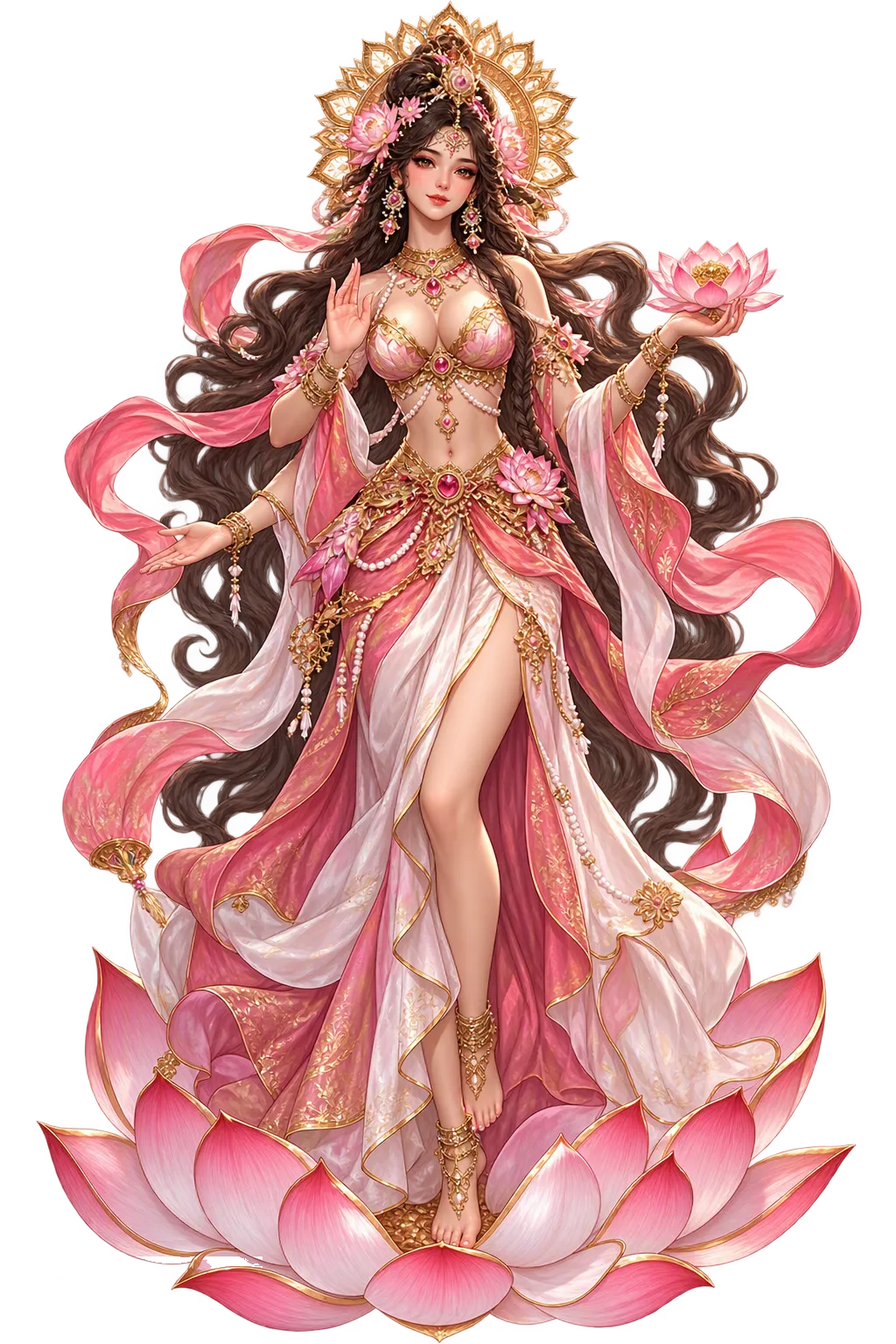
Stories of Yoni
The yoni’s mythology is the Śaiva theology of the pair: the god and his power, the liṅga and its base, the still and the flowing. Its narratives are the Goddess-traditions’ own — Satī’s sacrifice, the dismembered pīṭhas, and the tantric ritual in which the base is the goddess’s body receiving the god’s libation. The word itself is the doctrine: the womb as the world’s first fact.
The tradition’s founding image: the endless pillar of fire — the liṅga without top or bottom — that humbled Brahmā and Vishnu, standing in the yoni-base as the ground of the ground. The Purāṇa’s theology is exact: the mark is the god, the base is his power, and worship of the one without the other is incomplete.
When Satī self-immolated at her father’s insult, Śiva wandered the world with her corpse, and the pieces fell as the śakti-pīṭhas — each a seat of the goddess’s power, each in some tellings marked by the yoni. The tantric pilgrimages map the goddess’s body onto the subcontinent: the womb as sacred geography.
In the tantric pūjā the yoni-basin receives the libations poured over the liṅga, channelling the offering to the goddess below. The ritual grammar is the theology in action: creation as the union of the standing god and the flowing ground, generation as worship.
The Sāṃkhya makes yoni technical: prakṛti, the material cause, is the womb in which all effects pre-exist — the tree in the seed, the world in the matrix. The doctrine of satkāryavāda, ‘the effect pre-exists in the cause’, is the philosophy of the yoni stated as metaphysics.
The Source from Which All Creation Flows
Yoni is the source: the womb, the origin-place, the feminine principle that the Śaiva tradition pairs with the liṅga as the two-in-one of all generation. In philosophy it names the material cause — prakṛti, the matrix from which the differentiated world flows; in ritual it is the altar’s base, the goddess’s body, and the cosmic ground on which the god stands.
The Śaiva aniconic pair: the standing mark in the flowing base — creation and its ground, united.
In Sāṃkhya-Yoga, prakṛti the yoni is the womb of the world — all effects pre-exist in their cause.
In the Śākta traditions the yoni is the goddess herself — the pīṭha, the sacred seat of power.
Every Śaiva altar’s foundation is the yoni-shaped basin, catching the libation that feeds the god.
From the original script to the living URL
योनि
The name in its original Sanskrit form. Yoni (योनि) is attested in the source tradition — “'Womb, source' — the feminine principle, the origin from which all creation flows”. Its original diacritics and script distinctions carry the full phonetic and orthographic weight of the source tradition.
yoni
The plain yoni form is identical to the Unicode restoration. Because this name is already written in Latin letters, no diacritics, stress, or script information were lost — only capitalization differs.
Yoni
The Unicode restoration does not need to recover lost marks for Yoni. Its value is canonical spelling and consistent cataloguing, not the reconstruction of erased orthography. The domain is readable as-is to both DNS and humanity.
Yoni.com
This restoration is written entirely in ASCII letters — no Punycode encoding stands between Yoni and the DNS. The domain reads identically to machines and to human eyes.
The attested spelling family of Yoni
Yoni
Restores योनि. The full Unicode restoration. yoni.com is not in the PuniCodex collection — it is watched for release; if it drops, this temple upgrades to an owned flagship. Attested by MW, Shakta texts.
How Yoni was spoken
How Yoni travels from ancient script to the modern URL
The lore you have read is the living myth. Extended Lore opens the scholarly vault beneath it: the cult and its material remains, a history of the image, the name after antiquity, a meditation on what the name still means, and the full scholarly apparatus — etymology, orthography, sources.
Enter Extended Lore